Showing posts with label social memory. Show all posts

Friday, February 24, 2012

does Paul quote Hosea from memory?

The concept of "memory," especially of "social memory," is a live issue among New Testament scholars. (Social memory refers to a field of inquiry within the Humanities that raises questions about the social distribution, function, and contestation of knowledge about the past. In other words, how do humans, as part of the social groups of which they find themselves members, remember, utilize, and argue about the images, narratives, and rituals of the past?) I'm certain that social memory research holds potential for Pauline scholarship just as much as it has opened up new questions and routes of inquiry in Jesus scholarship, but I don't know specifically how.

As I was working on my comments on Romans 9 for a graduate course I'm teaching, I noted that Paul's citation of Hosea (and Isaiah, too) in this chapters seems a bit haphazard. Robert Jewett (Romans [Hermeneia; Minneapolis: Fortress Press, 2007], 599) provides a nice chart showing how re-arranged is Paul's citation(s) from Hosea 2:


It might be difficult to read, but the basic point is that Paul cites passages from Hosea in the following order:

  • Hos. 2.25c
  • Hos. 2.25b
  • Hos. 2.1b
  • Hos. 2.1c
My question: Does this suggest that Paul is citing Hosea from memory? Does it matter that neither his citations from Hosea here or of Isaiah in 9.27–29 exactly match the Septuagintal form of either text? If Paul is citing from memory, does this offer us a glimpse into how the traditions as well as the written texts of the Hebrew Bible worked (or functioned) in early Christian memory?

Sunday, December 11, 2011

a review of Dale Allison's CONSTRUCTING JESUS

I've recently returned to Dale Allison's Constructing Jesus: Memory, Imagination, and History (Grand Rapids: Baker Academic, 2010). I'm writing a longer review essay for an upcoming issue of The Journal for the Study of the Historical Jesus, and I need to get this off my list of things to do. But in the process, I've dusted off my original review, the shorter version of which will appear in The Stone-Campbell Journal soon. I've put the longer, rough draft of that review on Scribd, and I thought I'd share it with any of you who might be interested.
Review of Dale C. Allison, Jr. CONSTRUCTING JESUS: MEMORY, IMAGINATION, AND HISTORY. Grand Rapids: Baker Ac...

Monday, November 14, 2011

what social memory isn't

I'm currently reviewing Maurice Casey's book (perhaps even magnum opus), Jesus of Nazareth: An Independent Historian's Account of his Life and Teaching (London: T&T Clark International, 2010). I met Maurice in 2005 at the British New Testament Conference, where we both presented papers in the BNTC's Jesus Seminar (not to be confused with the Westar Institute's Jesus Seminar). I found him to be a friendly, encouraging, and collegial figure, which matters since he is a very senior NT scholar and I was (am) just getting my feet wet. Also, I consider one of his protégés, James Crossley, a personal friend; Crossley was also the internal examiner for my PhD thesis defense. This book is certainly the results of decades of detailed scholarship, both in the details and in the larger theoretical and methodological issues.

Moreover, the adjective found in the subtitle, independent, should be taken at face value; Maurice affirms a number of traditional conclusions among NT scholars (Markan priority, Jesus spoke Aramaic, etc.), but he also advances numerous arguments that challenge directly some of the most taken-for-granted ideas in our field. For example, Casey affirms Markan priority and the existence of "Q," though he argues that "Q" refers to a number of disparate written sources, in both Aramaic and Greek instead of a single document written in Greek. However, he also affirms that Luke knew and was influenced by Matthew. Anyone familiar with the Synoptic Problem and the discussion in that field will know how controversial it is for one person to hold to all these ideas at the same time.

And it is to be expected that I have some bones to pick with Casey's approach to the historical Jesus. If nothing else, the fact that Casey isn't a confessional scholar (he is forthright about this but not [always] antagonistic) and I am will necessitate areas of disagreement. But I don't think this difference explains all my complaints. Certainly this one has little if anything to do with my faith or his un- (or non-) faith.

In a section of his chapter on historical method, Casey addresses "social memory," a field in which I am heavily invested professionally. He writes, "In recently scholarly work, both rewriting history and telling stories about traditional figures have been drawn together into discussions of 'social memory'" (133). Already this is wrong. Social memory doesn't refer to either "rewriting history" or "telling stories about traditional figures," though both can be aspects of social memory. Barry Scwartz recently wrote,
"Social memory" refers to the distribution throughout society of individual knowledge, belief, feeling and moral judgement of the past as well as identification with past actors and events. Only individuals . . . possess the capacity to contemplate the past, but this does not mean that such capacity originates in the individual alone or can be explained solely on the basis of his or her experience. Individuals do not know the past singly; they know it with and against others situated in different groups, and through the knowledge and traditions that predecessors and contemporaries transmit to them. (Barry Schwartz, "What Difference Does the Medium Make?" in The Fourth Gospel in First-Century Media Culture [ESCO; LNTS 426; London: T&T Clark International, 2010], 225–38 [p. 231 quoted])

I know this sounds complicated, but the gist is that all of us are affected by social forces larger than our individual, personal identities as we remember the past, whether the past of our social groups (e.g., American history, Christian tradition, Western culture, etc.) or our own autobiographical pasts (e.g., my relationship with my wife and/or children, my personal experience of American citizenship, my religious testimony, etc.). The gap between Casey's rather myopic definition of social memory and the field of study that usually goes by the name is hard to overestimate. I once stood on the South Rim of the Grand Canyon; this seems roughly similar.

As a result, Casey very briefly summarizes the famous story in Josephus, Antiquities of the Jews, in which Josephus is waxing eloquently about Solomon's divine wisdom and the exorcistic and therapeutic prowess he exhibited. As an example, Josephus tells the story of a first-century CE exorcist named Eleazar who followed one of Solomon's recipes for removing a demon. At the conclusion of the story, Casey writes,
This is an overt declaration that Josephus had made this non-biblical report about Solomon because of its importance in the world in which he himself lived. His whole account is a perfect example of 'social memory'. (134; my emphasis)

No, this isn't. Josephus's whole account is certainly an appropriate field in which to bring questions of social memory to bear; I suspect this story, and a number of others, would help bring to light "the distribution throughout society of individual knowledge, belief, feeling and moral judgement of the past as well as identification with past actors and events" (Schwartz, cited above). But Casey hasn't brought these questions to bear on the text, and I'm surprised that he seems to think that he has.

Thursday, June 02, 2011

the new historiography of Jesus: step 1—memory

Yesterday I moved past Dale Allison's preface and began reading the first chapter, "The General and Particular: Memories of Jesus" (1–30), of Constructing Jesus: Memory, Imagination, and History (Baker Academic, 2010). As the title suggests, Allison begins his historical discussion of Jesus by providing an excellently researched and documented discussion of memory and, especially, all its vagaries.

I'll have much to say about this shortly, but I want to start by noting that historical Jesus scholarship seems to be moving beyond the so-called "Third Quest" and entering a new phase of its own history. In the Third Quest, the first step of scholarship was to apprehend something of Jesus' "Jewishness"; in this new phase, the first step is to explore the processes of memory and the recovery/reconstruction of the past. Whereas earlier Jesus scholarship neglected memory completely (because the Gospels weren't thought to be memory but were primarily expositions on the interests and conflicts of the early church projected back onto the figure of Jesus), the new historiography of Jesus recognizes that memory refers to so much more than simply "recall of the past." Memory is the retrieval and reconstruction of the past from which we perceive we have come within the circumstances and concerns of the present with which we must contend. Memory is about both the past and the present. And this is precisely what we have in the Gospels.

No, this isn't a "Fourth Quest" (how quaint that would be!). If anything, it's a post-Quest. How ironic, then, that the language of "questing" comes from Albert Schweitzer, that early-twentieth century champion of the failed apocalyptic prophet, and that Allison, an important heir of Schweitzer's legacy, is an important voice in historical Jesus scholarship after the Quests! Other voices would include Anthony Le Donne, Jens Schröter, Chris Keith, Samuel Byrskog, Richard Bauckham, and others. (And, of course, I would include myself here.) While some of us (e.g., Bauckham) turn to memory out of a conviction that the Gospels are or include eyewitness testimony about the life of Jesus, most if not all of us recognize that discussions of memory provide us with an apropos critical perspective from which to approach the Gospels even if the Evangelists themselves never saw or heard the prophet from Nazareth. We all remember a past much deeper and broader than simply our own limited fields of experience.
So Allison begins his discussion of memory by painting the canvas black. He appropriately sets the stage in the first sentence: "The frailty of human memory should distress all who quest for the so-called historical Jesus" (1). He immediately sets out a series of nine of memory's "sins," consequences of the "leaks and dissociat[ions]" of the human capacity to recall the past (2–8). Not surprisingly, Allison (who cites a broad range of memory studies) often references the work of Elizabeth F. Loftus, who perhaps more than any other researcher and experimenter has demonstrated how capable of being "messed with" is human memory. The conclusion vis-à-vis memory is stark:
Given what we now know about human recollection, given that "the past is produced in the present and is thus malleable," one researcher, Elizabeth Loftus, has opined, half seriously, that our lawcourts should administer this oath to witnesses on the stand: "Do you swear to tell the truth, the whole truth, or whatever it is you think you remember?" (8; citing Olick and Robbins, "Social Memory Studies," 128, and Loftus, "Memory Faults and Fixes," 127, respectively)

I am unable and unwilling to oppose anything Allison says about memory (at least up to this point); in all this he is exactly right. And yet I do object that the malleability and demonstrably fluid nature of our recall of the past are not weaknesses that the historian must overcome but rather resources that enable the past to persist across the ever-shifting present and make historiography possible in the first place. Or, to pick up a metaphor I dropped above, my canvas isn't as black as is Allison's. For example, in another sentence with which I generally agree, he writes, "As our recollections because increasingly tattered and faded, they are disposed to retain, if anything, only the substance or 'gist' of an event" (11; my emphasis). True. And yet I balk at the narrative underlying this sentence, viz. that memory, like a photograph left out in the wind and sun, tatters and fades at the onslaught of time. Certainly memories can fade. Just as certainly memories can change and even be retrojected. But memories can also persist, become more vivid and stark, take on clearer significances, teach more important lessons, and so on. In fact, memory does not either become clearer or more obscure; often memory's clarity or obscurity depends just as much on what or why we are trying to recall some thing.

Let me illustrate. If I'm trying to remember the squint of my wife's eyes as she smiled on our first date, or the color of her sweater on the night I proposed, the vagaries of the last ten years will certainly have tattered and faded my memory of the events. (To be honest, I'm only guessing that she was, in fact, wearing a sweater, since I proposed in early January and I certainly do remember that it was a very cold day.) If, however, I'm recalling the woman herself who once laughed at my jokes or accepted my proposal, my knowledge and memory of her is clearer now as we approach our tenth anniversary than it was even the day after the events in question. I know more about my wife now than I did then, and my understanding of her in 2011 is better than it was in 2001. So in 2011 I'm positioned to remember 2001 in ways that I wouldn't have been able to in 2001. In some ways my memory today is indeed tattered and faded. But in other ways it's clearer and crisper.

Despite the differences, I think Allison has exactly the right end of the stick (if the stick = how to engage historical Jesus research). As a beginning point, Allison offers the following conclusion about how to appropriate the data provided by the Gospels, a conclusion which differs categorically and fundamentally from work such as that proposed by the Jesus Seminar:
Given that memory is "fuzzy," that we remember the outlines of an event or the general import of a conversation better than the details, that we extract patterns and meaning from informational input, it would be peculiar to imagine that, although their general impressions of Jesus were hopelessly skewed, Christian tradents somehow managed to recall with some accuracy, let us say, two or three of his similitudes or parables and a handful of one-liners. . . . If general impressions are typically more trustworthy than details, then it makes little sense to reconstruct Jesus by starting with a few of the latter—perhaps some incidents and sayings that survive the gauntlet of our authenticating criteria—while setting aside the general impressions that our primary sources instill in us. The larger the generalization and the more data upon which it is based, the greater our confidence. The more specific the detail and the fewer the supporting data, the greater our uncertainty. (13, 14)

So Allison begins by looking not for isolated facts from which the historical Jesus will slowly but surely emerge, like a newer-model Terminator, out of the morass of the Gospels. Instead, he's looking for general impressions (16). Now, anyone familiar with Allison's work will expect him to find that most general of impressions at work in the Gospels: that Jesus was a prophet of the apocalypse. We'll see. But for now Allison's insights rightfully and helpfully set the program for historical Jesus scholarship of the second decade of the twenty-first century. The new historiography of Jesus begins with the Gospels as memorial artifacts, as plausible and coherent presentations of Jesus of Nazareth in the context of the challenges and concerns of his followers in the mid- to late-first century CE. Much critical work remains. But that work expressly is not filtering the Gospels through a battery of criteria and then trying to fit together the remaining textual shards into a critical reconstruction.
Friday, March 04, 2011

"collective" and/or "social" memory

I'm reading Samuel Byrskog's article, "A New Quest for the Sitz im Leben: Social Memory, the Jesus Tradition and the Gospel of Matthew" (New Testament Studies 52 [2006]: 319–36). Byrskog has recently fired off a series of essays looking to reframe the form-critical concept of Sitz im Leben within the contemporary theoretical framework sustaining NT scholarship. Of course, as I've mentioned previously, I'm not as interested in salvaging NT criticism's form-critical heritage. But inasmuch as Sitz im Leben has degenerated into a fairly generic term that means not much more than "context," it remains flexible enough to serve contemporary needs while maintaining an apparent continuity with the research of previous generations.

At any rate, Byrskog is rightfully drawing attention to the surprising terminological disarray in the secondary literature regarding the communal dimension of memory. "There is a confusing variety of terminology. The literature uses 'family memory', local memory', 'popular memory', 'public memory', 'relational memory', 'cultural memory', etc. These expressions sometimes carry different connotations, but are also often employed synonymously" (321–22). Byrskog's right; the loose use of language here is unfortunate and, I think, masks a worrying imprecision with respect to what we're after when we use these terms.

So I'm sympathetic with what Byrskog's trying to do when he defines more precisely what he means by "social" and "collective" memory. But I'm not sure he's successful. He clarifies:
With James Fentress and Chris Wickham, I will use "social memory" as a label distinct from "collective memory". While the latter is social in that it includes those recollections of a group that are shared by all of its members, being something else than the sum total of all the individual recollections, the former is social in that it deals with the social aspects of the mental act of remembering. Social memory is thus interested in the memory of individuals in social contexts which are larger than the individual and yet related to the individual. (322)

Byrskog describes beautifully the most important insight of social memory theorists: that every act of memory is social. But I'm not sure what his use of "collective memory"actually refers to. Byrskog equates collective memory with "recollections of a group," but I'm not sure what a group's recollection actually is, how it's manifested, for whom it's manifested, or whatever. Funnily enough, Byrskog himself has balked at this very idea of "collective memory": "Groups and cultures might have what we call ‘memory’, which affects the members of those contexts, but groups and cultures do not remember and recall; individuals do” (2000:255; original emphasis). Granted that in this current context (Byrskog's NTS article) he still focuses on the individual rememberer (notice the reference to "all of its [viz., a group's] members"). But I don't understand at what point a sufficient number of individuals within a group exhibit a particular recollection, and I don't understand what makes the memories of individuals "collective" other than, apparently, the mere fact that multiple individuals share them in common.

In a rough draft of another paper, I've questioned Byrskog's concept of "collective memory" this way:
Byrskog affirms that “groups and cultures do nurture a memory of their past” and that “memory is to some extent a social construct” (2000:255), though he does not explain what processes, social or psychological, are involved in this nurturing. This problem plagues Byrskog’s work at multiple points; another example, taken at random: “[O]ral historians of today often attempt to control the uniqueness of each eyewitness account with a sense of its representativeness and a careful method of strategic sampling. In order to do this, one needs to single out persons who are representative of a larger group, and compare their versions with each other. Groups are important, but one needs to focus on the individuals within each group, because the collective version [of the past] might be entirely different from the version of the individual” (2000:69; original emphasis). But what, precisely, is “the collective version” that an oral historian could compare and contrast with an account given by any given individual? And which individual, for that matter, is able to give an account of the past that isn’t already reflective of the history, interests, and culture of the groups to which s/he belongs?

I should clarify that I wrote these comments solely in reference to his very important monograph, Story as History, History as Story (Mohr Siebeck, 2000). However, the same problems are operative in his 2006 article. I'm very, very sympathetic to the interest in the social dynamics of even the most individual of processes (here, memory). And I do think that "remembering together" affects the way individuals express and employ memory. But I just can't convince myself that "collective memory" refers to "group memory" or even the aggregate of individuals' memories. Individuals and groups aren't separate (or separable) entities; my memories all by themselves are already social creations. The act of remembering with other people doesn't transform my memories into social facts; still less does it produce social facts in the melding of multiple individuals' memories. Remembering together augments and extends the social-ness of my/our memories; it does not cause that social-ness.

Monday, January 31, 2011

a great phrase

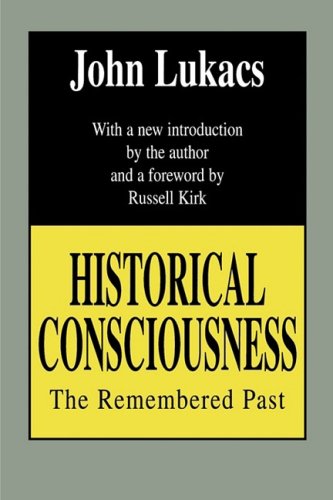
"[K]now thyself must also mean know thy history. . . . [T]he kind of history which we are apt to understand best may be our own."

John Lukacs, Historical Consciousness: The Remembered Past (New Brunswick: Transaction), 1994: 31

Monday, September 27, 2010

on books and memory

I'm currently reading through Loveday Alexander's chapter in Jesus in Memory: Traditions in Oral and Scribal Perspectives (Werner H. Kelber and Samuel Byrskog, eds.; Waco, TX: Baylor University Press, 2009): "Memory and Tradition in the Hellenistic Schools" (113–53). Reading this essay reminds me of the most enjoyable moments of researching my PhD under Loveday's supervision; she offers very much to think about and references to a broad range of Classical data that is quite simply beyond my realm of consciousness.

But in this post I only want to repeat an anecdote from the ancient world that Alexander shares with her readers:
The ambivalent relationship between memory and text in ancient understanding is captured nicely in a floating apophthegm attributed to Diocles of Carystus: "Someone once told Diocles the doctor that he would not need any more teaching because he had bought a medical book. Diocles responded: 'For those who have studied, books are reminders, but for the unlearned, they are tombs.'" (148)

[Διοκλῆς ὁ ίατρὸς λέγοντος αὐτῷ τινος βιβλίον ἠγορακέναι ἰατρικὸν καὶ μὴ προσδεῖσθαι διδασκαλίας εἶπε· τὰ βιβλία τῶν μεμαθηκότων ὑπομνήματα εἰσι, τῶν δὲ ἀμαθῶν μνήματα.]

Tuesday, September 07, 2010

Byrskog on haggadic tradition

I started reading the volume edited by Werner Kelber and Samuel Byrskog, Jesus in Memory: Traditions in Oral and Scribal Perspectives (Waco: Baylor University Press, 2009). This book springboards from the seminal works of Birger Gerhardsson in the areas of memory and tradition and sets the agenda for future research in these areas. I'm still reading Byrskog's introduction (1–38), which surveys Gerhardsson's work (who, I believe, supervised Byrskog's doctoral research). Byrskog provides an interesting analysis of Gerhardsson's distinction between sayings and narrative tradition:
The narrative tradition, with the exception of the imaginative, legendary haggadah type, was mainly formulated when the eyewitnesses at a later point needed to illustrate a particular question that was posed to them. (8; my emphasis)

If I'm reading him rightly, Byrskog seems to suggest (or to say that Gerhardsson believes) that rabbinic haggadic tradition stems from eyewitness memory unless it exhibits "imaginative, legendary" characteristics. This strikes me as an astonishingly nineteenth-century thing to say, as if critical scholars can accept without worry traditional materials from antiquity that transfer relatively easily into an Enlightenment framework and can discard those materials that violate Enlightenment sensibilities.

I'm not sure this approach to ancient texts can be sustained any longer. Instead, the memorial dynamics that produced more mundane "narrative tradition" also led to "the imaginative, legendary haggadah type" of Jewish tradition. Both stem from how ancient tradents (i) understood the worlds in which they found themselves and (ii) navigated the texts that explained and programmed their experiences in those worlds. These memorial dynamics are thoroughly social, and I've criticized Byrskog elsewhere on precisely this point (see chapter 3 of Structuring Early Christian Memory). Eyewitnesses at some later point may have needed to formulate accounts of their past in order to answer this or that question, but Byrskog's analysis needs to address the social factors that determined how those eyewitnesses formulated their accounts.

Saturday, June 26, 2010

on the psalms, again

For nearly ten years now I have been intrigued by the social aspects of individual life, or—in other words—the way the world outside us becomes the world inside us. Think, for example, of the kinds of dreams you have: what they're like, what happens in them, how they make sense until you wake up and realize they don't make any sense at all. Dreams may be the most private aspect of our lives (we never dream with other people!), and yet we all seem to have fairly similar dreams. Even more importantly, we all understand the people around us when they describe completely nonsensical dreams. This is because our private worlds—who we are inside, apart from all of our relationships with others—are formed and shaped by the same (or at least heavily overlapping) social worlds. I would suspect that the understandability of our very weird dreams begins to break down cross-culturally; if a person from sub-Saharan Africa or pre-Renaissance Europe were to describe their strangest dreams to us, we would have a harder time making "sense" of them.

This sense of the outside-world-in finds marvelous expression at the end of Ron Heine's discussion of the Psalms. Heine writes:
We can also learn from the fathers that even if we must pray the psalms in private, we still pray them in community. When I pray the psalms my voice blends in praise, petition, and confession with that of the whole people of God, whether my contemporaries or my predecessors in faith, who have lifted and who continue to lift up these prayers to God. This solidarity with the whole church in prayer includes even Christ himself, the head of the church. In this communal sense all the words of the psalms become my prayer even if I am not at the moment experiencing the joys or sufferings they express. I can lift up even the words of Psalm 22:1, which Jesus prayed on the cross, "My God, my God, why have you forsaken me?" for I am one with the whole body of Christ, and where "one member suffers all suffer together." My prayer is one with those in seemingly God-forsaken situations who cry out for deliverance but none comes, even as Jesus cried out for deliverance in Gethsemane, when none was forthcoming.1

Prayer in private is nevertheless prayer in community. The point of my doctoral thesis was similar: Memory in private is memory in community.2 Or even more simply, Memory is community—community in the present with the past. "So it is when people think that they are alone, face to face with themselves, other people appear and with them the groups of which they are members."3


1 Ronald E. Heine, Reading the Old Testament with the Ancient Church: Exploring the Formation of Early Christian Thought (Evangelical Ressourcement; Grand Rapids: Baker Academic, 2007), 174.
2 Rafael Rodríguez, Structuring Early Christian Memory: Jesus in Tradition, Performance, and Text (European Studies on Christian Origins; London and New York: T&T Clark, 2010).
3 Maurice Halbwachs, The Social Frameworks of Memory (L. A. Coser, ed. and trans.; Chicago and London: University of Chicago Press, 1992), 49.

Wednesday, May 19, 2010

that's a wrap!

I've finally finished my review of Anthony Le Donne's published PhD thesis, The Historiographical Jesus (Waco: Baylor University Press, 2009), and I've sent my review to the book review editor of The Journal for the Study of the Historical Jesus. I never know whether it would be appropriate or not so share online reviews that will be published shortly, so I normally don't include my reviews here. But I suppose it won't hurt to mention the conclusion to my review.
Le Donne raises important questions facing historical Jesus scholarship in light of the recent (and ongoing) rise of “memory” as an analytical historiographic category. The driving question is no longer simply, What actually happened? (It may never have been simply that.) Jesus research increasingly finds itself wrestling with the question, How does “what actually happened” relate to the gospels’ portrayals of Jesus? The Historiographical Jesus brings into focus how typological resources both constrained the early Christians’ memory of Jesus and enabled that memory to adapt to and address an ever-evolving present.

Tuesday, April 27, 2010

still reading

I'm still reading Anthony Le Donne's The Historiographical Jesus: Memory, Typology, and the Son of David (Waco: Baylor University Press, 2009), but both my reading and my commenting have slowed down considerably for a number of reasons. First, I'm currently in the eye of a hurricane (in reverse, perhaps). On the one hand, my oldest sister was married on 10 April in Phoenix, AZ; my wife was a bridesmaid, my daughter the flower girl, and I officiated. On the other hand, my youngest sister gets married this Saturday, 1 May. Only Janelle is involved (hence the in reverse comment), but this still requires serious adjustments to our schedules. Second, and much more significantly in terms of time, we have take custody of a baby girl we plan to adopt later this year. The move from one to two children has deprived me of sleep, productive work time, and (of course) time writing for the blog.

Even so, I did manage to read Le Donne's sixth chapter ("The Therapeutic Son of David" [137–83]) and his brief excursus, "The Presupposition of Davidic Descent" (185–9). Of course, the chapter depends rhetorically and historiographically on the identification of traditional trajectories, and I have registered elsewhere my objection to this approach to history (especially here). But that aside, there is much to praise in this chapter. First, I was pleased with how overlapping are his analysis of the Beelzebul controversy with my own analysis (see chapter 7 of my Structuring Early Christian Memory), even though we have very different emphases and agenda. Second, I think Le Donne is exactly right to point out that exorcisms and healings were not necessarily distinct therapeutic phenomena in the ancient world. Luke clearly blurs the distinctions between them, both in his account of the healing of Simon's mother-in-law (Luke 4.38–9) and in the healing of the bent woman (Luke 13.10–13); Le Donne focuses on Matthew's similar blurring. Third (and again, similar to my discussion of exorcisms in chapter 7 of Structuring Early Christian Memory), Le Donne draws attention to the ways the evangelists localized Jesus' exoricisms within Hebrew biblical traditions. This is no small feat, given the paucity of Hebrew biblical traditions that could be read demonologically (really, only 1 Sam 16.14-23). Even so, Matthew (as Le Donne argues) reads Jesus' exorcisms from the perspective of Isaianic therapeutic traditions (see Isa 35.5–6; 61.1–2 [LXX]), especially in Matthew 12.

Monday, April 05, 2010

historical and/or mnemonic trajectories

Okay. The fourth chapter ("Memory and Typology") of Anthony Le Donne's The Historiographical Jesus: Memory, Typology, and the Son of David (Waco, TX: Baylor University Press, 2009) presents the heart of Le Donne's argument regarding trajectories (and the utility thereof) for historical Jesus research (see the section, "Mnemonic Continuity and Trajectory" [70–77]). This, as I've said elsewhere, is so far the heart of my disagreement with Le Donne's historiographical program, including his appropriation of social memory theory. On the one hand, this is a significant disagreement, since without the argument for trajectories Le Donne's book loses a lot of its substance. On the other hand, the amount of theoretical and methodological material in the book with which I agree probably surpasses 90%, and so I'm prone to minimize the significance of this disagreement. Either way, let's make sure I understand the argument rightly.

First, Le Donne is not suggesting that mnemonic trajectories enable us to move behind the extant historical data to the historical realia that generated our data. As he has argued throughout the previous two chapters, there simply is no uninterpreted historical reality behind the data, no "real Jesus" for us to get to apart from the "Jesus Remembered" (note the intentional echo of James Dunn). Le Donne isn't suggesting that there wasn't an actual historical (= real) Jesus that the early Christians remembered in their accounts of his life and teachings. But he does insist that we cannot get behind our historical data to reconstruct the real person of whom the gospels are (or claim to be) traces.
What the postmodern mind has taught us is that we must always qualify what we mean by "real." What is real is that which has been perceived and interpreted and thus refracted. But once qualified it is no longer helpful to draw a distinction between the real Jesus and the remembered Jesus. For those disciples of the first generation, the real Jesus was the Jesus of their memory. (76)

I have to admit that I agree here. We can know the Jesus whom the early Christians remembered. Inasmuch as Paul's letters, the gospels, and other early Christian texts "get Jesus wrong," we cannot know the "real" Jesus who walked and talked throughout Galilee. Inasmuch as they "get Jesus right," we can. But in both cases, we are constrained by (n.b. not "restricted to") the evidence we have, all of which has already been "refracted."

Second, Le Donne builds his case for mnemonic trajectories on the strength of his argument for memory's continuity through time. Let me say, I agree completely with his case that memories are causally related to previous perceptions and conceptions of the past (= continuity), even if each generation has to expend its own energy to come to terms with the past it inherits from its forebears. "What is vital to this model is the concept of mnemonic continuity. . . . Once a perception has been localized within a particular mnemonic category, the refractions thereafter will constitute only incremental modifications to that category" (72; my emphasis). Le Donne's point isn't necessarily that dramatic changes in conceptions of the past don't happen, but only that they happen in relation to the conceptions of the past that were received as traditional. As an example (my own, not Le Donne's), if someone were to offer the (radically revisionist) view of Jimmy Carter's presidency as "successful," they would have to do so in direct conversation with thirty-years' of conceptions of Carter's administration as inept. Such an argument couldn't simply ignore received appraisals of the late-1970s American political milieu; it would have to tackle them head-on if it hoped to find any widespread reception. Again, "Our memories demand a high degree of continuity in order to tie all of our shifting frames of meaning together. The integrity of this chain determines its reliability. I can account for where and who I am now (and why) by analyzing the continuity of this chain" (73). This is exactly right.

Third, Le Donne moves directly from memory as continuous to memory as chartable: "Memory is in a constant process of refraction. Most of the time, this refracting process remains reliably stable and therefore historically chartable. . . . Because memory refraction is constant, it is chartable and therefore historically measurable" (75, 77). Perhaps. For those moments (or instances) of refraction for which we have data available for analysis, I think Le Donne's right. We can trace the diachronic development and movement of memory—how conceptions of the past morph and mutate and migrate across time. But if I've understood Le Donne's purposes rightly, his point is that we can extrapolate beyond our data (or more accurately, before our data) and posit originating (or simply earlier) memories that explain the instances of memory we have. For example,
In order adequately to account for the origin of a mnemonic trajectory, the historian must compare and contrast interpretive spheres (i.e., mnemonic cycles) that seem to be distorting a memory in opposite directions. Once these spheres are compared and contrasted, it is then necessary to postulate how these divergent traditions relate to one another. . . . it is now appropriate to speak in terms of memory trajectories that might be triangulated to postulate a common origin. (74)

In other words (again, if I understand rightly), given . . . D E F, we can postulate A B C. The problem, I think, is that Le Donne assumes not simply continuity between memories but also predictability. And as far as I can tell, there simply isn't any predictability between our gospels, even if we accept one of the traditionally accepted models of interdependence between them (e.g., the Two-Source Hypothesis, or the Farrer Theory).

Another problem, though perhaps not as significant as the leap Le Donne makes from continuity to predictability, concerns how to identify "interpretive spheres that seem to be distorting a memory in opposite directions" (74). Here the problems are legion. Is John the Baptist's question at Matt 11.3 pulling against his deferential response to Jesus at Matt 3.13–15? If so/not, what about the parallel in Luke 7.19–20, which doesn't pull against a previously narrated Johannine confession (unless you include John's pre-natal jubilation at Luke 1.41!)? Is Jesus' question about the messiah as Son of David in Mark 12.35–37 (parr.) in tension with the Davidic overtones of Mark's account of Jesus' entry into Jerusalem (Mark 11.9–10)? Is Mark a proponent of one of these christological perspectives over the other? Was Jesus? Do the gospel's portrayal of Jesus in Elijah-like terms stand in tension with the casting of John in Elijah's light? Or should we synthesize these portrayals instead?

The problem here is rooted in the relative paucity of our data; others have pursued the kind of analysis for more thoroughly documented figures (e.g., Abraham Lincoln; see Schwartz 2000; 2008) that Le Donne proposes for Jesus. It has proven an intractable problem to identify with any level of precision how various units of the Jesus tradition relate to one another, especially those traditions that may be "distorting a memory in opposite directions." It seems to me that our reconstructed trajectories will fail us anytime the early Christians' memories of Jesus behaved in ways we might not have expected. That's not to say their unexpected memorial practices weren't continuous with practices attested elsewhere. Le Donne's case for memory's continuity (which does not equal veracity, necessarily) is well made; I have my doubts, however, about its predictability.

Saturday, April 03, 2010

Le Donne on "History and Memory"

I don't plan on blogging on every chapter of Anthony Le Donne's book, The Historiographical Jesus: Memory, Typology, and the Son of David (Waco, TX: Baylor University Press, 2009), but as I read I'm struck by how similar are Le Donne's conclusions to my own. This might not be too surprising, since we both approach the Jesus tradition from a perspective heavily informed by social memory theory. But even so we still take different (sometimes surprisingly different) routes toward our conclusions, and I haven't read a number of the sources Le Donne cites. Social memory theory is a broad perspective rather than a narrowly defined research program, so I'm pleased to find another memory theorist using the theory much the same way I do (much the same, but not exactly).

Le Donne's discussion of "History and Memory" has one simple, over-arching, and long-overdue point: "Memory is distortion, regardless of any claims to veracity" (51; original italics). Unfortunately, "distortion" is one of those words that connotes negatively even when used in neutral or benign contexts, like "discrimination," "bias," or "vegan" (well, maybe not vegan). Le Donne bends this way and that trying to emphasize his non-value-laden use of the term "distortion": "memory distortion is not necessarily malevolent, nor does it always need to be consciously strategic in nature. Revisionist history is only an extreme form of memory distortion, and is by no means distortion's most prevalent manifestation" (50).

Even so, Le Donne rightly recognizes the futility of his efforts to rehabilitate distortion as an analytical concept (especially with regard to gospels and historical Jesus scholarship, in which the stakes for historical authenticity are, for many, very high). So Le Donne concedes:
Still, I have found that no matter how much I emphasize [that memory distortion is an essential feature of memory and does not necessarily denote "unreliable" memory or "invented" memory] (in academic dialogue and elsewhere), the term distortion carries too many negative associations. In order to avoid unnecessary baggage, I thus employ here the concept of refraction in place of the word distortion. (51–2; original italics)

I think Le Donne is right; in fact, I spend some time discussion the issue of distortion in memory in Structuring Early Christian Memory (see §3.3 [pp. 50–64], especially pp. 55–7). The issue facing memory theorists and historians alike isn't the falsification of the past so much as the transformation (or refraction, to use Le Donne's term) of the past into another form. The point, of course, is that "the past" is useless apart from this refraction; you can't do anything with the past until it has been expressed in language, emplotted into socially meaningful narrative structures, given clear beginning, ending, and turning points, etc. But more than this, "the past" is distorted/transformed/refracted simply by being perceived in the first place. Here Le Donne is exactly right; this is precisely what justifies his stark declaration (quoted above): "Memory is distortion."

Clearly, I am very appreciative of Le Donne's argument. But, in keeping with the tradition of quibbling and minor points, let me raise one criticism. Le Donne, it seems to me, draws too sharp a distinction between individual and collective processes of memory at a number of places. For instance, Le Donne raises the example of a person's memory of a childhood event being "reinforced" by family discussions of that event: "Here the memory has not only been reinforced, but it has been socially reinforced. Moreover, it has been socially reinforced to such an extent that the memory has become entirely social in nature" (49). I think this distinction leads us astray, however; notice how a person's memory of an event is similarly reinforced by her own narrations of that event. The social and the individual were always already inextricably implicated in one another.

This is a fatal distinction in a number of contemporary monographs; perhaps the most recent and well-known example is Richard Bauckham's 2006 book, Jesus and the Eyewitnesses (Grand Rapids and Cambridge: Eerdmans; see my review of Bauckham in BTB 2008). Le Donne, however, does not put any real significance on this distinction, though he does come close to it in his differentiation of memory and commemoration (60–64). But even here Le Donne recognizes ways in which the individual's internalization of social norms and processes affect how they remember the past:
It is important to grant that such narrative distortions happen at the stage of personal memory long before these stories enter the realm of commemoration. . . . Because the first memories of a historical event are narrativized at the start by the acting agents themselves, these remembering individuals impact how their stories will be retold. "Narrative does indeed create meaning, but it does so in the course of life, and not simply after fact." Moreover, this becomes an absolutely crucial point to underscore when the historical memories are being narrativized within the lifetime of those who experienced these events. (62, 62; citing Denton 2004: 172)

To be sure, differentiating individual and collective aspects of memorial processes is analytically necessary; I really am just quibbling here. But when we forget that the distinction is only ever analytical, we distort (in a negative sense) the objects of our analyses. For more on this issue, I've found Richard Jenkins's monograph, Social Identity (London and New York: Routledge, 1996), very helpful in this regard.

Wednesday, March 31, 2010

social memory and the historical Jesus

My PhD, from The University of Sheffield. (the capitalized article and the full-stop [period] are part of the uni's name, as you can see on their website; I know, I know . . . it's stupid), brought together social memory theory, oral traditional research, and gospels/historical Jesus research. My thesis was published earlier this year as Structuring Early Christian Memory: Jesus in Tradition, Performance and Text (European Studies on Christian Origins, LNTS 407; London and New York: T&T Clark, 2010). The only other PhD project I know of that focuses so intensively on the sociological inquiry into memory is Anthony Le Donne's, which he completed at Durham University. Le Donne's thesis was published as The Historiographical Jesus: Memory, Typology, and the Son of David (Waco, TX: Baylor University Press, 2009), which I began reading earlier this week. My review is scheduled to be published by the Journal for the Study of the Historical Jesus later this year.

I've only read the first chapter ("Introduction") and the first section of the second ("Hermeneutics and History"). Already, however, I'm discovering quite a bit I like and a bit with which I can argue. Anyone faintly familiar with academia knows that these books—the ones you agree with and argue against—are the best books. Le Donne begins by chronicling the bifurcation among Jesus historians between interpretation ("typology") and history. Even in scholars sensitive to the problem (e.g., E. P. Sanders), Le Donne suggests the model of "two contexts" oversimplifies the processes by which people perceive historical events and narrate them. Historians, then, cannot simply divide historical data into two categories (typology/history, or, I wonder, inauthentic/authentic?).
No, there are not only two contexts; there is a long continuum of many historical contexts that stand between Jesus and the Gospels, each connected and continuous with the others [emphasis added]. By placing the typological discussion in a different category than the context of "Jesus' own career," Sanders has created two contexts and thereby bifurcates his historical portrait of Jesus. (5)

All this is very good. In Structuring Early Christian Memory as well as my article, "Authenticating Criteria," I question the bifurcation of historical data into authentic and inauthentic categories. Le Donne pursues the same topic (independently; I've met Le Donne a few times, but our work has not interacted with each other in any significant way [at least, not yet]). His second chapter, as far as I can tell up to now, traces the hermeneutical essence of any discourse on the past ("memory," or "history") and how modern historiographical praxis has come to understand the two issues, interpretation and history.

As I mentioned above, there are some things I don't buy, at least not yet. Le Donne's research pursues a new approach to historical Jesus scholarship, one that identifies and traces backwards mnemonic trajectories. For well over a hundred years historical Jesus research has relied on models and the rhetoric of trajectories, and this, I think, is part of the problem. So I see red flags when I read:
I contend that typological appeals to salvation history are to be expected along each stage of the Jesus tradition. All history, whether salvation history or otherwise, borrows language, categories, and types from previous eras. For this reason the model of a continuum is to be preferred, one that places early typological interpretations of Jesus and the interpretations of the early church along the same trajectory. (5; emphasis added)

I agree wholeheartedly with Le Donne here; I've even written in the margin, "the past as constitutive of the present," which is a major emphasis of my own work. But when it comes to the italicized phrase, I'm not sure I would follow Le Donne. Memorial events (or acts) are both constitutively linked with memorial events from the past (as Le Donne states here), and they are inextricably embedded in their present contexts (another point Le Donne acknowledges). But the unpredictable and non-sequential nature of "present moments" problematizes any appeal to trajectories as part of our historiographical models.

Of course, I'm only twenty-two pages into Le Donne's book, so I haven't yet read his arguments supporting his use of trajectories. And I'm genuinely open to being convinced. I'll write more as time permits.

Monday, December 14, 2009

in today's mail

Okay . . . so I've wanted to get to this post all day, but first my Gospel Narratives final exam and then Midnight Breakfast (which started at 9.00 pm!) kept me from my computer. When I got the mail today, hidden amidst the bills and various solicitations, was Structuring Early Christian Memory, the published version of my PhD thesis. I looks . . . well, it looks like every other volume in T&T Clark's Library of New Testament Studies series, except that it has my name on the cover and spine. In other words, it's very sexy.

A few of my colleagues have commented on the price, and I am a little embarrassed at the $140 list. The price, however, is a reflection of the very limited print run more than a statement of its intrinsic value. And no, I don't get $50 for each copy sold.

Speaking of copies sold, tonight at Midnight Breakfast one of my colleagues told me that she bought a copy. You can get it from Amazon.com for 37% off (which is actually better than my author's discount with T&T Clark!!), but it's still over $85. But hey, shipping's free, so . . . At any rate, she's the first person that I know of who's bought my book, so I should be slowly creeping up the Amazon Sales Rank now.

UPDATE: I was remiss in not providing requisite photographic evidence of the book; I have now rectified the oversight.

[HT: Chris Keith]

Saturday, October 31, 2009

What John doesn't say

A good friend of mine has explored the Fourth Evangelist's conception of memory in an interesting essay called, "Why John Wrote a Gospel: Memory and History in an Early Christian Community" (Memory, Tradition, and Text: Uses of the Past in Early Christianity [A. Kirk and T. Thatcher, eds.; Atlanta: SBL, 2005], 79–97), which he later expanded into Why John WROTE a Gospel: Jesus—Memory—History (Louisville, KY: Westminster John Knox, 2006). In the essay he addresses the Fourth Evangelist's conception of "memory," especially given the somewhat unusual passages in John 2.21 and 12.16:
Then, when Jesus was raised from the dead, his disciples remembered [ἐμνήσθησαν; emnēsthēsan] that he said this, and they believed the scripture as well as the word Jesus had spoken. (John 2.21)

His disciples did not understand these things at first, but when Jesus had been glorified, then they remembered [ἐμνήσθησαν; emnēsthēsan] that these things were written about him, and that they did these things to him. (John 12.16)

Of course, the reference to the disciples later remembering what Jesus had said/done in John 2 comes at the end of John's account of the Temple incident, and especially Jesus' answer to "the Jews," "Destroy this temple, and in three days I will raise it" (2.19). In John 12 the events that were later remembered concerned Jesus' entry into Jerusalem amidst acclaims of blessing as the one who comes in the name of the Lord. These are clearly pivotal events in the Fourth Gospel's account of Jesus' life, and the evangelist explicitly acknowledges that, beyond actually witnessing Jesus' ministry, "remembering" Jesus' life from a perspective informed by (i) the resurrection and (ii) the Paraclete [= Holy Spirit] are crucial for anyone wanting to properly understand Jesus.

As I was reading Craig Koester's The Word of Life: A Theology of John's Gospel (Grand Rapids and Cambridge: Eerdmans, 2008), a question stuck in my head. First, the passage from Koester responsible for making me think:
Jesus speaks of dying as the act of giving his flesh. He tells the crowd that what "I give for the life of the world is my flesh" (6:51). In what follows, Jesus speaks of those who eat his flesh and drink his blood, using disturbingly graphic terms to underscore the reality of his death (6:53–56). . . . [Many] recognize that the primary level of meaning concerns crucifixion, which is the way Jesus' flesh is given and his blood is shed." (84)

In John's gospel, Jesus says a lot of difficult things, whether about eating his flesh and drinking his blood, as here, or about living water flowing out of people, or those who oppose him being the children of the devil, and so on. What surprises me, however, is that the evangelist doesn't add more comments that later, after Jesus had appeared to his followers raised from the dead, that then they understood his comment about eating his flesh and drinking his blood. How appropriate it would have been, in my opinion, for the narrator to have added the words in bold:
Then Jesus said to them, "Verily, verily I tell you: Unless you eat the Son of Man's flesh and drink his blood, you do not have life among you. But whoever eats my flesh and drinks my blood does have eternal life, and I will raise him up on the last day. For my flesh is true food, and my blood is true drink. Whoever eats my flesh and drinks my blood remains in me and I in them." His disciples had no clue what Jesus was talking about, but later, when he had been raised from the dead and had explained the Law and the prophets to them, they remembered his words and rejoiced. (John 6.53–56, and then some)

But John doesn't say that, and I'm a little intrigued why not. There are no answers to this question, of course; John also never tells us if Jesus ever got indigestion or if he ever sneezed so hard it hurt his back. But from where I sit, Jesus' words in John 6 are much more difficult to "remember" than his statement in the Temple or his acclamation on the road into Jerusalem. But I think one point is fairly clear: In order to read the whole gospel properly, the evangelist intends us to remember every pericope, every paragraph, even every word, with the enhanced memory informed by Jesus' resurrection and the guidance of the Counselor who comes in Jesus' absence (John 15.26–27).

Wednesday, August 12, 2009

on the allure of learning Greek

Every year around this time (well, in a couple weeks) I ask my students why they decided to commit the time and energy, endure the frustrations, and (even) suffer the stigmata involved in learning New Testament Greek. There are about half-a-dozen typical answers (and usually one or two from out past left field), but one answer is far and away the most popular: "I want to read God's Word in its original language." A little digging reveals an awareness, impressive coming from nineteen-year-olds if not clearly articulated, that reading the Bible in translation entails depending on a layer (or several layers) of translation. If "the Bible" is God's Word, the NIV is a translation committee's mediation of God's Word. The same goes, mutatis mutandis, for the NASB, NRSV, NLT, etc. etc. etc.

Very early in my own experiences as a Greek student, however, I realized that things were a bit more complicated. I learned from D. A. Black's Learn to Read New Testament Greek (now available in a third edition, with an accompanying workbook), the same text I use ten years later in my own course. And as I learned that βαπτίζω means I baptize and ὁ ὄχλος means crowd, I realized that I was exchanging a translation committee's mediation of the texts' meaning(s) for Prof. Black's. Could I ever close the door to the rest of the world and sit—just me and the text—alone with God's Word?

The problem, of course, is that I never read any text alone, whether the New Testament in Greek or the newspaper in English. I've always learned how to interact with texts from others and with others, and even in the solitude of my office or at home I invoke them in my reading of those texts. I don't depend on Prof. Black to understand the nuances of Greek vocabulary, of course; my exposure to and experiences with a variety of Greek texts and lexica have broadened and deepened my knowledge base. And though I feel relatively free (not completely, though) of any of the popular translation committees, I'm more aware than ever that I read the texts as one part of a larger community, one which includes members of translation committees, compilers and editors of lexica, text critics, philologists, exegetes and expositors, homileticians, and a host of others.

Even so, I still long for—strive after, even—an unmediated experience of the text. I want to experience it first-hand, to read it "for myself," to know it face-to-face rather than dimly, through a glass. And I see my longing reflected in Moses' request to see God's glory (Exod 33). And as I finish up Barry Schwartz's book, Abraham Lincoln in the Post-Heroic Era, I see it reflected, and partially realized, in Sigmund Freud's reaction to the Acropolis:
When, finally, on the afternoon after our arrival, I stood upon the Acropolis and cast my eyes around upon the landscape, a remarkable thought suddenly entered my mind: 'So all this really does exist, just as we learnt in school!' Or it would be possible to maintain that when I was a schoolboy I had thought I was convinced of the historic reality of the city of Athens and its history, but that the occurrence of this idea on the Acropolis had precisely shown that . . . I had not believed in it . . . ! (cited in Schwartz 2008: 250)

The challenge, it seems to me, is to stop teaching my students about the Acropolis and to bring them to it—to stop [merely] teaching them Greek so that they can read the Greek texts at some point in the future and to bring them in contact with the texts themselves.

Tuesday, July 07, 2009

Washington, Lincoln, slaves, war

With the July 4th celebrations last weekend and my time reading Barry Schwartz's Abraham Lincoln in the Post-Heroic Age, I've been spending a lot of time thinking about American history. And, of course, most of this thinking has been filtered through my interests in the processes and dynamics of how we remember historical figures.

So the memories of Abraham Lincoln and George Washington—both heroic figures in American memory and history, if for differing reasons and to varied degrees—is especially interesting, and particularly as these two figures relate to a vibrant issue in contemporary American political discourse: race relations. Schwartz, in his analysis of the presentation of the Emancipation Proclamation in American history textbooks between 1920–44 and 1945–present, notices a shift in this presentation. Since WWII Emancipation has become an issue of humanitarian ("civil rights") more than philosophical ("liberty") dimensions, and in history textbooks the motivations for pressing the Civil War have shifted to emphasize the moral urgency of abolishing slavery. This was not always the case.
Between 1915 and 1944 . . . textbook writers described slavery as a moral wrong, but defined emancipation as an instrument of Union victory, not an end in itself. The rationale for emancipation was to weaken the South's labor force, augment the Union's manpower, and prevent European governments from recognizing the Confederacy. (Schwartz 2008: 132)

The presentation of the Civil War in these textbooks emphasized the State ("preservation of the Union"), military battles and heroes, and so on. After WWII, the presentation of the Civil War would shift to focus on "history from below": images of slave experience and the accoutrements thereof, the emphasizing of "black contributions to the war effort" (Schwartz 2008: 133), and so on. In other words, late-twentieth-century American memory has seized on an historical event (the Emancipation Proclamation) but has reconfigured its significance from freedom to equality. The fact (indisputable, I would have thought, though such things rarely are) that nineteenth-century Americans could emancipate millions of slaves without also making the necessary provisions to ensure equality, coupled with the inconceivability of emancipation without equality in the wake of the Civil Rights Movement, strongly suggest that emancipation, though we keep on using that word, did not mean [in the late 1800s and early 1900s] what we think it means.

If Abraham Lincoln issued the Emancipation Proclamation as a political maneuver to pursue war goals (rather than as a moral maneuver to restore human dignity), George Washington did neither. At least, not according to a series of docudramas that ran on the History Channel on the 4th of July. Washington, in the process of configuring his army, rather confidently asserted that they (a group of men with guns rather than a trained army) would be able to fight the British (then the premier military machine in the Western world) without the aid of "negro soldiers." (Though see the section, "The Congress refuses Black enlistees" here for a different perspective.) I haven't done any research here, but according to the History Channel (I know, I know) the British, capitalizing on Washington's decision, opened up their ranks to blacks who would run away from their slave owners and enlist in His Majesty's army.

As near as I can tell, this is exactly the opposite move Lincoln would take nearly eighty-eight years ago. But the motivations of both men seem to me to flow in the same direction. Washington, trying to galvanize an army from thirteen disparate colonies with wildly divergent views of slaves and blacks, avoided putting off pro-slavery interests in order to achieve his war goal of fielding a unified fighting force against the Crown. Lincoln, trying to counter a number of military defeats in the early years of the War, sought to undermine the South's ability to meet his forces by robbing them of their labor force. Interestingly, the colonies faced a similar problem during the Revolutionary War when many men of fighting age—whom Washington refused to recruit—stopped participating in the colonial economic machine as slaves and fought with the Red Coats.

But—and here's the point—neither man seems to have been motivated to engage in race relations by the concepts of equality, civil rights, justice, or whatever. For both these seem to have been very practical decisions, so much so that we could be cynical regarding these American heroes' legacies for race relations. (We should acknowledge, however, that the relationship between Washington and his personal man-slave [!!!], William Lee, is rather ambiguous, being neither the abusive owner-slave relation of much popular depiction nor the rather egalitarian situation we who admire Washington might like it to have been.)

So my questions are as follows:
  • First, How do we assess our American heritage in light of these ambiguities? I don't think we can valorize our past, which was clearly marred by realities we should not wish to recreate. But neither can we demonize our past, cut ourselves loose from it, in order to avoid those realities.
  • Second, Why do we insist that people today make the right decisions for the right reasons (= for my reasons)? For example, I'm certainly no environmentalist, and I'm alarmed at the massive effort at wealth-redistribution masquerading as "cap and trade." If we want to engage in redistributing resources, that's one thing. But let's not do it while telling ourselves we're doing something else (viz., saving the planet). But as a capitalist, I'm all for conserving energy, becoming more efficient, and minimizing our impact on the world around us. Making an impact costs money, and if we can do as little of that as possible to pursue our goals, I'm all for it. But the current discussion doesn't allow people like me. There are two sides in this debate, and neither one of them seem to tolerate positions like mine, who aren't motivated by apocalyptic fears of rising oceans but who like the idea of using less gas/petrol, electricity, water, etc.
  • Third (and just to end on a controversial note), Has the focus on "civil rights" over the last fifty years neglected the dynamic of "liberty"? Do we need to stamp out racism, bigotry, and hatred, and make everyone love everyone else? If so, are we supposed to hate and discriminate against bigots? If not, can we let bigots and racists and others be who they want to be and live the consequences of their decisions and at the same time provide a social context in which the traditional objects of hatred, bigotry, and discrimination are empowered to live fulfilling lives, pursue their goals, and enjoy liberty?
I have answers I prefer to the first two questions, but this third one genuinely stumps me. Perhaps I've asked the question in an unhelpful way. Or perhaps the question itself is unhelpful. I don't think civil rights and liberty are the same thing, but I don't want to suggest that they are opposites, either. I guess I'm asking, Do we think we've been pursuing both up till now, and if not, How do we do so?

Monday, July 06, 2009

moral mediocrity and the influence of media dynamics

In Abraham Lincoln in the Post-Heroic Era (which I originally mentioned here), American sociologist Barry Schwartz discusses "Moral Mediocrity" (113–4) as a factor in the ebb of Abraham Lincoln's aura in the second half of the twentieth century. Moral mediocrity doesn't refer to the decline of America's social fabric (as it might in some conservative circles) but rather to the shift from more to less socially conscious cultural patterns, from less to more individually centered ways of being.

In Schwartz's words,
Every society moves alternately from one phase to another, from moral passion to moral mediocrity, from eras of "collective effervescence" wherein the nation's sacredness is felt and its myths and symbols reaffirmed, to eras in which the presence of sacred myths and symbols recedes. During the 1950s, the United States found itself somewhere between these two states: morally passionate, but less so than it had been; morally mediocre, but less so than it would become. (Schwartz 2008: 113)

At any rate, it wasn't Schwartz's comments on moral mediocrity that sent me back to my blog. Rather, it was an observation about heroes and celebrities.
That television has brought into prominence entertainers and athletes whose celebrity has overwhelmed the public's interest in the great figures of history is certain. These celebrities, in many ways inferior to their audience, do the opposite of what great men did. "The celebrity cult," Orrin Klapp observed in 1962, "celebrates the triumph of ordinariness—charm without character, showmanship without ability, bodies without minds, information without wisdom. Hero-worship looks horizontally, even downward, to a 'man like myself.'" Heroes, as Klapp defines them, are no longer great men [sic]. (Schwartz 2008: 114)

Klapp's description of celebrity cult as "showmanship without ability, bodies without minds," and so on is at least as relevant in 2009 as it would have been in 1962. I'm not interested in arguing that society is going downhill, to hell in a handbasket, or anything like that. American culture has always had its strengths; it has also always had its weaknesses, and we have been swapping these for those since the eighteenth century. But our gains in historical knowledge and awareness (with respect to our heroes and their life-sized [rather than larger-than-life] personae) come at the expense of some losses with respect to our moral and societal ideals. Epic heroes may not be historically authentic or socially sophisticated, but they inspire and challenge in ways that real-life people never can. We gain one; we lose the other.

But one of the things I appreciate about Schwartz's analyses (see the bibliography in Structuring Early Christian Memory for more of Schwartz's works) is his ability to move beyond simplistic conclusions to appreciate and comment upon the complex dynamics behind social commemorative patterns. Besides memory, I am also very interested in media criticism (start here for a helpful précis). But one of the perennial problems among media critics is an overly deterministic view of media. Too often scholars assume that changes in media (from oral to written, from written to print, from print to electronic, etc.) result in specific, even inevitable changes in social as well as psychological patterns. So Walter J. Ong speaks of "oral noetics," and Werner H. Kelber of an "oral synthesis." And these scholars stand squarely in a venerable academic tradition (see the works of McLuhan, Havelock, Goody, and many others), but they have overestimated the consequences of shifts in media.

With respect to the passage cited above, Schwartz does not assume that the rise of television caused or resulted in the moral mediocrity mentioned earlier. Television may have enabled Americans to more readily replace traditional heroes with popular celebrities, and it may even have enabled them to do so in larger numbers. But television did not cause people to ditch their heroes in favor of Brangelina. Media dynamics are vehicles as much as they are causes of social changes.

Turning to media criticism and New Testament studies, scholars have been prolific over the last two plus decades identifying and explaining the results of the shift from oral traditions to written gospels. In Kelber's case, the shift from (a written!) Q to Mark is presumed to disrupt the pre-Markan Jesus tradition (Traditionsbruch) and create something entirely new. Arguments such as these strike me as overstated. Yes, media dynamics are important. But perhaps we need to think about how media dynamics facilitated social and cultural transformations that were already underway among Jesus' first-century followers (and their social and cultural milieux) rather than taking deterministic views of oral and scribal media.

Sunday, June 28, 2009

The New Tragedy

I'm taking a very short break from indexing Structuring Early Christian Memory to start reading Barry Schwartz's Abraham Lincoln in the Post-Heroic Era: History and Memory in Late Twentieth-Century America (Chicago University Press, 2008). This book continues his Abraham Lincoln and the Forge of National Memory (2000), which was the first book I read as I began my PhD research. Schwartz's analyses are piercing and nuanced, his writing clear and engaging, and his vision panoptic. Those of us interested in analyzing how the past is taken up into, represented within, and used for the present need to become familiar with Schwartz's work.

A few pages into the Introduction to his most recent book, Schwartz quotes from W. H. Auden's "For the Time Being: A Christmas Oratorio" (see here for an excerpt), and then writes:
Classic tragedy presents performers of great feats destroyed by their own flaws; in the New Tragedy, insignificant figures enlarge themselves by means of their own problems. Social and moral distinctions disappear; pity replaces justice. Present-day realities with which Auden's words have affinity are not difficult to identify: nonjudgmentalism, victim-centeredness, radical egalitarianism, multiculturalism. The moral and social leveling supporting the most congenial society in history, a society largely free of ethnic and racial hatred, inclusive of all peoples and solicitous of their rights, is precisely the kind of society in which great mean and women and their achievements count for less, while the victimized, wounded, handicapped, and oppressed count for more than ever before. (p. 8)

I find myself responding somewhat ambivalently to this description of "present-day realities." On the one hand, Schwartz can point to easily documentable realities (as well as to scholarly consensus) to support the notion of American "post-heroic" era. And yet, in light of the 2008 presidential election and its aftermath—and especially the imagery used to portray and depict first candidate and then President Obama—I can't commit myself whole-heartedly to the notion of our current society as "post-heroic." Every time we shop at Target I see a number of products, including children's books, posters and prints, toys, as well as merchandise intended for adult consumption (here, among many others). Obama is more than the American President; for at least the last twelve months—once Hillary Clinton publicly acknowledged what the rest of us had known for a while—Barack Obama has truly become an American hero. I think we have to admit this point before we can discuss and debate the positive and negative consequences of Obama's apotheosis (is that too strong a word?).

But I'm also struggling to think about the "radical egalitarianism" to which Schwartz refers. In American political discourse democracy, like liberty, freedom, and independence, has become an ultimate value. And we are struggling to understand how democracy relates to other ultimate values; for example, how should we relate to the legitimately elected Iranian president—if he is ever recognized as such—given his role in launching Iran's nuclear program? What are America's obligations and interests in Palestine when the people, in 2006, gave surprising support to Hamas over Fatah?

And these foreign policy examples raise hairy questions for American domestic policy, too. Are American democratic practices always beneficial for America? Did the re-election of George W. Bush in 2004 harm rather than help American society? What about Obama's election? I don't think we're very well tooled to ask—let alone address—such questions, which I think explains, at least in part, the amount of interest in voter fraud and election rigging since 2000. That is, if democracy is always a positive force in the evolution of social and political organisms, then negative outcomes of democratic contests (including the recent gains of the UK's BNP) must result from irregularities in the democratic system rather than from its inherent processes.

For my own part, I'm uncomfortable with my current ambivalence toward democracy, if only because I can't seem to shake it. What would I put in its place? Which curbs would help steer democratic dynamics in more productive directions, and who gets to decide which directions are "more productive"? I can't help but think that the rule of an uneducated populace is the rule of ignorance, and yet I'm also extremely uncomfortable with the elitist potential of such sentiments. I find myself ill-equipped to raise such issues, in part because I don't see other, more thoughtful and sensitive people raising them.

To return to the idea of America as a [post?] post-heroic society, I'm suspicious of current efforts to argue that certain people are "indispensable" to American government, or the urgency with which certain legislative measures are portrayed. I can't help but wonder if rhetoric such as these rely on the heroic reputations of certain political actors (especially President Obama). I suppose I can only hope that (a) the American public will pursue information and education regarding political questions (whether they pursue liberal or conservative agenda), and (b) that we will choose our courses of action thoughtfully and carefully rather than on the basis of anyone's charismatic and/or heroic persona.

My Visual Bookshelf