Showing posts with label ancient poetics. Show all posts

Monday, February 07, 2011

relating text and tradition

I've started reading David C. Parker's short little book, The Living Text of the Gospels (Cambridge: Cambridge University Press, 1997). This is an epoch-changing book, both for the studies of the gospels (and other early Christian written texts) and for text-critical research. Fifty years ago New Testament text critics may have been fairly confident regarding the goal of their research—viz., the recovery of the original text of the writings of the NT. Today, however, most text critics and a growing number of NT scholars more generally are coming to question both the utility of "original text" as an academic pursuit and the utility of text-critical methods for uncovering (or recovering) the prized "original text." David Parker's book is an important factor behind this shift:
Instead of eliminating material in order to recover a single original text, the editor analyses all the developments of the material in order to demonstrate the processes to which they owe their origin. The textual critic's task has not become less important because there is no definitive text to be recovered. There is a sense in which an editor's continuing importance has increased. For when it is assumed that there is an original text [original emphasis], the textual critic's task is very simple: to recover the original text. The user then offers grateful thanks for the definitive product, and gets on with the interpretation, while the editor goes in search of another text to polish off. But if the task does not consist in recovery of an original text, then the study of the entire range of materials available will not cease with the publication of an edition. . . . [T]he quest for an original text need not be the only option available to the modern textual critic, or the only expectation of the modern reader. Returning to the Gospels armed with these possibilities, we ask this question: are the Gospels the kinds of texts that have originals? (6, 7; my emphasis)

At any rate, enough of the introduction to the current state of text-critical research. I'm actually very interested in a comment Parker makes regarding an illustrated manuscript of the Pentateuch. This example, I think, illustrates the kind of claim I make regarding early copies of the written gospels (by "early," I mean of the first three or four centuries). Namely, I suggest that we should read the written texts of the gospels as moments or instances of the Jesus tradition rather than as standard, fixed, "canonical" versions of that tradition. In the earliest Christian centuries the Jesus tradition was considerably more fluid than we experience it today (though we should recognize that even today we are comfortable with a surprise level of fluidity; consider as one example the myriad nativity displays every year sporting both angelic hosts and Magi worshiping the baby Jesus, despite the fact that not one single text bring angels and Magi together with Mary, Joseph, and the new-born Christ). Did Matthew, as one who performed the Jesus tradition, always include eight beatitudes in the third person and one in the second? Did Luke, as another performer, always limit himself to four beatitudes (in the second person)? And did he always pair his beatitudes with corresponding woes? I find it unlikely, though providing documented support for my opinion here is especially difficult. So I was especially interested in the following, which seems, at least, to support my approach to relating text and tradition:
The provision of pictures places the text in a different light for the reader. This may best be illustrated by the example of a manuscript of the Pentateuch. It has a series of miniatures accompanying the story of Joseph. But the miniatures contain material and scenes which are found in Jewish apocryphal writings, and not in the written text of the Genesis. Thus the entire manuscript, text and pictures, is telling a different story from that found in the text alone. (27; the manuscript in question is the Vienna Genesis)
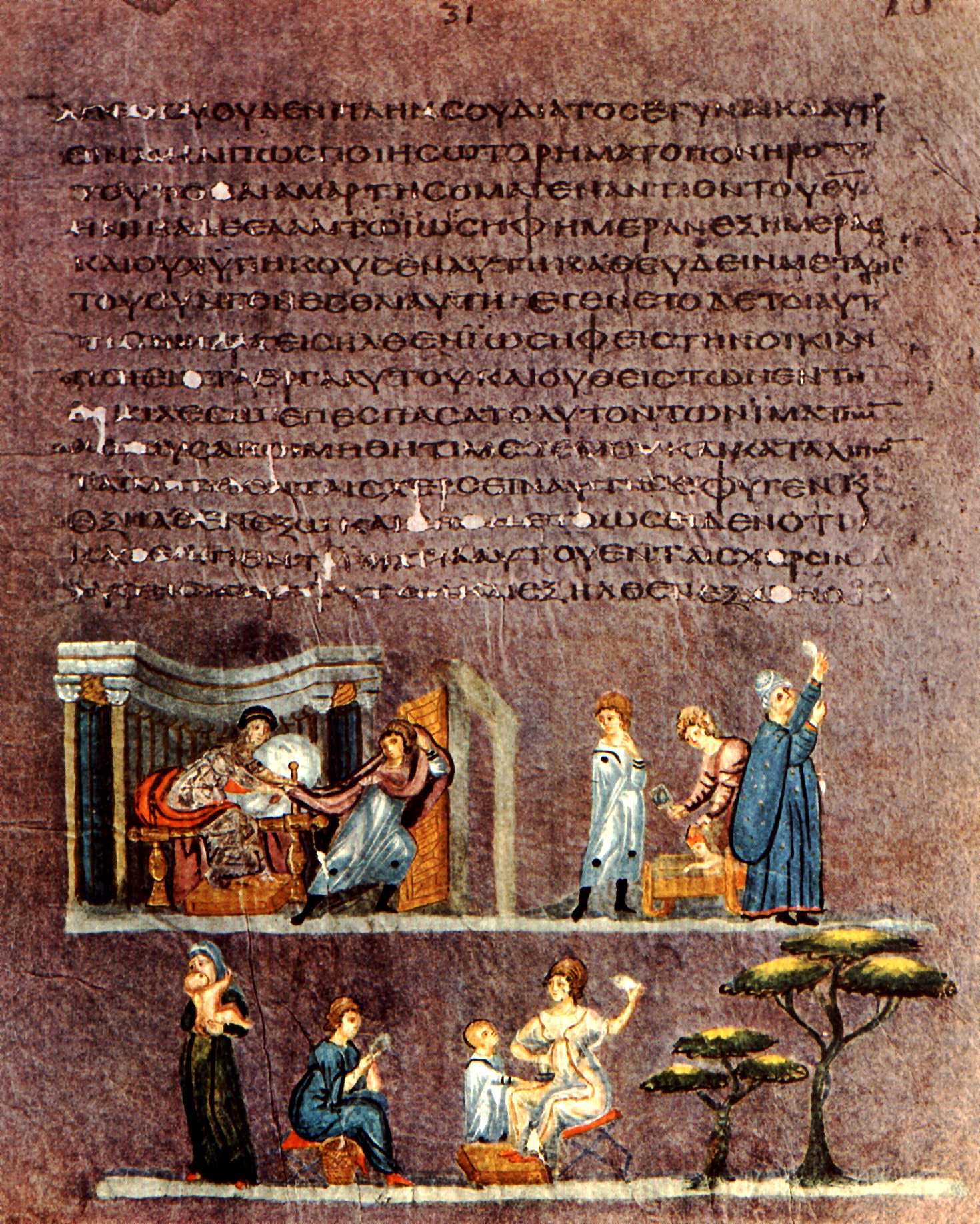
I don't think I agree with Parker's last point. "The entire manuscript" isn't telling "a different story from that found in the text alone." Rather, the manuscript is telling a larger story from that found in the text alone. For its intended audience, this "larger story" was already invoked and evoked by the manuscript. This is the only way, as far as I can see, why an illustrator would think it okay to illustrate a biblical manuscript with scenes from apocryphal texts. That is, the written text was a moment or instance of the larger Joseph tradition. And it doesn't much matter that the written text doesn't narrate other moments or instances of the tradition, some of which are only found in apocryphal writings. Text and tradition belong together, and this "belonging together" happens within the audience, at the moment of reception, rather than within the text. Unfortunately, that means it's much more difficult—and often impossible—for us to see today how text and tradition relate to one another. But every now and then we get a glimpse of the larger traditional connections, and these glimpses remind us not to read our written texts too narrowly, too myopically, or with too great a restriction on what we think a text does not say.

Friday, January 14, 2011

is this nonsense?

I'm still reading The Interface of Orality and Writing: Speaking, Seeing, Writing in the Shaping of New Genres (A. Weissenrieder and R. Coote, eds.; WUNT 260; Tübingen: Mohr Siebeck, 2010). Now I'm working through David Rhoads's essay, "Performance Events in Early Christianity: New Testament Writings in an Oral Context" (166–93). Rhoads frames the NT texts as "performance literature," written texts that are incomplete in themselves.
Simply put, the writings we have in the New Testament are examples of "performance literature," that is, literature that was meant for performance—like music or theater or ancient poetry. It is difficult to imagine musicologists studying scores of music without ever hearing a performance. Nor can we imagine theater scholars studying scripts of ancient drama without having seen performances of the plays or without trying to determine how they may have been performed and experienced in ancient times. Yet we biblical scholars have studied the literature of the New Testament for centuries without ever hearing them performed as stories or speeches or epistolary orations, without trying to determine how they may have been performed in the early church, and without constructing ancient performance scenarios as a basis for interpretation. (169)

I agree completely. Rhoads has put his money where his mouth is. He regularly performs large sections of the New Testament (e.g., the Gospel of Mark, or Revelation) from memory; so deep is his conviction that people need to hear the text at least as much as they should read the text. And so I have a real appreciation for Rhoads's work.

But. When Rhoads turns to the question of memory, he makes the following statement: "The first century was a memory culture more than it was a manuscript culture." My question: Is this gibberish? What does Rhoads mean by "the first century," and how is that any kind of culture, memory or otherwise? Are "memory culture" and "manuscript culture" "things," separatable, isolatable, able to be set in contrast with each other like lemons and protractors?

I appreciate the question Rhoads is trying to raise, and I even agree that we need to raise it. That is, How did "memory" (whatever that is) and "manuscripts" function in antiquity in specific cultural locations? That is a very important question (or better, a very important set of questions). But notice that Rhoads's language is way too blunt to get at the question, let alone to propose helpful starts at useful answers. Rhoads's identification of "the first century" as any kind of "culture," as if it were a culture at all, swings a sledgehammer at a question that requires considerable finesse.

Tuesday, March 16, 2010

how the ancients used language

I need some help. I'm reading Ruth A. Clements and Daniel R. Schwartz's edited volume, Text, Thought, and Practice in Qumran and Early Christianity (Studies on the Texts of the Desert of Judah 84; Leiden and Boston: Brill, 2009), which has been a fascinating collection of essays to this point (I'm about two-thirds of the way through). I'm currently reading Menahem Kister's essay, "Divorce, Reproof, and Other Sayings in the Synoptic Gospels: Jesus Traditions in the Context of 'Qumranic' and Other Texts" (195–229). I'm extremely sympathetic to Kister's reading program, which situations NT traditions (here the sayings of Jesus) within overtly Jewish frames of reference.

But I am once again flummoxed at the implicit model of language and communication that enables conceptions such as the following:
Moreover, the expected Greek rendering of יסוד הבריאה is ἡ ἀρχὴ τῆς κτίσεως, an expression in which the word ἀρχὴ would mean "principle." It seems that this expression was changed in Mark to ἀπ᾽ ἀρχῆς κτίσεως, "from the beginning of creation" (10:6), and in Matthew further revised to ἀπ᾽ ἀρχῆς (19:4, 8). If this expression indeed underlies both CD and the sayings tradition, there must be a close genetic link between them. If this is the case, we have here a striking case in which the originality of the wording in one Gospel may be established over against that of another through comparison with the Qumranic parallel. (Kister 2009: 202; my emphasis)

Anyone familiar with redaction-critical analyses of the synoptics will recognize immediately the familiar notion of language revised in later gospels from earlier ones. So Matthew's "from the beginning" is a modification of Mark's "from the beginning of creation" rather than an autonomous instance of language that relates to the sociolinguistic phenomena of Hellenistic Greek in general. Kister takes that thinking to a new level, if I understand him rightly, by applying redaction-critical analytical tools to texts that don't exhibit a literary relationship. In other words, the comparison of Mark and Matthew at least rests on the theory that Matthew knew and copied from Mark; but what theory legitimates Kister's claim that Mark changes language from another (Hebrew) text?

The larger problem, however, stems from our theory of language and communication, if it can be said that we have one at all. As historians of antiquity, we can only work with and analyze the remains of language that was inscribed some place, whether on papyrus or parchment, on a monumental stele or statue, or even the plethora of graffiti that survives from the ancient world. It seems to me, however, that redaction criticism in general, and especially analyses such as Kister's, implicitly assume that written language was all there was. This sounds ridiculous, of course; who could imagine a silent world where people communicated solely in writing?! But this is precisely the conception of language that appears to underlie anlyses of language from text to text. Otherwise, how can Kister (or anyone else) suppose that Mark has changed "the principle of creation" to "the beginning of creation"? Why is either phrase the cause or the effect of the other?

Werner Kelber has for over two decades been arguing against just these very analytical assumptions when he refers to the "equiprimordial"-ness of variant sayings. Kelber's neologism is, perhaps, unfortunate for two reasons. First, it's just plain weird, though it seems Kelber delights in weird language (or in weirdly using language). But second—and more substantively—the concept of equiprimordiality is an exaggeration of an otherwise very insightful point. That is, Kelber argues that tradition, in oral performance, enjoys a certain autonomy vis-à-vis previous and subsequent performances of the tradition. That is, if in one performance Jesus is reported to say, "Blessed are the poor . . . Blessed are the hungry," and in another performance he is made to say, "Blessed are those who mourn . . . Blessed are the meek," the two instances are both equally ("equi-") original instances of the tradition ("-primordial"). One is not "more original" than the other. This variability in the tradition goes back as far as Jesus himself, who on different occasions may have given various renditions of the Beatitudes (cp. Matthew and Luke), and who may have sometimes correlated his Beatitudes with parallel woes (Luke) or not (Matthew).

Kelber perhaps goes too far when he insists that traditions in oral performance are equally "original" or "primordial." Tradition could certainly develop as well as devolve; it could be applied to new contexts, integrated with other traditions, or cast in new frames of reference. These would not be equi-primordial. But we should recognize the fairly obvious point that the traditions we analyze transcended and existed well beyond the texts we work with. As a result, any analysis of one text solely—or even primarily—in terms of another text runs the risk of neglecting the ways that nontextual factors contextualized both the production and the reception of our texts. In other words, in a world where people could (and presumably did) say ἡ ἀρχὴ τῆς κτίσεως as well as ἀπ᾽ ἀρχῆς κτίσεως, and many other things besides, no one was likely to perceive one phrase in terms of (or as a change from) the other.

Thursday, June 11, 2009

review of Why Did They Write This Way?

In the most recent issue of RBL Werner Kelber offers a typically poetic review of Katherine M. Stott's book, Why Did They Write this Way: Reflections on References to Written Documents in the Hebrew Bible and Ancient Literature (LHBOT 492; London and New York: T&T Clark, 2008). I look forward to reading Stott's book primarily because in my own work (Structuring Early Christian Memory, as well as "Reading and Hearing in Ancient Contexts," forthcoming in JSNT) I suggest that biblical scholars would do well to shift their focus away from strictly compositional interests and ask questions regarding reception.

Too often we have focused on the text in front of us and neglected the way that text would have "worked" in its ancient context. In addition, when we suspect the use of written traditions in the composition of other texts, we have neglected the ways that composition represents an instance of reception (viz., of the source text).

Kelber's review leads me to suspect that Stott's work advances our interest in compositional dynamics precisely by broadening her focus to include dynamics of reception. If any of you have read this book, I welcome your comments here.

Friday, May 15, 2009

What really mattered when reading the Bible?

I'm reading a pre-publication version of an article on the significance of the (later) insertion of the Pericopae Adulterae (John 7.53–8.11) into John's gospel. The author, Chris Keith, is a good friend of mine, and I find that he and I seem to be making very similar arguments, more or less independently of each other, with respect to different sets of data (I have focused my research on Jesus' logia pertaining to his acts of healing and exorcism). Since this is a tentative version of Chris's paper I don't want to reveal too much. But he does present a wonderful opportunity to formulate a question I've been wrestling with for a few months.

When we read the Bible (and by we here I mean primarily the church, believers in and worshippers of God, rather than the scholarly community) we have certain expectations about the texts before us. Those texts reveal the God of whom they speak. Those texts describe the history, current state, and future of this world. Those texts make certain claims on my own life as one who lives within the world under the reign and/or care of the God mentioned above. I don't intend to argue with any of these expectations. But I wonder how much these expectations have led us to assume, perhaps even unknowingly, that what matters when reading the Bible is the relationship between the text and the reality behind—as well as above!—the text. Again, no complaints here. But I wonder if this focus on the relationship between the text and something else betrays an unwillingness to affirm the text in itself.

This question was raised for me originally by the argument of, among others, James Dunn, that the textual dynamics relevant for understanding the relationship between the synoptic gospels is best described as variation within the same (a point Keith is discussing in his paper). What accounts for this variation, a phenomenon many of us wouldn't accept today? With respect to the synoptic gospels (Dunn), this variation is evident in readings across the synoptics (compare, for example, the three different versions of the Parable of the Vineyard [Mark 12.1–12 parr.; note also the parallel in the Gospel of Thomas]). With respect to the Pericopae Adulterae (Keith), this variation is evident in the manuscript tradition of John's gospel, which at some point did not contain this tradition and then, without a sense of corruption or intrusion, it did.

If, in church, we would never accept the kind of flux with respect to the Bible that seemed to be at the very least acceptable—and at most commonplace—what significant difference between the church then and the church now explains this contrast? Is our way of reading the Bible "better" than theirs? or is theirs better? How can we know? In other words, I am serious about the past-tense verb in the title of this post: What really mattered—to the early Christians more than to us—when reading the Bible?

One answer—not the answer but one answer—may focus on the reception of the Bible and the God that we believe reveals himself through it. In the assumptions undergirding how we read the Bible we expect the Bible to mean what it means, and our job is to meet the Bible where it is. This assumption is facilitated by the widespread availability of printed Bibles, in which anyone of any age and life circumstance can have their own copy (and often their own copies) of the Bible and read it for themselves. In an ancient environment where the Bible was much less accessible and many people only had access to it through another person's reading and/or performance of the text, things may have worked a bit differently. Instead of a reader "figuring out" what the text means, a performer (or lector) had to connect the text's meaning with the people listening. The meaning of the text, rather than the text itself, occupied the church's focus.

How exactly we could—or even whether or not we should—distinguish between the biblical text and its meaning isn't clear to me. But one thing I'm increasingly sure of: For us the Bible's text is relatively (even firmly) stable (often we cite Matt. 5.18 here), but its meaning might fluctuate depending on circumstances of reading. I'm not willing to say that meaning was stable in the earlier church, but I am confident that the text could shift and adapt in service of what mattered: the text's meaning, its significance. And I can't shake the feeling that the church today could learn something from our ancestors in the faith in this regard.

My Visual Bookshelf