Showing posts with label research. Show all posts

Wednesday, December 05, 2012

is Mark a pre-war document?

In yesterday's mail I received an examination copy of David A. deSilva's new book, The Jewish Teachers of Jesus, James, and Jude (Oxford University Press, 2012), which I am considering adopting for my graduate course, World of the New Testament. I started looking through the book, and so far I'm enjoying it. Much to disagree with, of course, but much more to learn from. This is what we enjoy about NT scholarship, right?

At any rate, in the light of yesterday's post about Mark Goodacre's suspicion of an potentially emerging consensus that Mark is a post-war document, I thought it interesting to read the following from deSilva, who affirms (along with nearly every other NT scholar) that Luke-Acts was written after the Roman-Jewish War:
. . . Occasionally the "apocalyptic discourse" has been used to argue that the Gospels of Mark and Matthew also postdate these events, but there is nothing in either account that could not have been uttered by a Jewish prophet in the first half of the first century—quite aside from the question of whether or not such prophetic utterance is "really" predictive. (2012:263, ftn. 5)

Goodacre, in the course of his discussion, will refer to three very recent monographs focused on the question of the date of Mark's Gospel (and an article by John Kloppenborg). deSilva, on the other hand,  is simply making a point about Luke's Gospel and contrasting that point, briefly and in a footnote, against the Gospels of Mark and Matthew. My point here is certainly not that deSilva has the better or more convincing argument. Rather, I just want to point out how easily one can encounter—even accidentally!!—exceptions to the potentially emerging consensus to which Goodacre made reference. Without question detailed and sophisticated arguments for a post-war date are current within the scholarly discussion, and clearly Goodacre has found them persuasive. But if anything, I suspect the consensus—if there be one—pushes Mark back into the immediately pre-war years. deSilva even pushes Matthew back before the destruction of Jerusalem and her Temple!

Tuesday, December 04, 2012

is Mark a post-war document?

I'm reading Mark Goodacre's Thomas and the Gospels: The Case for Thomas's Familiarity with the Synoptics (Eerdmans, 2012). I'll comment on the book as a whole later, though let me say I cannot praise Goodacre enough for his meticulous attention to detail and his clear (and clear-headed) writing.

In his discussion of the date of the Gospel of Thomas, he makes the (obvious) point that, if Thomas knew and depended upon the synoptic Gospels, then Thomas must have been written after them. A first step in dating Thomas, then, is to attempt to date the synoptics. So far so good.

But then we find the following paragraph, which I will reproduce in its entirety. Note that there are no footnotes in this paragraph, which is part of why I'm raising a question mark against it. But first, Goodacre:
Second, the case for a post-70 dating for Mark is strong, and gaining in momentum in recent scholarship. Although it might be overstating the case to speak about a post-70 Mark as an emerging consensus, several recent works place the onus on those wishing to argue the opposite. The importance of this is obvious. Since Mark is the first in the sequence of literary works, dating Mark is a very helpful way of moving forward. If Mark post-dates 70, so do Matthew, Luke, and Thomas. (Goodacre 2012:161)

I was surprised by the strength of Goodacre's statement. I can't say that the date of the synoptics is my area of expertise, but I'm familiar enough with the field that I think Goodacre has, indeed, overstated the case even that the onus is on those who argue a pre-70 date for Mark. Here I'd make two points.
  • First, there are some fringe arguments that date Mark considerably earlier than 70 CE. For example, James Crossley argued in his doctoral dissertation that Mark is nearer the Caligula crisis (41 CE). As far as I know, James has not found an impressive following (though his doctoral supervisor, Maurice Casey, accepts his argument in the latter's Jesus of Nazareth). R. T. France, a Matthean scholar, also dates Mark early, though for completely different reasons. As I have already conceded, these are fringe arguments. Because they are fringe, however, they are more easily disregarded than disproven. At the very least, these arguments force us to temper our confidence in the consensus.
  • Second, my own impression is that the developing consensus fixes the date of Mark's Gospel in the vicinity of the war with Rome, either in the buildup to hostilities or in the war's immediate aftermath (viz. 65–75 CE). Especially significant here are the details of Mark 13, details which (i) echo biblical themes pertaining to the destruction of the First Temple and (ii) do not correlate precisely to Titus' destruction of the Second Temple.
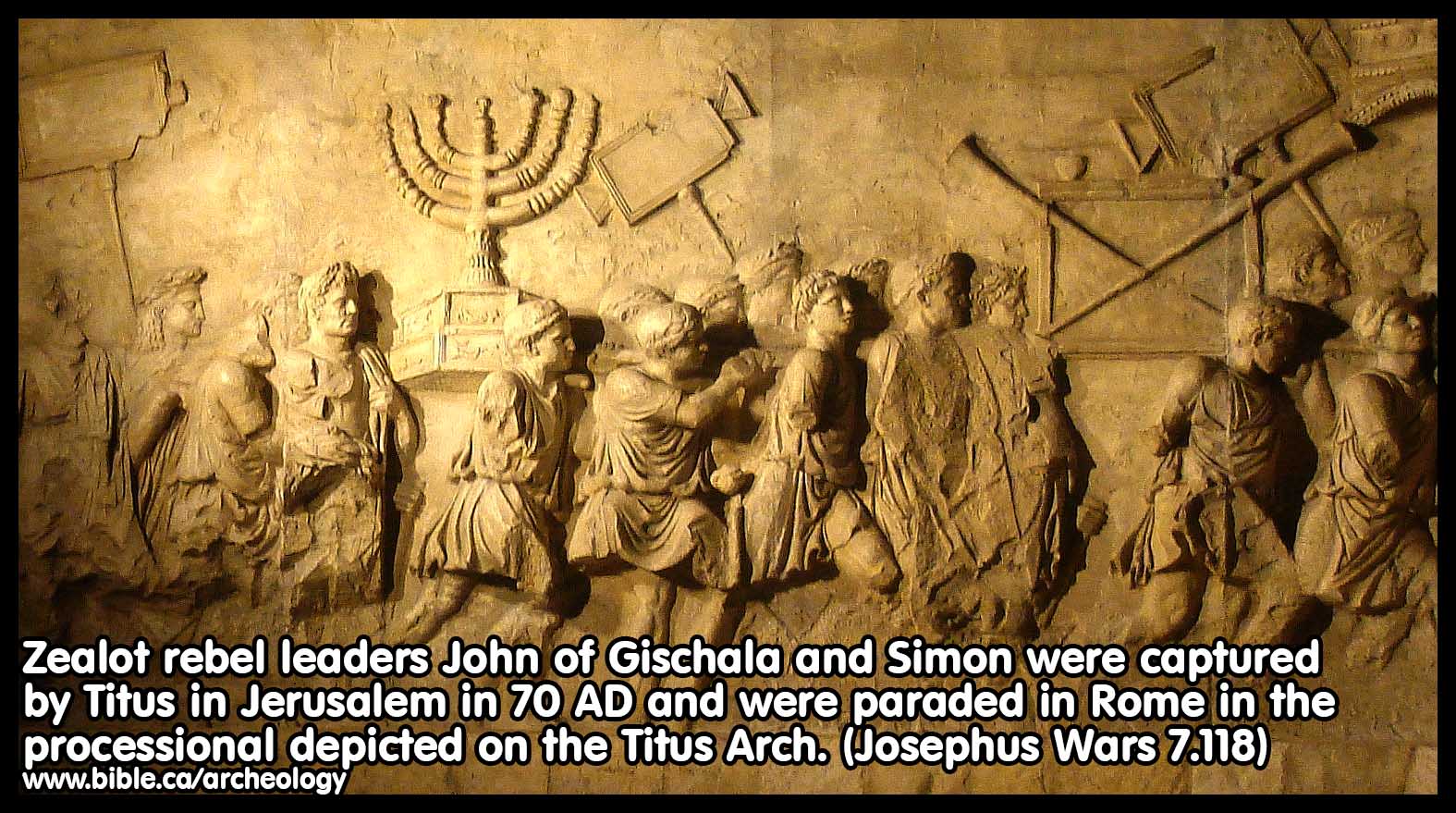
Scene from Titus' Arch depicting the triumphal procession and the spoils from the Jerusalem Temple.
Perhaps I'm wrong here, and Goodacre is right. In fact, my first instinct is to trust Goodacre. But I was under the impression that the case was just as strong that Mark dates to immediately before the war as it was that Mark was written after the war. You Markan specialists out there, let me ask: What are your impressions regarding any potential "emerging consensus" among Markan (and historical Jesus?) scholars? Is there broad agreement that Mark is a post-war document?

UPDATE: Goodacre does consider specific arguments for dating Mark (including Crossley's; see Goodacre 2012:162–64). In rereading this post after it was published, I realized I might give the impression that Goodacre simply ignores Markan scholarship. That impression would be false.

Thursday, September 20, 2012

Jesus, Criteria, and the Demise of Authenticity—the schedule

On The Jesus Blog Anthony Le Donne and Chris Keith have published the schedule for the up-coming Jesus, Criteria, and the Demise of Authenticity conference in Dayton, OH (4–5 October 2012). If you've been meaning to register for the meeting but have been putting it off (or didn't know where to do so), click here for the conference website ($70 registration; $10 lunch).

If you're coming, don't forget to purchase a copy of the volume, don't forget to purchase a copy of the book, Jesus, Criteria, and the Demise of Authenticity (T&T Clark International, 2012). If you can't make the conference, then buy two copies!!

Wednesday, September 19, 2012

Coptic question

I know I'm supposed to be blogging about Jesus' wife. I'll try to get to that later today. But for now, can any of you access or guide me toward the Middle Egyptian Coptic reading of Acts 13.34? Theodore Petersen offers the following translation of vv. 33–34
. . . this day have I begotten thee. Ask of me and I will give thee the gentiles for they inheritance and for they possessions the ends of the earth. (And to show that) he has raised him up from the dead in such a way as never again to return to decay, that all the people may know and do penance (he has said thus) this namely is the way which is written in Isaias the prophet, I will give you the holy and everlasting covenant and sure (promises) mercies of David. (Theodore C. Petersen, "An Early Coptic Manuscript of Acts: An Unrevised Version of the Ancient So-called Western Text," CBQ 26/2 [1964], 240)

The italicized phrases represent the Coptic additions over the critical Greek text. But I'm especially interested in the italicized and bold phrase, "everlasting covenant." Any help?

Tuesday, June 05, 2012

Jesus, Criteria, and the Demise of Authenticity

As Mark Goodacre has already noted, the Jesus, Criteria, and the Demise of Authenticity Conference, scheduled for 4–5 October 2012, has been moved to Dayton, Ohio. I recently received the following announcement:
The 2012 Jesus Conference will be held Oct. 4 and 5, 2012 in Dayton, OH. The co-hosts are United Theological Seminary and the University of Dayton's Center for Scriptural Exegesis, Philosophy, and Doctrine. We're very excited to partner with these institutions and their fine faculty. More information concerning registration, schedule, etc., will be forthcoming.

(Please see the United Theological Seminary and the University of Dayton's Center for Scriptural Exegesis, Philosophy, and Doctrine websites.)

The conference will feature discussion and elaboration on the book, Jesus, Criteria and the Demise of Authenticity (T&T Clark International; forthcoming). If you follow the link you can find a preview of the book. The publisher's description reads:
Criteria of authenticity, whose roots go back to before the pioneering work of Albert Schweitzer, have become a unifying feature of the so-called Third Quest for the Historical Jesus, finding a prominent and common place in the research of otherwise differing scholars. More recently, however, scholars from different methodological frameworks have expressed discontent with this approach to the historical Jesus. In the past five years, these expressions of discontent have reached a fever pitch.

The internationally renowned authors of this book examine the nature of this new debate and present the findings in a cohesive way aimed directly at making the coalface of Historical Jesus research accessible to undergraduates and seminary students. The book’s larger ramifications as a thorough end to the Third Quest will provide a pressure valve for thousands of scholars who view historical Jesus studies as outmoded and misguided. This book has the potential to guide Jesus studies beyond the Third Quest and demand to be consulted by any scholar who discards, adopts, or adapts historical criteria.

When I hear more (registration procedures, housing, costs, etc.), I'll let you know.

(See also T&T Clark International's blogpost about the book.)

Tuesday, February 14, 2012

something's amiss here

I'm working through some thoughts on the identity of Paul's interlocutor in Romans (chapters 2–11, though my focus is on Romans 1–4). I've been reading Runar Thorsteinsson's Paul's Interlocutor in Romans 2: Function and Identity in the Context of Ancient Epistolography (Almqvist & Wiksell International: Stockholm, 2003), which is just a fantastic book. With very few exceptions, Thorsteinsson's arguments are both clear and compelling; when I examine his reading of Romans, he sees the text the way I see the text. Though I'm neither a Romans nor even a Pauline specialist, it seems to me that this is a book of which NT scholarship must take much greater account. You Pauline scholars out there, Am I wrong?

On the other hand, I'm also working my way through [parts of] Douglas Campbell's The Deliverance of God: An Apocalyptic Rereading of Justification in Paul (Grand Rapids: Eerdmans, 2009). Campbell's book was the subject of the December 2011 issue of JSNT, with very critical review articles by Barry Matlock and Grant Macaskill. Of the very many distinctive reading positions and arguments in this very lengthy book, Campbell argues that we should read Rom. 1.18–32 as "speech-in-character," as Paul taking up the voice of and speaking as a character other than himself. Stanley Stowers has argued convincingly that Paul employs the rhetorical device, speech-in-character, in Rom. 7.7–25, so such things are not impossible. However, as Stowers emphasizes and Campbell acknowledges, anyone who proposes this as a reading strategy has to explain how Paul might have expected his readers to recognize his rhetorical maneuver. In Romans 7 there are several clear signals (which I discuss in my notes on Romans; if there's interest I can post those comments on this site). But Romans 1 lacks such clear signals. So Campbell argues instead,
It is my contention that the initial auditors of Romans could have detected such a strategy relatively easily through a plethora of nonverbal signals—the types of signals with which performed texts abound. And it must be emphasized that at this stage of our discussion it is necessary only to establish this identification as a possibility. Ultimately, my suggested rereading of Romans 1:18–32 will rely on evidence that emerges "downstream," so we will affirm this identification strongly only in retrospect. But it should be noted that this retrospective judgment is an accident of the text's canonical preservation, of the resulting loss of its original performed context, and also of some of our modern hermeneutical assumptions. We will realize belatedly what the Roman auditors could recognize relatively quickly, through the text's appropriate performance. For this reason, my auditors need for the moment only to be open to this reading of 1:18–32 as a possibility. Could the Roman Christians have detected a satirical textual operation here if it was indeed present? (Deliverance of God, 530; my emphasis [see pp. 530–41])

As I have already admitted, I am not a Pauline specialist, so I'm a bit outside my field. But I am a bit more experienced with oral traditional scholarship, and I have spent eight years reflecting on and exploring how to apply the theories, methods, and results of oral traditional scholarship to written textual questions. In fact, oral traditional scholars themselves have spent decades exploring this issue, so there's a vast body of literature on the subject. And oral traditional scholars have long emphasized that nonverbal and/or extratextual factors such as intonation, gesture, voice inflection, pace/tempo, musical accompaniment, social and/or physical environment, facial expression and other body language, eye contact, directionality, etc. etc. etc. affect how a written text communicates its meaning to an audience. In fact, it's safe to say that the written text itself didn't communicate its meaning to its original audience; rather, a reader/lector/oral performer communicated the text's meaning, and s/he did so via a number of techniques that (i) cannot be found within the tradition's textual stratum (i.e., the written text itself) and so (ii) is no longer available to us. This is unfortunate, because these methods, as Campbell rightly recognizes, are often if not always determinative for how and what a written text means.

Anyone reading Campbell's book, however, needs to know, this is NOT the way to apply issues of oral performance and/or presentation to (written) textual analysis. The problem with Campbell's argument here in Romans 1 is that there's no way to falsify it. There's no way to prove that Campbell's rereading runs exactly counter to Paul's intentions for Rom. 1.18–32 precisely because there's no evidence in support of his rereading. Unlike Romans 7, no textual clues suggest that Paul is speaking "in character" in Romans 1, and so all Campbell can do is grin and ask us to bear it.

But, given that, first, Rom. 1.18–32 makes perfectly good sense within Paul's own authorial voice (i.e., in his undisputed letters, in the disputed [or deutero-Pauline] letters, and in Acts, Paul speaks of God's judgment against the gentiles) and that, second, nothing that follows 1.18–32 requires us to hear Paul's comments about gentile depravity as "speech-in-character," we need to read this text straightforwardly, as the author presents it to us. Indeed, Thorsteinsson, in the much more helpful reading of Romans that I mentioned above, argues persuasively against exactly the kind of retrospective reading strategies Campbell employs here. So while we might grant that we could read Rom. 1.18–32 as a "satirical textual operation," we—and Campbell, too—need to admit that Paul has utterly failed to encode that operation with the text itself. And that failure, I would argue, is the best evidence against the proposal that we should read this passage satirically (pace Campbell, 541: "[s]uch texts therefore deliver their ironic and subversive potential entirely performatively" [emphasis his]).
Monday, November 14, 2011

what social memory isn't

I'm currently reviewing Maurice Casey's book (perhaps even magnum opus), Jesus of Nazareth: An Independent Historian's Account of his Life and Teaching (London: T&T Clark International, 2010). I met Maurice in 2005 at the British New Testament Conference, where we both presented papers in the BNTC's Jesus Seminar (not to be confused with the Westar Institute's Jesus Seminar). I found him to be a friendly, encouraging, and collegial figure, which matters since he is a very senior NT scholar and I was (am) just getting my feet wet. Also, I consider one of his protégés, James Crossley, a personal friend; Crossley was also the internal examiner for my PhD thesis defense. This book is certainly the results of decades of detailed scholarship, both in the details and in the larger theoretical and methodological issues.

Moreover, the adjective found in the subtitle, independent, should be taken at face value; Maurice affirms a number of traditional conclusions among NT scholars (Markan priority, Jesus spoke Aramaic, etc.), but he also advances numerous arguments that challenge directly some of the most taken-for-granted ideas in our field. For example, Casey affirms Markan priority and the existence of "Q," though he argues that "Q" refers to a number of disparate written sources, in both Aramaic and Greek instead of a single document written in Greek. However, he also affirms that Luke knew and was influenced by Matthew. Anyone familiar with the Synoptic Problem and the discussion in that field will know how controversial it is for one person to hold to all these ideas at the same time.

And it is to be expected that I have some bones to pick with Casey's approach to the historical Jesus. If nothing else, the fact that Casey isn't a confessional scholar (he is forthright about this but not [always] antagonistic) and I am will necessitate areas of disagreement. But I don't think this difference explains all my complaints. Certainly this one has little if anything to do with my faith or his un- (or non-) faith.

In a section of his chapter on historical method, Casey addresses "social memory," a field in which I am heavily invested professionally. He writes, "In recently scholarly work, both rewriting history and telling stories about traditional figures have been drawn together into discussions of 'social memory'" (133). Already this is wrong. Social memory doesn't refer to either "rewriting history" or "telling stories about traditional figures," though both can be aspects of social memory. Barry Scwartz recently wrote,
"Social memory" refers to the distribution throughout society of individual knowledge, belief, feeling and moral judgement of the past as well as identification with past actors and events. Only individuals . . . possess the capacity to contemplate the past, but this does not mean that such capacity originates in the individual alone or can be explained solely on the basis of his or her experience. Individuals do not know the past singly; they know it with and against others situated in different groups, and through the knowledge and traditions that predecessors and contemporaries transmit to them. (Barry Schwartz, "What Difference Does the Medium Make?" in The Fourth Gospel in First-Century Media Culture [ESCO; LNTS 426; London: T&T Clark International, 2010], 225–38 [p. 231 quoted])

I know this sounds complicated, but the gist is that all of us are affected by social forces larger than our individual, personal identities as we remember the past, whether the past of our social groups (e.g., American history, Christian tradition, Western culture, etc.) or our own autobiographical pasts (e.g., my relationship with my wife and/or children, my personal experience of American citizenship, my religious testimony, etc.). The gap between Casey's rather myopic definition of social memory and the field of study that usually goes by the name is hard to overestimate. I once stood on the South Rim of the Grand Canyon; this seems roughly similar.

As a result, Casey very briefly summarizes the famous story in Josephus, Antiquities of the Jews, in which Josephus is waxing eloquently about Solomon's divine wisdom and the exorcistic and therapeutic prowess he exhibited. As an example, Josephus tells the story of a first-century CE exorcist named Eleazar who followed one of Solomon's recipes for removing a demon. At the conclusion of the story, Casey writes,
This is an overt declaration that Josephus had made this non-biblical report about Solomon because of its importance in the world in which he himself lived. His whole account is a perfect example of 'social memory'. (134; my emphasis)

No, this isn't. Josephus's whole account is certainly an appropriate field in which to bring questions of social memory to bear; I suspect this story, and a number of others, would help bring to light "the distribution throughout society of individual knowledge, belief, feeling and moral judgement of the past as well as identification with past actors and events" (Schwartz, cited above). But Casey hasn't brought these questions to bear on the text, and I'm surprised that he seems to think that he has.

Thursday, October 20, 2011

Pieter Craffert on historiography

Historiography refers, among other things, to "the body of techniques, theories, and principles of historical research and presentation; methods of historical scholarship" (dictionary.com, which suffices for our purposes). I am currently reading Pieter F. Craffert's article, "How Historiography Creates (Some) Body: Jesus, the Son of David—Royal Stock or Social Construct" (Scriptura 90 [2005]: 608–20). I'm not  persuaded by his main thesis—at least, not yet—but his description and diagnosis of standard historiographical practices among historians of Jesus is very good and well worth paying attention to.

For example, Craffert writes:
What historians learned from anthropologists is that "people lead meaningful lives, and that these meanings can only be discovered within the context of those lives, it cannot be imputed to them on the basis of some previously established ideas about the biological or psychological makeup of people" (Cohn 1980, 201). Therefore, anthropological historians recognise that they "must grasp the absolute presuppositions, the unspoken assumptions, of the society under review, in order to understand what has occurred" (Stanford 1986, 93). (Craffert 2005:611)

In other words, it will not do to run through historical documents (the Gospel of Mark, the Acts of the Apostles, Xenophon's Anabasis, or whatever) and attempt to isolate historically credible or plausible data that the historian can then use to reconstruct the past. Our documents are situated accounts of the past, written by people with particular perspectives—biases, expectations, values, ideas about what could happen, what should happen, and so on. And unless historians can approximate to some significant degree those particular perspectives, we simply will not be able to get in touch with "what actually happened" (the ultimate goal of most historiography) in any meaningful sense.

As a result, "[a]nthropological historians approach the documents as narrative constructs themselves of cultural realities and experiences" (Craffert 2005:611). This way of approaching texts matters, I think, not just because this more accurately perceives what our historical sources are (though this is true). Instead, it helps us to appreciate more acutely that our own historical reconstructions are similar phenomena: expressions of the past in terms that make sense within, communicate meaningfully to, and provide orientation for people in the present. Back in 2005 I made a similar point in a post on the SBL Forum (available here).

As I said above, I'm not persuaded by Craffert's main thesis regarding the claim of Davidic descent in the Gospels and (I would argue) during the life of the historical (= real) Jesus. However, he has offered us real insight in how we engage historical practice—historiography—as we try to know with some degree of precision and/or certainty what the past actually was. I strongly recommend you check out this essay.

Friday, August 12, 2011

review of Structuring Early Christian Memory

I don't know how other scholars keep track of who has reviewed their works, in which journal, and what they've said. It seems to me that you just kind of accidentally encounter a review that you didn't know was being written.

That happened to me last week. I accidentally discovered that Kelly Iverson, of St Andrews University (Scotland) reviewed my published thesis in the Journal for the Study of the New Testament. His brief review is positive and exactly the kind of thing an author hopes for (accurate, fair, critical, etc.). Here's an excerpt, if you're interested:
This study is a welcome addition to historical Jesus studies and provides a fresh perspective that deserves careful attention. For those who may be relatively new to the fields of performance and social memory, this volume offers an informative summary and helpful bibliography. In addition, there is detailed interaction with several textual examples (exorcisms and healings) that illustrates the potential usefulness of the approach. Given the broad objective of this monograph, some will not be convinced that the thesis sufficiently undermines the traditional criteria of authenticity or develops an unobstructed path forward. This volume does, however, make a reasoned argument for appreciating the variability in the Jesus tradition within the contours of an oral culture.

These, I think, are all fair comments. For lengthier and more substantive critiques of the traditional criteria of authenticity, see my "Authenticating Criteria: The Use and Misuse of a Critical Method" (Journal for the Study of the Historical Jesus 7/2 [2009]: 152–67), as well as the forthcoming volume, Jesus, History, and the Demise of Authenticity (Chris Keith and Anthony Le Donne, eds.; T&T Clark International), for which I contributed an essay on the failings of the criterion of embarrassment.

For Kelly Iverson's full review of Structuring Early Christian Memory, you can follow this link (you'll need to search for "Structuring Early Christian Memory," or you can scroll down to p. 44).

Monday, August 01, 2011

Tom Holmén on the criteria of authenticity

I'm currently reading Tom Holmén's entry, "Authenticity Criteria," which appears in the Encyclopedia of the Historical Jesus (edited by Craig A. Evans; New York: Routledge, 2008, 43–54). The piece is frustrating, at least to me, because Holmén continues to advocate an atomistic approach to reconstructing the "historical Jesus." In this approach, a critic will take an individual piece of the tradition (e.g., Luke 11.20 par.) and run it through a battery of tests. If the piece passes the battery, it then features in his historical reconstruction. If not, the piece is discarded.

But things are even more complicated than this. Holmén also advocates identifying and, again, discarding secondary additions to the tradition (e.g., many scholars, but not Holmén in this context, view the phrase "in spirit" in Matt. 5.3 as a later addition to something Jesus probably did say, which is more pristinely preserved in Luke 6.20). While this sounds good (who wouldn't want to identify corruptions in the tradition and remove them?!), in practice NT scholars have never been able to pull this off. The problem may be with NT scholars (we're just not smart enough to pull this off, or more charitably, perhaps not enough evidence has survived for us to distill authentic and/or original material from latter additions). But I think it more likely that the problem lies with the approach Holmén and traditional NT scholarship have advocated.

Instead of putting two or more parallel passages beside one another and arguing that this or that feature of one of the passages is later and secondary (what NT scholars call "tradition criticism"), NT scholars need to learn to accept the multiformity that lies at the heart of the Jesus tradition and to stop trying to reduce the extant multiforms to a single original forebear. For one thing, nothing gives us the right to suppose that Jesus ever said anything only once (even such striking and context-bound sayings as, "Give to Caesar . . ." or "Let the dead bury the dead . . ." may have been said on multiple occasions). But for another, what we have preserved for us in the Gospels are not more-or-less original traditions and the corruption of those traditions in later texts. The multiforms provide, instead, stereoscopic access for us to see the types of things Jesus' followers could say about him that (i) made sense of Jesus to themselves, (ii) made Jesus relevant and applicable in later situations, and (iii) illuminated appropriate and desirable courses of actions in the face of new and challenging questions.

So did Jesus say, "Blessed are you poor," as Luke has it, or "Blessed are the poor in spirit," as we read in Matthew? Perhaps both, perhaps neither. As a historian, I simply cannot prove that one or the other or either of them accurately records words that Jesus spoke on any given occasion. But what we do have preserved in the Gospels are two authors who attribute to Jesus strikingly similar (but not identical) sayings, and both seem to understand Jesus in similar (but, again, not identical) ways. This is exactly what we ought to expect, again, as historians, if the authors of Luke and Matthew had any access, direct or indirect, to the real Jesus.

More importantly, their portrayals of Jesus speaking his blessing on the poor (in spirit?) were sufficiently plausible to (i) be accepted, (ii) preserved, and (iii) disseminated. If Jesus was not the kind of person to bless the poor, spiritual or otherwise, such portrayals should have been less plausible in the first century. If Jesus was actually a friend of the rich and an elitist with regard to the poor, our extant sources have simply forgotten too much of the truth for us to know it. But if he actually pronounced blessing on the poor and preferred the socially marginalized, then our sources have preserved exactly this image of Jesus, and we are able to know something about this Jesus on the basis of their testimony. This is a significant (though not new) conclusion of historical scholarship on Jesus. But none of it, I would stress, depends on identifying secondary or later additions to the tradition and removing them. Such historical-critical approaches are, I think, well beyond their sell-by date.

Friday, June 17, 2011

thoughts on the limits of historical description

I begin with an obvious point: Humans exhibit significant limitations regarding the ability to describe and/or reconstruct the past. I have two such limitations primarily in mind, though perhaps there are others. First, processes of human perception already filter through the sensory data assaulting our senses and limit what we notice about the world around us. As we move through the ever-moving stream of the present, we don't even notice some things (how windy it is on an average day, how many people walked past my office door in any given hour, etc.). We remember even less (I almost certainly noticed things that happened on 11 September, 2000, but I can't recall any of them).

Second, our language is limited in its capacity to describe and communicate the things we do notice and remember about the real world, and what utility our language does have already directs interpretation of the events we're attempting to describe. For example, if I tell you about "what happened" to me at the bank, you expect a certain type of story (perhaps I slipped on the wet floor, or I found a $10 bill on the counter). If, however, I tell you about "the incident" in which I was involved at the bank, you expect another type of story (such as I couldn't get in because the police had barricaded an armed robber inside).

Such easily documented considerations have typically urged historians to exercise caution in what we think we know about the past. And rightfully so. But we have run the risk of being immobilized in our attempts to know anything meaningful and authentic about the past with any degree confidence. So I enjoyed Gerd Theissen's comments in this regard, from his 1996 essay, "Historical Scepticism and the Criteria of Jesus Research: or, My Attempt to Leap Across Lessing’s Yawning Gulf” (SJT 49: 147–76):
So human inability to give a genuine account of truth implies the equal inability totally to refashion everything according to certain interests and intentions. As we are axiomatically convinced of human imperfection before we have studied a single source, so—provided our source material is sufficiently complex—we are protected a priori from the suspicion that everything described in these sources is fictitious. (Theissen 1996:155)

Theissen's comments echo things written by folks such as Michael Schudson, Barry Schwartz, and Gary Alan Fine, all of whose works are finding their voice among biblical scholars. This is a helpful development in biblical historical criticism.

Thursday, June 16, 2011

sayings or narratives?

I'm currently reading William Arnal's essay, "Major Episodes in the Biography of Jesus: An Assessment of the Historicity of the Narrative Tradition" (Toronto Journal of Theology 13/2 [1997]: 201–26). Arnal is a member of the [in]famed Jesus Seminar, and anyone familiar with their work will find Arnal's work squarely within that tradition. (I don't intend this polemically, even though I disagree vociferously with the Seminar; and, to be fair, Arnal takes a number of Seminar Fellows to task at a number of points, including John Dominic Crossan, Marcus Borg, and even Robert Funk.)

Arnal questions the historicity of three key events in the life of the historical Jesus: his baptism by John, his tantrum in the Temple, and his Passion ("suffering"). These events are "key" not simply because they are normally understood as watershed moments in the life of the historical Jesus; they are "key" because they are almost (almost!) universally accepted as historical. But Arnal's argument isn't just that these three events were fabricated by Jesus' followers after his death (though he does argue this). Arnal goes further to offer "a general point about the narrative tradition in the Synoptics":
I believe that a reasonable case can be made that the stories developed out of motifs in the sayings tradition. Sanders very much to the contrary, the narrative tradition can be understood as a result of a narrativization of themes already present in the sayings tradition, as interest in Jesus as a teacher modulated into a desire to make Jesus himself a champion and paradigm of the community ethos generated by those sayings. (Arnal 1997:215; emphasis in the original)

Anyone familiar with the history of the historical study of Jesus knows that the distinction between the sayings and narrative traditions has played a storied role in the historical Jesus scholarship. The so-called "third quest" has largely privileged the narrative tradition (see Arnal's reference to E. P. Sanders, above), though I get the impression that some third-questers try to remove the distinction rather than invert it.

Here, however, is my problem with Arnal's argument (and with any Jesus historian who privileges the sayings tradition and actively derides the narrative tradition). Arnal offers his "reasonable case" that the narratives he examines arose from motifs in the sayings tradition, but nowhere does he justify the bifurcation between sayings and narratives in the first place. What historical basis does he have for presuming that Jesus' earliest followers preserved/passed on his teachings but were uninterested in narratives about him? Additionally, what historical basis does he have for assuming that, once Jesus' followers did develop an interest in stories about Jesus, they didn't have any and so had to turn to what they knew from the sayings tradition in order to fabricate some?

I know of two usual answers. First, Jesus' sayings are demonstrably more similar across the three synoptic Gospels (Matthew, Mark, and Luke) than are the accounts of Jesus' actions. Some historians (not necessarily Arnal and/or the Jesus Seminar) have used this empirical observation to justify the bifurcation between sayings and narratives. Second, and more importantly, a number of scholars, mostly associated with the Jesus Seminar (and here I would include Arnal) privilege the sayings source, known as "Q" (= material that appears in Matthew and Luke that does not appear in Mark), in their reconstructions of Christian origins. Since Q largely comprises sayings and not narratives, the assumption is that Jesus' earliest followers (or at least a subset of Jesus' earliest followers) cherised his teachings and had little or no use for stories about him.

Even leaving aside the hypothetical nature of the so-called Q-document, this second point rests on some dubious assumptions. First, it assumes that the Q-document, assuming it did actually exist, corresponds to the theology of a specific, identifiable group of Jesus' earliest followers. Second, it neglects that Q as currently reconstructed does indeed contain a number of narrative features. Third, again assuming that a Q-document actually existed, it assumes that reconstructions of that document from the material in Matthew and Luke give a reasonably accurate portrait of the Q-document. Joe Weaks's PhD dissertation, "Mark without Mark: Problematizing the Reliability of a Reconstructed Text of Q," should convince us to put such confidence behind us.

In sum, the choice between sayings and narrative traditions in historical Jesus research is a lark. Neither is epiphenomenal of the other; both were of utmost importance to Jesus' earliest followers. Jesus was remembered as an authoritative teacher (so Mark, passim) whose halakha put Torah into proper perspective (see, e.g., Mark 7.1–23; Matt. 5.17–20; Rom. 3.21–31, among many others). But he was also and simultaneously remembered as a powerful prophet/healer/exorcist, whose words calmed the seas, cast out demons, and silenced his enemies (e.g., Mark 1, 4, and 5). Any reconstruction that privileges the sayings over the narratives or the narratives over the sayings has already started off on the wrong foot.

Sunday, March 27, 2011

making sense of Paul

As I continue reading Kathy Ehrensperger and J. Brian Tucker's edited volume, Reading Paul in Context: Explorations in Identity Formation (LNTS 428; London: T&T Clark International, 2010), I find myself scratching my head sometimes. I've raved about Ekkhard Stegemann's essay (here and here), and I enjoyed Robert Jewett's analysis of the relationship between the gospel and the revelation of God's wrath in Romans (even if, in the end, I was unconvinced by his universalist interpretation). Neil Elliott's political reading of Romans was significantly less convincing than Stegemann's, perhaps because he trades in the same distinction between theology and politics that he criticizes in others. Mark Nanos's interpretation of Rom. 11.25–26 is suggestive if still, in my opinion, unsatisfying.

But Ian Rock's essay, "Another Reason for Romans—A Pastoral Response to Augustan Imperial Theology: Paul's Use of the Song of Moses in Romans 9–11 and 14–15" (74–89), strikes me as odd. I'll raise two issues here. First, I simply have no idea what Rock means when he refers to "the substantial evidence that the addresses of this letter are not Christians but rather the saints in Rome (Rom. 1.7)" (74; my emphases). Does anyone have any idea what distinction Rock might have in mind here? Is this the complaint that the term Christian is anachronistic for the mid-first century CE? Or does Rock have two distinct (and distinguishable) groups in mind here?

Second, Rock locates Paul primarily within the sphere of Roman imperial political rhetoric (rather than within Israelite/Hebrew biblical tradition), a move reminiscent of Elliott's essay, mentioned above. In fact, Rock asks,
Could Paul's references to the kingship of David, the universal covenant with Abraham, the cosmic character of the Law of Moses, the historicity of the people and Israel as the true people of God, his articulation of the messiahship of Jesus the Son of God and Lord, have all stemmed from a subcultural reading the Aenid? (78; my emphasis)

In general, we biblical scholars don't usually ask questions that can be satisfactorily answered, "yes" or "no." But this one is easy: No. The emphatically Jewish topoi Rock names certainly and without doubt did not "stem from" Paul's reading of the Aenid or any other Roman literature. Are we really to imagine Paul developing the ideas we find in his letters about "the kingship of David, . . ." in response to the imperial claims coming out of Rome? What, then, did Paul think before he encountered these claims (or rather, before he needed to formulate responses to them)?

It may well be that Rock didn't mean to ask whether Paul's Jewish ideas "stemmed from" his encounter with Roman propaganda. Perhaps he's merely after how Paul employed Jewish theological resources to answer things that were being advocated about Caesar, for example in the Aenid. But this isn't what he said. And NT scholarship needs to carefully explore the way NT texts employ Jewish theologoumena to counter Roman political and theological ideology without obscuring the fact that, among the NT authors, Jewish ideas and concepts precede Roman ideas. Our authors were Jews navigating Jewish identity in Roman contexts, not Romans engaging Jewish ideas.

Wednesday, February 23, 2011

New JSP imminent

According to their website, the current issue of The Journal for the Study of the Pseudepigrapha is still the December 2010 issue. However, I have it on good authority that the next issue (20/3 [March 2011]) will be issued very soon. When it's released I'll put up a link and a list of its contents. But for now, as a teaser, let me suggest that this issue will feature a very helpful discussion of the literal vs. metaphorical intentions of the therapeutic language in 4Q521. That text, famously found among the cache of texts from Cave 4 near the Dead Sea and originally published in 1992, contains striking thematic and traditional similarities to Jesus' response to John the Baptist's disciples, recorded in Matt. 11.2–6||Luke 7.18–23.

James Tabor, who published an essay with Michael Wise on this fragmentary text in the early 1990s, has posted a translation and discussion on his website. All of this is very interesting!!

Monday, February 07, 2011

relating text and tradition

I've started reading David C. Parker's short little book, The Living Text of the Gospels (Cambridge: Cambridge University Press, 1997). This is an epoch-changing book, both for the studies of the gospels (and other early Christian written texts) and for text-critical research. Fifty years ago New Testament text critics may have been fairly confident regarding the goal of their research—viz., the recovery of the original text of the writings of the NT. Today, however, most text critics and a growing number of NT scholars more generally are coming to question both the utility of "original text" as an academic pursuit and the utility of text-critical methods for uncovering (or recovering) the prized "original text." David Parker's book is an important factor behind this shift:
Instead of eliminating material in order to recover a single original text, the editor analyses all the developments of the material in order to demonstrate the processes to which they owe their origin. The textual critic's task has not become less important because there is no definitive text to be recovered. There is a sense in which an editor's continuing importance has increased. For when it is assumed that there is an original text [original emphasis], the textual critic's task is very simple: to recover the original text. The user then offers grateful thanks for the definitive product, and gets on with the interpretation, while the editor goes in search of another text to polish off. But if the task does not consist in recovery of an original text, then the study of the entire range of materials available will not cease with the publication of an edition. . . . [T]he quest for an original text need not be the only option available to the modern textual critic, or the only expectation of the modern reader. Returning to the Gospels armed with these possibilities, we ask this question: are the Gospels the kinds of texts that have originals? (6, 7; my emphasis)

At any rate, enough of the introduction to the current state of text-critical research. I'm actually very interested in a comment Parker makes regarding an illustrated manuscript of the Pentateuch. This example, I think, illustrates the kind of claim I make regarding early copies of the written gospels (by "early," I mean of the first three or four centuries). Namely, I suggest that we should read the written texts of the gospels as moments or instances of the Jesus tradition rather than as standard, fixed, "canonical" versions of that tradition. In the earliest Christian centuries the Jesus tradition was considerably more fluid than we experience it today (though we should recognize that even today we are comfortable with a surprise level of fluidity; consider as one example the myriad nativity displays every year sporting both angelic hosts and Magi worshiping the baby Jesus, despite the fact that not one single text bring angels and Magi together with Mary, Joseph, and the new-born Christ). Did Matthew, as one who performed the Jesus tradition, always include eight beatitudes in the third person and one in the second? Did Luke, as another performer, always limit himself to four beatitudes (in the second person)? And did he always pair his beatitudes with corresponding woes? I find it unlikely, though providing documented support for my opinion here is especially difficult. So I was especially interested in the following, which seems, at least, to support my approach to relating text and tradition:
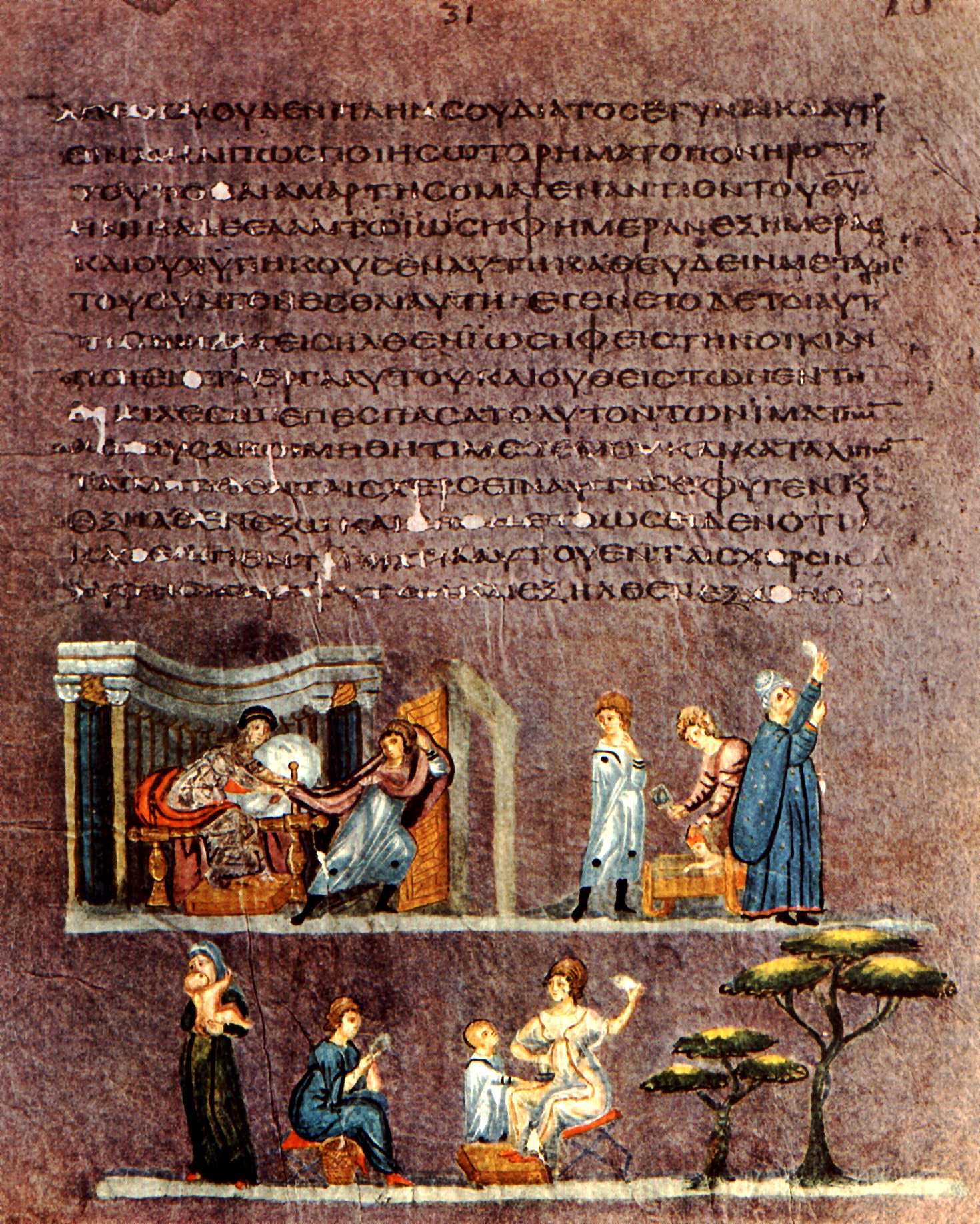
The provision of pictures places the text in a different light for the reader. This may best be illustrated by the example of a manuscript of the Pentateuch. It has a series of miniatures accompanying the story of Joseph. But the miniatures contain material and scenes which are found in Jewish apocryphal writings, and not in the written text of the Genesis. Thus the entire manuscript, text and pictures, is telling a different story from that found in the text alone. (27; the manuscript in question is the Vienna Genesis)

I don't think I agree with Parker's last point. "The entire manuscript" isn't telling "a different story from that found in the text alone." Rather, the manuscript is telling a larger story from that found in the text alone. For its intended audience, this "larger story" was already invoked and evoked by the manuscript. This is the only way, as far as I can see, why an illustrator would think it okay to illustrate a biblical manuscript with scenes from apocryphal texts. That is, the written text was a moment or instance of the larger Joseph tradition. And it doesn't much matter that the written text doesn't narrate other moments or instances of the tradition, some of which are only found in apocryphal writings. Text and tradition belong together, and this "belonging together" happens within the audience, at the moment of reception, rather than within the text. Unfortunately, that means it's much more difficult—and often impossible—for us to see today how text and tradition relate to one another. But every now and then we get a glimpse of the larger traditional connections, and these glimpses remind us not to read our written texts too narrowly, too myopically, or with too great a restriction on what we think a text does not say.

Wednesday, February 02, 2011

the first review

I received an e-mail yesterday from T&T Clark that included a review of Structuring Early Christian Memory: Jesus in Tradition, Performance, and Text. Daniel Frayer-Griggs, of the University of Durham, has reviewed my book for Theological Book Review, and he has had kind things to say. I've included the concluding paragraph of his review below:
This is a profoundly ambitious and highly technical work, calling for nothing short of a paradigm shift in gospels research. Rodriguez's discussion of social memory theory is highly suggestive and should enliven both gospels and historical Jesus research, and, while he is perhaps too sceptical regarding the existence of Q and the continued relevance of source and redaction criticism, his analysis of the relationship between orality and textuality is learned and illuminating.

Thank you, Mr Frayer-Griggs. I hope we meet one day.

Monday, January 31, 2011

a great phrase

"[K]now thyself must also mean know thy history. . . . [T]he kind of history which we are apt to understand best may be our own."

John Lukacs, Historical Consciousness: The Remembered Past (New Brunswick: Transaction), 1994: 31

Tuesday, January 25, 2011

texts in context

A common refrain among scholars and people who want to appear scholarly is, "Context is king" (or some something similar). So when we read, for instance, the story of Mary and Martha entertaining Jesus in Luke 10, it should matter to us that Luke has included this story immediately after his account of the Parable of the Good Samaritan. That is, the Good Samaritan is a vital part of the context of the story of Mary and Martha.

Many examples of how "Context is king," including the one just given, concern the history of ideas. If you want to understand, for example, the various conceptions of "the messiah" in the New Testament documents, then you need to know something of how the idea, messiah, functioned in the world in which the NT was written. So the Dead Sea Scrolls, Josephus, pseudepigraphical texts (esp. 1 Enoch and 4 Baruch), and other texts come into play.

But context isn't simply about ideas. The historical figures who interest us—Paul, Peter, Herod, and even (or especially) Jesus—lived in real time and real space, handled real objects, engaged in real social interactions with other real people, and so on. And the realness, or the materiality, of the world these people lived in can have important consequences for our own efforts to understand ancient texts and reconstruction historical scenarios.

So I especially enjoyed the following paragraph, from Pieter J. J. Botha's essay, "'Publishing' a Gospel: Notes on Historical Constraints to Gospel Criticism" (pp. 335–52 in The Interface of Orality and Writing: Speaking, Seeing, Writing in the Shaping of New Genres [A. Weissenrieder and R. Coote, eds.; WUNT 260; Tübingen: Mohr Siebeck, 2010]):
Readers, audiences and authors are products of particular historical conditions. By studying the formats of books and their typographical disposition(s) we can learn how they were created, how they were read, and undersatnd something about their possible meanings. In writing and reading materials, technology and human activity interact, and these various specifics must be taken into account when written artifacts are to be understood. Historical investigation requires that textual criticism, the historical study of books and cultural history be interrelated to describe "the variations that differentiate the 'readable space' (the texts in their material and discursive forms) and those which govern the circumstances of the 'actualization' (the readings seen as concrete practices and interpretive procedures)." (336, citing R. Chartier, "Laborers and Voyagers: From the Text to the Reader," Diacritics 22 [1992]: 50)

Wednesday, January 19, 2011

a cool thing, I guess

I'm still reading The Interface of Orality and Writing: Speaking, Seeing, Writing in the Shaping of New Genres (A. Weissenrieder and R. Coote, eds.; WUNT 260; Tübingen: Mohr Siebeck, 2010). At the moment I'm working through Annette Weissenrieder's essay, "The Didactic of Images: The Fig Tree in Mark 11:12–14 and 20–21" (260–82). Weissenrieder locates the story of Jesus cursing of the fig tree in Mark 11 in Rome rather than in Palestine—not that Mark places Jesus in Rome but that the fig tree generates meaning within the context of Rome's foundation story (which Weissenrieder documents) rather than with Hebrew biblical themes of Israel, judgment, and fig trees.

At any rate, she writes the following:
What does the motif of the fig tree associated with the suckling twins Romulus and Remus and with the goddess Roma on the coins and on the Ara Pacis, have to do with the withered fig tree in Mark 11? The connection would be provided if Jesus' saying about the fig tree, which produces no fruit and for that reason withers, alluded to Rome's foundation saga, in particular and Augustus's new version of the saga and its intensification by Claudius and Nero. Jesus' word on the cursing of the fig tree thus would point to a historical event. (274)

At the end of this paragraph Weissenrieder places a footnote and references a number of books, including Jesus, the Voice, and the Text (T. Thatcher, ed. [see here]), Memory, Tradition, and Text (A. Kirk and T. Thatcher, eds.), and Performing the Gospel (R. Horsley et al., eds.). But I was surprised to find my own book, Structuring Early Christian Memory: Jesus in Tradition, Performance, and Text included in the footnote. Now, to be honest, I'm not sure how my book supports her point—that "Jesus' word on the cursing of the fig tree thus would point to a historical event"—but I'm glad to find my work cited here.

Annette: If somehow you ever happen to find this post, perhaps you could provide a brief explanation?

Friday, January 14, 2011

is this nonsense?

I'm still reading The Interface of Orality and Writing: Speaking, Seeing, Writing in the Shaping of New Genres (A. Weissenrieder and R. Coote, eds.; WUNT 260; Tübingen: Mohr Siebeck, 2010). Now I'm working through David Rhoads's essay, "Performance Events in Early Christianity: New Testament Writings in an Oral Context" (166–93). Rhoads frames the NT texts as "performance literature," written texts that are incomplete in themselves.
Simply put, the writings we have in the New Testament are examples of "performance literature," that is, literature that was meant for performance—like music or theater or ancient poetry. It is difficult to imagine musicologists studying scores of music without ever hearing a performance. Nor can we imagine theater scholars studying scripts of ancient drama without having seen performances of the plays or without trying to determine how they may have been performed and experienced in ancient times. Yet we biblical scholars have studied the literature of the New Testament for centuries without ever hearing them performed as stories or speeches or epistolary orations, without trying to determine how they may have been performed in the early church, and without constructing ancient performance scenarios as a basis for interpretation. (169)

I agree completely. Rhoads has put his money where his mouth is. He regularly performs large sections of the New Testament (e.g., the Gospel of Mark, or Revelation) from memory; so deep is his conviction that people need to hear the text at least as much as they should read the text. And so I have a real appreciation for Rhoads's work.

But. When Rhoads turns to the question of memory, he makes the following statement: "The first century was a memory culture more than it was a manuscript culture." My question: Is this gibberish? What does Rhoads mean by "the first century," and how is that any kind of culture, memory or otherwise? Are "memory culture" and "manuscript culture" "things," separatable, isolatable, able to be set in contrast with each other like lemons and protractors?

I appreciate the question Rhoads is trying to raise, and I even agree that we need to raise it. That is, How did "memory" (whatever that is) and "manuscripts" function in antiquity in specific cultural locations? That is a very important question (or better, a very important set of questions). But notice that Rhoads's language is way too blunt to get at the question, let alone to propose helpful starts at useful answers. Rhoads's identification of "the first century" as any kind of "culture," as if it were a culture at all, swings a sledgehammer at a question that requires considerable finesse.

My Visual Bookshelf