Showing posts with label Ekkehard Stegemann. Show all posts

Tuesday, March 22, 2011

Ekkhard Stegemann on Romans 13.1–7

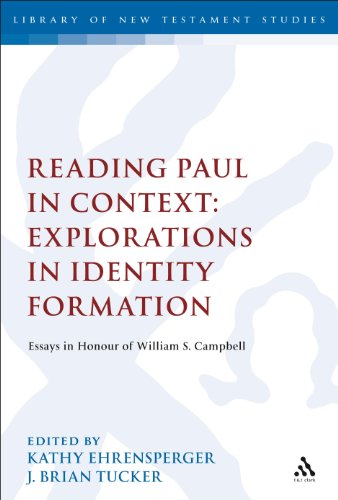
In a post last week I mentioned Ekkhard Stegemann's essay, "Coexistence and Transformation: Reading the Politics of Identity in Romans in an Imperial Context," which opens the volume, Reading Paul in Context: Explorations in Identity Formation. Essays in Honour of William S. Campbell (LNTS 428; London: T&T Clark International, 2010). I cannot recommend highly enough this essay, which, in my view, treads the narrow path between ignoring the political, Roman imperial context that defined every moment of early Christianity in its opening centuries, on the one hand, and focusing on that context so thoroughly that early Christianity becomes, in effect, an anti-Roman response to imperial dynamics, on the other. In some discussions the reader could be forgiven for thinking that Caesar, not Christ, provided the driving impetus for the theologizing processes we see at work in the NT texts; Jesus becomes, almost, merely the vehicle for opposing Rome.

Not so with Stegemann's analysis. I have already said enough to introduce Stegemann's primary thesis (see the post I mentioned above). In his own words, he builds upon William Campbell's work "to show that for Paul the insistence on obedience to the (Roman) rulers and the obedience of faith in Jesus Christ as Son of God in power and Lord, which implies the expectation of the coming of God's kingdom, coexist as well—and that without contradiction" (22). But my introduction does not do justice to Stegemann's masterful portrayal of this coexistence, for example, in the essay's closing paragraph:
Virgil's prophecy for Augustus, which he put in the mouth of Anchises, the father of Aeneas, promised Augustus Caesar, the descendant of the divine (divi genus), that he will extend his empire beyond the stars, and bring a golden age to the Latin land. He will eventually ascend with all th Julian offspring to the exalted firmament (omnis Iuli progenies magnum caeli ventura sub axem; Aen. 6.790–92). For Paul it is Jesus Christ and his followers who will ascend to their Father, God, and his kingdom in heaven, Jesus Christ as the firstborn of the resurrection of the dead and his brothers and sisters after him. But up to now they still coexist with this aeon and its frailties. (23)

I'm not so certain Paul trades on the idea of "ascent" as much as Christian reading of Paul has supposed it has (largely on the basis, I think, of 1 Thess. 4.13–18). And Stegemann, as you can see, includes that idea here. Even so, this is an excellent essay, nearly poetic. And it points the way, I think, for responsible explorations of and appreciations for the political dynamics underlying every word the early Christians said and wrote.

Wednesday, March 16, 2011

a point finely (and finally) made

I've begun reading Kathy Ehrensperger and J. Brian Tucker's edited volume, Reading Paul in Context: Explorations in Identity Formation (LNTS 428; London: T&T Clark International, 2010), which presents a collection of essays in honour of William S. Campbell. The first essay is Ekkehard Stegemann's, "Coexistence and Transformation: Reading the Politics of Identity in Romans in an Imperial Context" (3–23), in which Stegemann nuances the politically sensitive readings of Romans that have been cropping up recently.

But this is the point that is (or should be) both patently obvious and thoroughly heeded. Stegemann notes:
Reading Romans in a Roman imperial context does not exclude the recognition that Paul's words and message belong at the same time and to an even greater extent to a Jewish cultural concept, more precisely to an 'apocalyptic' or 'theocentric' or 'messianic' Jewish language. Admittedly C. Bryan stresses this very difference in his critique of the counter-imperial reading of Paul, 'Christians were using some of the same words about Jesus as pagans used about Caesar, but they were hardly using them in the same context, or meaning anything like the same thing by them.' But Jewish culture and especially its 'apocalyptic' or 'messianic' version in some sense represents imperial rhetoric too. (6, citing C. Bryan, Render to Caesar: Jesus, the Early Church, and the Roman Superpower [Oxford: Oxford University Press, 2005], 91)

I'm not sure how "precise" the language of apocalyptic, theocentric, or messianic Judaism really is. But Stegemann rightly resists reading Paul in either Jewish or pagan contexts and understands him as operating as a Jew in a pagan context. To say things a bit differently, I don't think Paul used words like euangelion ("gospel"), kyrios ("lord"), pistis ("faith[fulness]"), etc. simply because these were the catchwords of Roman imperial rhetoric; these are terms that are clearly operative in his biblical/Jewish context. But neither was he unaware of the imperial employment of these terms. And I don't understand why we should think we need to choose between Jewish and Roman readings of Paul. At least since Martin Hengel's landmark study, Judaism and Hellenism (1974), we have known that these aren't two discrete cultural universes. Stegemann's study helps us see more clearly Paul, the Jewish philosopher/evangelist, as he was formed by and engaged with the Roman imperial context in which he lived his entire life and ultimately met his end.

My Visual Bookshelf