Showing posts with label Gospel of Mark. Show all posts

Wednesday, December 05, 2012

is Mark a pre-war document?

In yesterday's mail I received an examination copy of David A. deSilva's new book, The Jewish Teachers of Jesus, James, and Jude (Oxford University Press, 2012), which I am considering adopting for my graduate course, World of the New Testament. I started looking through the book, and so far I'm enjoying it. Much to disagree with, of course, but much more to learn from. This is what we enjoy about NT scholarship, right?

At any rate, in the light of yesterday's post about Mark Goodacre's suspicion of an potentially emerging consensus that Mark is a post-war document, I thought it interesting to read the following from deSilva, who affirms (along with nearly every other NT scholar) that Luke-Acts was written after the Roman-Jewish War:
. . . Occasionally the "apocalyptic discourse" has been used to argue that the Gospels of Mark and Matthew also postdate these events, but there is nothing in either account that could not have been uttered by a Jewish prophet in the first half of the first century—quite aside from the question of whether or not such prophetic utterance is "really" predictive. (2012:263, ftn. 5)

Goodacre, in the course of his discussion, will refer to three very recent monographs focused on the question of the date of Mark's Gospel (and an article by John Kloppenborg). deSilva, on the other hand,  is simply making a point about Luke's Gospel and contrasting that point, briefly and in a footnote, against the Gospels of Mark and Matthew. My point here is certainly not that deSilva has the better or more convincing argument. Rather, I just want to point out how easily one can encounter—even accidentally!!—exceptions to the potentially emerging consensus to which Goodacre made reference. Without question detailed and sophisticated arguments for a post-war date are current within the scholarly discussion, and clearly Goodacre has found them persuasive. But if anything, I suspect the consensus—if there be one—pushes Mark back into the immediately pre-war years. deSilva even pushes Matthew back before the destruction of Jerusalem and her Temple!

Tuesday, December 04, 2012

is Mark a post-war document?

I'm reading Mark Goodacre's Thomas and the Gospels: The Case for Thomas's Familiarity with the Synoptics (Eerdmans, 2012). I'll comment on the book as a whole later, though let me say I cannot praise Goodacre enough for his meticulous attention to detail and his clear (and clear-headed) writing.

In his discussion of the date of the Gospel of Thomas, he makes the (obvious) point that, if Thomas knew and depended upon the synoptic Gospels, then Thomas must have been written after them. A first step in dating Thomas, then, is to attempt to date the synoptics. So far so good.

But then we find the following paragraph, which I will reproduce in its entirety. Note that there are no footnotes in this paragraph, which is part of why I'm raising a question mark against it. But first, Goodacre:
Second, the case for a post-70 dating for Mark is strong, and gaining in momentum in recent scholarship. Although it might be overstating the case to speak about a post-70 Mark as an emerging consensus, several recent works place the onus on those wishing to argue the opposite. The importance of this is obvious. Since Mark is the first in the sequence of literary works, dating Mark is a very helpful way of moving forward. If Mark post-dates 70, so do Matthew, Luke, and Thomas. (Goodacre 2012:161)

I was surprised by the strength of Goodacre's statement. I can't say that the date of the synoptics is my area of expertise, but I'm familiar enough with the field that I think Goodacre has, indeed, overstated the case even that the onus is on those who argue a pre-70 date for Mark. Here I'd make two points.
  • First, there are some fringe arguments that date Mark considerably earlier than 70 CE. For example, James Crossley argued in his doctoral dissertation that Mark is nearer the Caligula crisis (41 CE). As far as I know, James has not found an impressive following (though his doctoral supervisor, Maurice Casey, accepts his argument in the latter's Jesus of Nazareth). R. T. France, a Matthean scholar, also dates Mark early, though for completely different reasons. As I have already conceded, these are fringe arguments. Because they are fringe, however, they are more easily disregarded than disproven. At the very least, these arguments force us to temper our confidence in the consensus.
  • Second, my own impression is that the developing consensus fixes the date of Mark's Gospel in the vicinity of the war with Rome, either in the buildup to hostilities or in the war's immediate aftermath (viz. 65–75 CE). Especially significant here are the details of Mark 13, details which (i) echo biblical themes pertaining to the destruction of the First Temple and (ii) do not correlate precisely to Titus' destruction of the Second Temple.
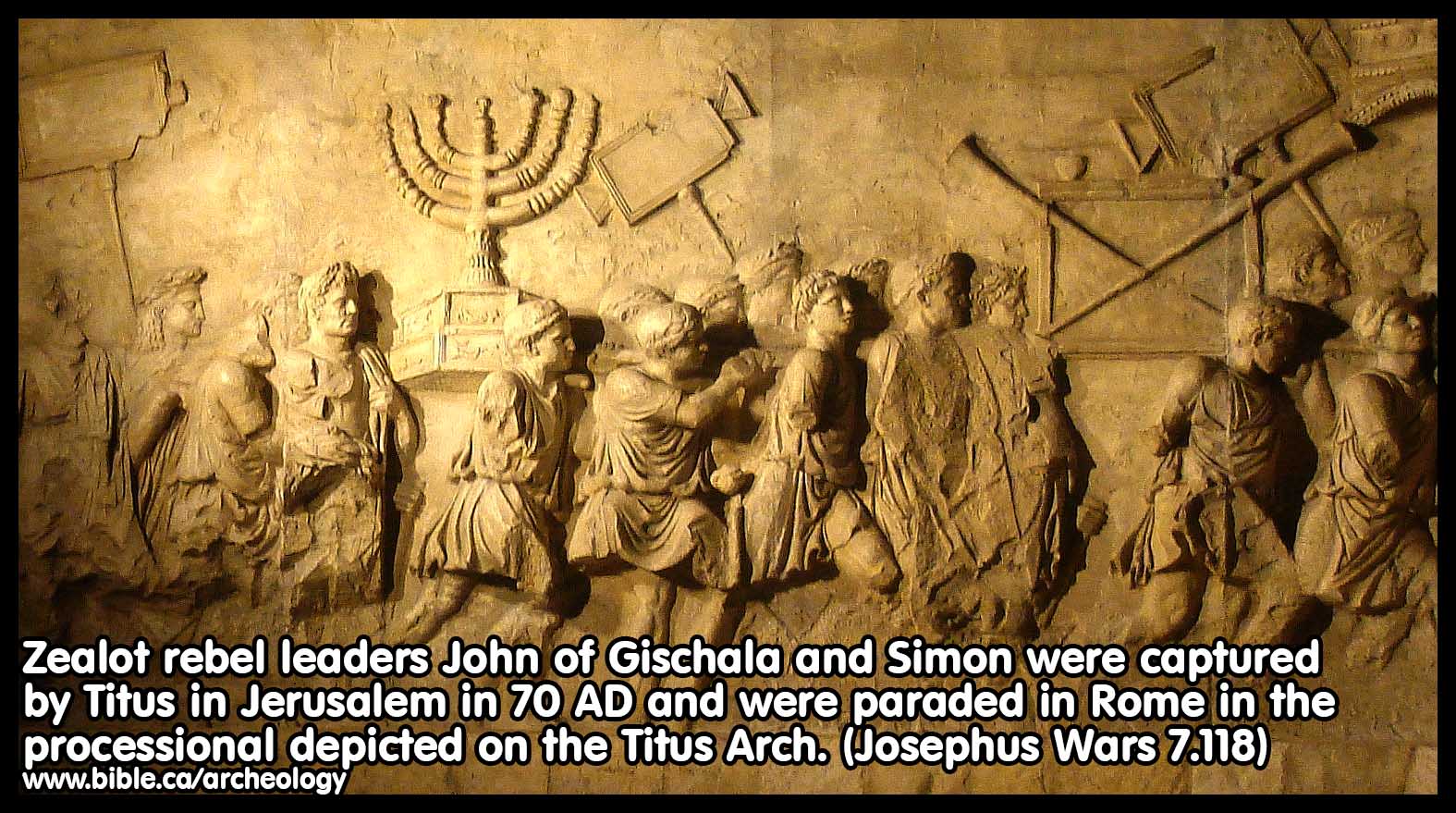
Scene from Titus' Arch depicting the triumphal procession and the spoils from the Jerusalem Temple.
Perhaps I'm wrong here, and Goodacre is right. In fact, my first instinct is to trust Goodacre. But I was under the impression that the case was just as strong that Mark dates to immediately before the war as it was that Mark was written after the war. You Markan specialists out there, let me ask: What are your impressions regarding any potential "emerging consensus" among Markan (and historical Jesus?) scholars? Is there broad agreement that Mark is a post-war document?

UPDATE: Goodacre does consider specific arguments for dating Mark (including Crossley's; see Goodacre 2012:162–64). In rereading this post after it was published, I realized I might give the impression that Goodacre simply ignores Markan scholarship. That impression would be false.

Saturday, February 11, 2012

a first-century CE Markan manuscript?

Dan Wallace (Dallas Theological Seminary) has announced the discovery of a number of papyrus manuscripts of the New Testament. He says,
[S]even New Testament papyri had recently been discovered—six of them probably from the second century and one of them probably from the first. These fragments will be published in about a year.

The first-century manuscript is of the Gospel of Mark, he claims. The difficulty, of course, with identifying Mark in fragmentary texts is that so much of Mark appears in Matthew and Luke, too. So if Wallace is this confident that we have a copy of Mark (whatever the ms's date), it must be a text that only Mark has (e.g., Mark 4.26–29, 8.22–26, etc.), or it has some detail that Matthew and Luke lack (e.g., the mention of the cushion in Mark 4.38, or the "splitting" of the heavens in 1.10, etc.), or it lacks some detail that both Matthew and Luke have (e.g., the fuller narration of Jesus' temptation in the wilderness, or John the Baptist's teaching, etc.). As Wallace explains, our earliest manuscript of Mark comes from the third century CE (P45, c. 200–250 CE), so a new and early manuscript of Mark would indeed be exciting, even if it isn't as early as the first century.

But for now, we should emphasize, no physical evidence has been made public, and so we don't have any idea of what we have. In the quote I provided above, Wallace promises publication "in about a year." Unfortunately, that's hardly sufficient to give us any confidence. So, for now, we're better off to imagine ourselves sitting in a café waiting for a blind date to arrive. We've been told nice things, and we hope she's both attractive and engaging. But we sit near the rear entrance in case attractive-and-engaging's step-sister shows up instead. After all, we've been burned before.

See also comments on NT Blog, Exploring our Matrix, Evangelical Textual Criticism, Paleojudaica, and many, many others.

Wednesday, March 16, 2011

on Mark's ending

David Parker addresses "The endings of Mark's Gospel" in the eighth chapter (124–47) of his short but important treatise, The Living Text of the Gospels (Cambridge: Cambridge University Press, 1997). In this chapter, Parker does more than present and analyze the manuscript evidence for the various endings of Mark; he also assesses the effect of these various endings upon the whole story of Mark.

I certainly don't want to deny that the decision of how (or when) to end one's reading of Mark matters. I think the earliest recoverable ending of Mark is 16.8, and it matters for how we read 1.1–16.8 that the final words of the gospel—ἐφοβοῦντο γάρ ["for they were afraid"]—leave the account of Jesus' life after the crucifixion unnarrated (but not unstated!).

Nevertheless, I think Parker over-reaches in his discussion of the endings' importances. Parker writes,
Both the Intermediate and the Long Ending, with their emphasis on proclamation, provide the Gospel with its own validation. By writing, Mark is obedient to this command, for he enshrines the command within his book. The Short Ending provides no such security for the book. Indeed, quite the reverse, for the women's silence means that, within the story, we have no means of knowing that any of it happened. (146; original emphasis)

Ending with the women's silence and fear is certainly strange. But isn't Parker's limitation—"within the story"—rather artificial? Doesn't the very fact of Mark's gospel (by which I mean Mark 1.1–16.8) indicate that the silence is broken, that the women have found their voice despite their fear, and that their testimony has been taken over and become Mark's? If, "within the story," the women never pass on the angelic announcement, then there is no "within the story" to speak of.

But instead, by ending the story at 16.8, with the women fearful and silent, the Markan narrator leaves open a space for the audience to consider their response to the narrative. Will they speak through their fear, as the women surely must have, or will the gospel's proclamation come to an end after its reading? Mark 16.8 encourages—even requires!—not only the women but also us to begin to tell Jesus' story anew. This, in fact, is the transgression of the so-called Longer Endings: Mark 16.8 doesn't call for 16.9 but rather for a return to 1.1, ἀρχὴ τοῦ εὐαγγελίου Ἰησοῦ Χριστοῦ ["The beginning of the gospel of Jesus Christ"]. After 16.8 the audience becomes the narrator, the silence is overcome by the beginning of the gospel, and we the audience-become-narrator become the messenger of God who prepares the way for Jesus (1.2–3).

Tuesday, March 01, 2011

thinking poorly about Mark's audience

As part of my senior-level undergraduate course on Mark's gospel I've assigned James Edwards's commentary in Eerdman's Pillar New Testament Commentary series (The Gospel according to Mark [Grand Rapids: Eerdmans, 2002]). Edwards argues that Mark was written for gentile Christians in or near Rome. While I don't have a problem with this position (though neither do I subscribe to it), I do have a problem with Edwards's favorite argument in its favor.

Whenever Mark translates an Aramaic phrase or a Jewish custom (e.g., Mark 5.41–42; 7.2–5), Edwards makes a comment regarding Mark's gentile Roman audience. And whenever he does so, I make a point to explain to my students how unnecessary such comments are. But now Edwards has crossed the line from claiming more than the data demands (a common and, in my view, acceptable practice) to making claims that simply aren't true. Let me explain.

In his comments on Mark 7.34 ["Jesus looked up into heaven and sighed, and he said to him, 'Ephphatha' (which means, 'Be opened')."], Edwards drops a footnote in which he claims, "The need to translate an Aramaic saying into Greek again indicates that Mark is writing for non-Jews" (2002:225, n. 28). But this simply isn't true! At the very least, such a view assumes that every Jew in Mark's world understood Aramaic.

Instead, we need to recognize at least two basic facts, both of which require explanation. First, Mark includes Jesus command in an Aramaic form. Second, Mark translates the Aramaic command into Greek. Edwards focuses on this second datum and infers, therefore, that Mark must be writing for non-Jews. But, as I've already said, this goes too far. The most we can say with confidence is that Mark is writing for people who know Greek but do not know Aramaic.

The really interesting question, I think, is: Why did Mark include the command in Aramaic in the first place? Answers will be speculative, of course. But I can think of two: First, there was a power associated with Jesus' actual spoken words, and so Mark included those words even though he wrote for a Greek-speaking audience. We have remains of hundreds of magical papyri, mostly from Egypt, that attest the perceived power of foreign words (somewhat like the pseudo-Latin of Harry Potter). But second—and here's where Edwards goes astray—the presence of both the Aramaic command and its Greek translation may suggest that Mark is writing for a multi-ethnic (and multi-lingual?) audience. If so, then Mark may preserve the Aramaic/Judaic form of much of his tradition because many among his audience were well positioned to appreciate its preservation, but he explains the Aramaisms/Judaisms because others (many?) among his audience would not have understood them.

At any rate, if you're convinced, along with Edwards, that Mark writes for gentile Christians in/near Rome, then you need to provide some explanation why Mark includes words like, Ephphatha, or Talitha koum, or Elōi, Elōi lema sabachthani. Certainly the gospel story is intelligible without them, so why does Mark bother to include them at all?

Wednesday, January 12, 2011

on imagining new worlds

I'm currently reading Richard Horsley's essay, "The Gospel of Mark in the Interface of Orality and Writing," in The Interface of Orality and Writing: Speaking, Seeing, Writing in the Shaping of New Genres (A. Weissenrieder and R. Coote, eds.; WUNT 260; Tübingen: Mohr Siebeck, 2010). If you're familiar with Horsley's other works then you'll already know what to expect from this essay: a critique of certain culturally inappropriate models sustaining biblical scholarship and a striking reliance on certain key binary oppositions (Judean vs. Galilean, élite vs. ordinary people, etc.).

Despite the need to improve on and further Horsley's work, he nevertheless does provide a helpful opportunity to think more largely about biblical studies and the concrete social functioning of the texts we analyze. This has always been one of the key strengths of Horsley's scholarship. So I thought I'd reproduce this helpful quote on the need for us to get past ourselves and appreciate Mark's gospel as, perhaps, a single performance of the Jesus tradition rather than a collection of previously independent short stories (novella, according to Dibelius).
What remains difficult even for those who recognize Mark as a sustained story, I think, and perhaps also for those of us who also recognize the interface of orality and writing, is to imagine the formation, the composition, of the whole (Gospel) story. Perhaps because we are so habituated to composition in/as writing we have particular difficulty imagining how a text of the length and complexity of Mark could have been composed other than in writing—even though many epics that are orally performed (and composed) are much longer and more complex in plotting than Mark and the other Gospels. (157)

Of course, worlds of difference separate Mark and the other gospels from the epics I think Horsley has in mind (Homer, Moslem Yugoslavian epics, etc.). But that's not the point Horsley's making. He's reminding us that Mark's story—impressive and complicated as it is—isn't really so impressive and complicated that it had to be composed by an author in possession of himself, deliberate and laboriously working at a table or desk, free of the distractions of the wide world around him.

Instead, Mark certainly could have been (I think probably would have been) the kind of story Jesus' followers told as they gathered together to learn, to worship, to fellowship, and to pray. Certainly at some point someone (let's call him Mark) wrote the story down—though strangely Horsley would disagree. But that doesn't mean that Mark's written gospel was the first time the story ("the whole [Gospel] story") was apprehended in a single social engagement by women and men devoted to Jesus. In fact, given that the first mention of Mark's gospel doesn't occur until early in the second century CE (Papias), I suspect no one thought what Mark had done to Jesus' story was particularly groundbreaking or innovative (pace Kelber). Mark's gospel provided another in a very large number of possible performances of the Jesus story, and before long Matthew and Luke (and even John) would show that Mark's story, indeed, wasn't even that long!

Tuesday, March 16, 2010

how the ancients used language

I need some help. I'm reading Ruth A. Clements and Daniel R. Schwartz's edited volume, Text, Thought, and Practice in Qumran and Early Christianity (Studies on the Texts of the Desert of Judah 84; Leiden and Boston: Brill, 2009), which has been a fascinating collection of essays to this point (I'm about two-thirds of the way through). I'm currently reading Menahem Kister's essay, "Divorce, Reproof, and Other Sayings in the Synoptic Gospels: Jesus Traditions in the Context of 'Qumranic' and Other Texts" (195–229). I'm extremely sympathetic to Kister's reading program, which situations NT traditions (here the sayings of Jesus) within overtly Jewish frames of reference.

But I am once again flummoxed at the implicit model of language and communication that enables conceptions such as the following:
Moreover, the expected Greek rendering of יסוד הבריאה is ἡ ἀρχὴ τῆς κτίσεως, an expression in which the word ἀρχὴ would mean "principle." It seems that this expression was changed in Mark to ἀπ᾽ ἀρχῆς κτίσεως, "from the beginning of creation" (10:6), and in Matthew further revised to ἀπ᾽ ἀρχῆς (19:4, 8). If this expression indeed underlies both CD and the sayings tradition, there must be a close genetic link between them. If this is the case, we have here a striking case in which the originality of the wording in one Gospel may be established over against that of another through comparison with the Qumranic parallel. (Kister 2009: 202; my emphasis)

Anyone familiar with redaction-critical analyses of the synoptics will recognize immediately the familiar notion of language revised in later gospels from earlier ones. So Matthew's "from the beginning" is a modification of Mark's "from the beginning of creation" rather than an autonomous instance of language that relates to the sociolinguistic phenomena of Hellenistic Greek in general. Kister takes that thinking to a new level, if I understand him rightly, by applying redaction-critical analytical tools to texts that don't exhibit a literary relationship. In other words, the comparison of Mark and Matthew at least rests on the theory that Matthew knew and copied from Mark; but what theory legitimates Kister's claim that Mark changes language from another (Hebrew) text?

The larger problem, however, stems from our theory of language and communication, if it can be said that we have one at all. As historians of antiquity, we can only work with and analyze the remains of language that was inscribed some place, whether on papyrus or parchment, on a monumental stele or statue, or even the plethora of graffiti that survives from the ancient world. It seems to me, however, that redaction criticism in general, and especially analyses such as Kister's, implicitly assume that written language was all there was. This sounds ridiculous, of course; who could imagine a silent world where people communicated solely in writing?! But this is precisely the conception of language that appears to underlie anlyses of language from text to text. Otherwise, how can Kister (or anyone else) suppose that Mark has changed "the principle of creation" to "the beginning of creation"? Why is either phrase the cause or the effect of the other?

Werner Kelber has for over two decades been arguing against just these very analytical assumptions when he refers to the "equiprimordial"-ness of variant sayings. Kelber's neologism is, perhaps, unfortunate for two reasons. First, it's just plain weird, though it seems Kelber delights in weird language (or in weirdly using language). But second—and more substantively—the concept of equiprimordiality is an exaggeration of an otherwise very insightful point. That is, Kelber argues that tradition, in oral performance, enjoys a certain autonomy vis-à-vis previous and subsequent performances of the tradition. That is, if in one performance Jesus is reported to say, "Blessed are the poor . . . Blessed are the hungry," and in another performance he is made to say, "Blessed are those who mourn . . . Blessed are the meek," the two instances are both equally ("equi-") original instances of the tradition ("-primordial"). One is not "more original" than the other. This variability in the tradition goes back as far as Jesus himself, who on different occasions may have given various renditions of the Beatitudes (cp. Matthew and Luke), and who may have sometimes correlated his Beatitudes with parallel woes (Luke) or not (Matthew).

Kelber perhaps goes too far when he insists that traditions in oral performance are equally "original" or "primordial." Tradition could certainly develop as well as devolve; it could be applied to new contexts, integrated with other traditions, or cast in new frames of reference. These would not be equi-primordial. But we should recognize the fairly obvious point that the traditions we analyze transcended and existed well beyond the texts we work with. As a result, any analysis of one text solely—or even primarily—in terms of another text runs the risk of neglecting the ways that nontextual factors contextualized both the production and the reception of our texts. In other words, in a world where people could (and presumably did) say ἡ ἀρχὴ τῆς κτίσεως as well as ἀπ᾽ ἀρχῆς κτίσεως, and many other things besides, no one was likely to perceive one phrase in terms of (or as a change from) the other.
Saturday, March 06, 2010

SECSOR: Day Two (pt I)

The theme of this morning's New Testament session was "The Gospels," and as it turns out the four papers, between them, touched on all four canonical gospels.
  • The first paper, "John's Use and Disuse of Matthew" (James W. Barker, Vanderbilt University), argued that in at least three specific instances the Fourth Evangelist knew and responded to Matthean redaction: John's reference to forgiving/retaining sins (20.32; see Matthew's binding/loosing tradition); John's account of Jesus riding into Jerusalem on a donkey and his citation of Zech 9.9 (see Matthew's account; cf. the Markan and Lukan parallels); and Jesus' "evangelization" of Samaria in John 4 (cf. Matthew's refusal to allow Jesus entry into Samaria). I'm predisposed against Barker's thesis because of my suspicions vis-à-vis redaction criticism (and so the probative value of asking whether John knew "Matthean redaction"). But Barker does address a very interesting issue standing between synoptics and Johannine scholarship; i.e., How John came to be read alongside and included with the other three gospels. In Barker's reading, such was the intention of the Johannine author (specifically with regard to Matthew's gospel).

  • The second paper, "Jonah, Jews, Jesus, and Gentiles: Matthew's Appropriation of the Sign of Jonah Saying in Light of the Gentile Mission" (David Moffitt, Duke University), approached Matthew's use of the Sign of Jonah via an intertextual reading of the larger Jonah tradition. I'm often wary of intertextual analyses on the basis of John Miles Foley's criticism that, despite the broadened field of vision, intertextuality still privileges discrete, bounded entities ("texts") at the expense of larger traditional dynamics. Moffitt, I think, avoids this problem. His analysis explored the polyvalent connections that the Sign of Jonah enabled early Christian tradents (here, Matthew) to make without insisting that he make all of them or even that he make specific and predetermined uses of them. In other words, Moffitt took into consideration the Jonah tradition as he read the Jonah text. (If memory serves, I also enjoyed Moffitt's paper at last year's SECSOR, which focused [I think] on Hebrews).

  • The third paper, "Mark, the Jerusalem Temple and Jewish Sectarianism" (Tim Wardle, Wake Forest University), analyzed Mark's references to the Temple in Mark 11–15. His analysis raised some interesting questions and rightly, I think, emphasized the Jewish critique of idolatry in the Septuagint's use of ἀ/χειροποίητος ("[not] made with hands"). I think Wardle makes too much of the use of ἱερόν ("temple") and the fact that Mark only refers to the Jerusalem ἱερόν in chapters 11–16. This allows him to (i) ignore the clear reference to the Jerusalem Temple in Mark 1.44 ("Go, show yourself to the priest [τῷ ἱερεῖ] and offer [προσένεγκε] for your cleansing the things Moses commanded, as a testimony to/for/against them"). Despite the difficulties that still attend the precise interpretation of this verse (including the dative αὐτοῖς ["to/for/against them"]), Mark 1.44 is clearly not a critique of the Temple like Wardle legitimately finds in Mark 11–16. (ii) Second, his focus on ἱερόν allows him to read some passages in Mark 11–16 as connoting negatively for the Temple, such as the widow's offering in Mark 12, or even Jesus' lament that the Temple should have been (but wasn't) a "house of prayer for all nations" in Mark 11. As you can see, Wardle's paper raised some interesting questions for me.

  • The fourth paper, "Locating Luke 6:5d: Toward a Social Context for the Sabbath Worker" (Jason Robert Combs, UNC Chapel Hill) sought a social location for the reading at Luke 6.5 in Codex Bezae. In the majority of manuscripts (and likely in Luke's "original"), Jesus in Luke 6.5 "says to them, 'The Son of Man is Lord also over the Sabbath'" [κύριός ἐστιν τοῦ σαββάτου ὁ υἱὸς τοῦ ἀνθρώπου]. In Bezae, however, this reading is postponed until after the healing of the man with the withered hand (Luke 6.6–11), and 6.5d has encounter a man working on the Sabbath: "On the same day, when [Jesus] saw a certain main working [ἐργαζόμενον] on the Sabbath, he said to him, 'Man, if you know what you are doing, you are blessed; but if you do not know, then you are cursed and a transgressor of Torah'" [τοῦ νόμου]. Combs locates this variant as part of the mid- to late-fourth century debates about Sabbath, knowledge, and work. I was reminded of the last chapter of Chris Keith's similar investigation into the socio-historical context that might explain the interpolation of the Pericope Adulterae at John 7.53–8.11 (Keith's book, BTW, has received the John Templeton Award for Theological Promise).

That was it for the morning session. More later, of course, as time permits.

Friday, March 05, 2010

SECSOR: Day One

The 2010 meeting of the Southeastern Commission for the Study of Religion (SECSOR) began tonight. Attendance appears to be down quite a bit from last year, if memory serves. This time last year wasn't exactly plush, economically speaking, so I'm not sure the economy is the main factor at play here. But maybe it is. Or maybe tomorrow will be different. I dunno.

Anyway, I attended tonight's "New Testament I" session, which featured three rather interesting papers (the fourth, "Gossiping Jesus Into Being: The Oral Processing of a Social Personage in the Gospels" [John Daniels, Flagler College] was, unfortunately cancelled).
  • The first paper, "Eschatology and Soteriology in 1 Peter" (Alexander Stewart, Southeastern Baptist Theological Seminary), examined the "now" and "not yet" aspects of the language of salvation in 1 Peter. The paper doesn't exactly break new ground; Stewart acknowledged that he was taking aim at a more popular-level conception of salvation in "the American church." And his focus, as is often the case in discussions of "now" and "not yet," was on the relation between the present and the future. As I mentioned to him in a conversation after the session, however, the question that interests me is the relation (and the distinction!) between the present and the past! That is, if the "new age" is supposed to be different from the "present age"—with its suffering, injustice, etc.—and if early Christians believed that Jesus' death and resurrection inaugurated the new age, what's changed? I still don't think Stewart has addressed the question, though he emphasized conversion (and, I think, the inclusion of gentiles among God's chosen people) as the difference. Something still seems missing to me, but I enjoyed the way Stewart's paper framed the question for me (albeit indirectly).

  • The second paper, "Neglected Considerations in Understanding the Structure of the Book of Revelation" (Kevin Larsen, Mid-Atlantic Christian University), raised questions about Revelation's structure (sequential or cyclical) and, relatedly, its genre. Larsen—whose training is in the gospels and who acknowledged at the start his novice status among the apocalypses—reads Revelation salvation-historically, with Jesus and his climactic role in the story of salvation not figuring into Revelation's narrative until chapter 12. There were a number of interesting observations, I thought, but then again I, too, know very little about John's apocalypse. What I appreciated most, however, was Larsen's insistence that Revelation, as a text, spoke to and was written for real first-century CE people. This is a truism among NT scholars, but with Revelation in particular the temptation to read the text as written for (and about!) later Christians too easily leads interpretation astray.

  • The third paper, "One Saturday in Capernaum: Mark's Gentile Appropriation of the Sabbath" (Ricky Shinall, Vanderbilt University), discussed gentile [mis]understandings of Jewish Sabbath observances and then read Mark's portrayal of Jesus healing and teaching in the Capernaum synagogue on the Sabbath. In Shinall's reading, Mark has little knowledge of or use for Jewish Sabbath observance, except that Sabbath does present a useful occasion for teaching and healing. So, unlike the superstitious Jews (in Mark's perspective, not Shinall's), Jesus is uninhibited in his Sabbath observance and, just as importantly, isn't lazy. Shinall closed by suggesting Mark's misunderstanding of Jewish Sabbath observance supports a Roman rather than Palestinian provenance for the gospel. Unfortunately, there were too many other ways to read the evidence (e.g., whereas gentiles mistakenly thought Jews fasted on the Sabbath, Mark has Simon's mother-in-law serve Jesus and his companions after Jesus healed her fever [Mark 1.31]), though presumably, outside the confines of a 25-minute paper, Shinall addresses this (I would prefer to locate the Sabbath controversies within an inter-Jewish framework; Shinall cited E. P. Sanders and J. P. Meier to explain his preference for a gentile framework).

I missed the presidential addresses, which was too bad given that Jodi Magness presented what I presume was an interesting paper: "Truth and Fiction: The Talpiyot Tomb in Context." The reception afterward (which I did not miss, of course) was perhaps the best-supplied SBL reception I've ever seen. I had the pineapple and some grapes, but there was sushi, various dips, and many other selections. I was thoroughly impressed.

That's it for Day One. I'm looking forward to tomorrow; I'll let you know how it goes. If you'd like to see the program, it's available online on SECSOR's website.

Thursday, February 11, 2010

Jesus and the Twelve

In my freshman-level Gospel Narratives course I have a lesson on "Jesus' Disciples" that tries to explore the significance and function of the Twelve within the context of Israelite tradition. I begin that lesson by rejecting the popular idea that interprets Jesus' choice of twelve disciples in terms of small group leadership theory and practice. I begin that lesson the with the following:
Like Jesus’ healings and exorcisms (see Lesson 9), Jesus’ calling and equipping of twelve disciples to participate in the gospel program is largely misunderstood. Contemporary preaching, heavily influenced by the last couple decades’ emphasis on leadership, portrays Jesus as a leader of a small group of men facing an impossible challenge: to change the world. As a brief experiment, I googled the words Jesus leadership disciples, which returned over 200,000 hits. The very first search result [!] returned an essay by Barry McWilliams, “Jesus’ Leadership Principles and Method of Training His Disciples.” McWilliams frames Jesus’ choice of twelve disciples in terms of small-group leadership. “Jesus could have made a play for the masses and sought to usher in the kingdom by popular acclaim.” But large numbers of followers, apparently, would not have served Jesus’ purposes. “The Lord knew that quality of discipleship and not quantity of disciples was more important” (my emphases). McWilliams emphasizes the point a little further on: “[Jesus] did not try to reach all the masses with the Gospel. Even if He had wanted to, the task would be too big. Rather He concentrated on a few selected ordinary men, who were ‘with Him’ and to whom he gave both verbal instruction and a constant example—preparing through their time with Him to do the same. A similar method of discipleship was practiced by the early churches in Acts.”

I don’t want to single McWilliams out as a “bad” Bible teacher. Quite the contrary. Precisely because of his (apparent) lack of formal biblical education McWilliams provides an excellent glimpse into how Jesus’ relationship with and purpose for the Twelve is understood in popular Christianity. I also don’t disagree with McWilliams’s larger point, that leaders are more effective when discipling a manageable number of close relationships rather than broadcasting themselves to massive crowds. Rather, I am concerned that views such as McWilliams’s miss what’s actually going on with Jesus’ selection of twelve disciples and the references to them as “the Twelve.” For this reason, I want in this lesson to put Jesus’ calling of his disciples, and his commissioning of them to continue his mission, back into historical and biblical perspective.

It's one thing to take aim at popular-level Christian thinking and aim at greater precision. But this morning, as I was preparing for my senior-level Gospel of Mark class, I was going over David Rhoads's book, Reading Mark, Engaging the Gospel (Minneapolis: Fortress Press, 2004), which my students have reviewed. In his fifth chapter, "Network for Mission: The Social System of the Jesus Movement in Mark," Rhoads analyzes Jesus' program and relation with his disciples and larger circle of followers in terms of sociological analyses of networks. I'm struck that there's an awful lot to disagree with if I read Rhoads in terms of Jesus' intentional decision to employ networking principles and practices (a reading Rhoads's writing readily encourages). But Rhoads's essay is more helpful if we read it as an analysis in terms of networking principles and practices without ascribing any these to Jesus' intentions (which, I think, is how Rhoads intends us to read his analysis).

Even so, I think there are some larger connections and similarities between McWilliams' popular analysis and Rhoads's technical one. Given my own affinity for sociological perspectives and the questions they open up for biblical scholarship, I'm especially concerned that such perspectives don't facilitate our reading the texts in contemporary rather than ancient contexts. Of course, all readings of the text are contemporary readings. But I can't help but think that there's a real difference between analyses that help us register and begin to account for the differences between our worlds and the worlds in which the NT texts were written, performed, and read, on the one hand, and those that help us smooth over those differences and appropriate the texts more easily, on the other. I suspect that "Network for Mission" may be more of the latter than the former.

Tuesday, February 02, 2010

bound in the first century CE

In my essay, "Reading and Hearing in Ancient Contexts" (JSNT 32/2 [2009]: 151–78), I criticize one NT scholar for portraying the author of Hebrews as a writer who exists outside the constraints of his time and culture and who labors to present his point in such a way that his audience—who are so constrained—can understand what he's trying to teach them.
Davis portrays the author of Hebrews as a cultural monstrosity who wishes to communicate complex (literate?) ideas but finds himself constrained by the inability of his audience to follow ‘analytic’, ‘objectively distanced’ or ‘abstract’ discourse. Davis’s author, among other things, seems to grasp the truth he conveys in ways unconstrained by cultural or historical forces, and the task before him as he writes is to express that truth in terms that are accessible within the cultural limitations affecting his hapless readers. Though Davis rightly insists that processes of composing as well as receiving written traditions are at least somewhat culturally specific, his analysis never acknowledges that both the author and auditors of Hebrews were constrained by similar such patterns of information perception, organization, and presentation. Some authors and some oral performers were undoubtedly more effective at navigating cultural scripts when presenting written or oral information than were others, but to varying degrees they all navigated those scripts as insiders, hardly aware, if at all, that they or their audiences were constrained by any supposed ‘oral mindset’. (153–4)

Davis, of course, is just one manifestation of a common problem among NT scholars rather than a particularly inept expression of NT scholarship. As another example, notice Robert Stein's description of Jesus. Whereas my criticism of Davis concerns his conception of "orality" (as opposed to "literate" patterns of information processing and presentation), here I question Stein's implicit conception of Jesus' relation to Judaism. In Mark 1.40–45 Jesus cleanses a leper and tells him to present himself to the priest and offer the sacrifices prescribed by Moses.
Within the present story this command provides the proof of the leper's healing, even as "serving" demonstrated the healing of Simon's mother-in-law in 1:31. In the original setting of the incident and in light of 2:15–17, 18–22, 23–28; 3:1–6; 7:1–23, Jesus appears to be less concerned with demonstrating that he keeps the law than in helping the healed leper reenter society. (Stein 2008: 107–8)

Notice that "demonstrating that [Jesus] keeps the law" is an issue in our own cultural context and not necessarily an issue in Jesus'. Rather, the problem in first-century Galilee concerned how one should keep Torah, not whether one should do so. All the passages Stein cites (Mark 2.15–3.6; 7.1–23) don't present Jesus as non-Torah observant; in these passages Jesus engages in debates about the proper observation of the Mosaic covenant rather than the value of observing Torah. Notice, however, that these ways of talking about the text (Davis's and Stein's) both assume that "the good guy" (whether the author of Hebrews or Jesus himself) is more like us (literate, or unburdened by petty legalism, respectively) but forced to deal with people who aren't like us (oral, or obsessed with the Law, respectively). If only Jesus and the NT authors had had the foresight to wait until the twenty-first century to do their thing, they wouldn't have had to deal with those sad, backward people who couldn't read or were scrupulous about the Law's commands. Pity.

[Clarification: I don't think Mark is trying say that Jesus was a Torah-observant Jew; neither do I think Mark is trying to avoid the implication that Jesus kept the Mosaic Law. Rather, the Torah was the most conspicuous feature of the cultural world Jesus inhabited, and the issues he engaged concerned how to live in light of Torah rather than whether or not to do so. Jesus never had to "demonstrat[e] that he keeps the law," and so Stein has missed the point of the text.]

Saturday, January 30, 2010

Markan forgery

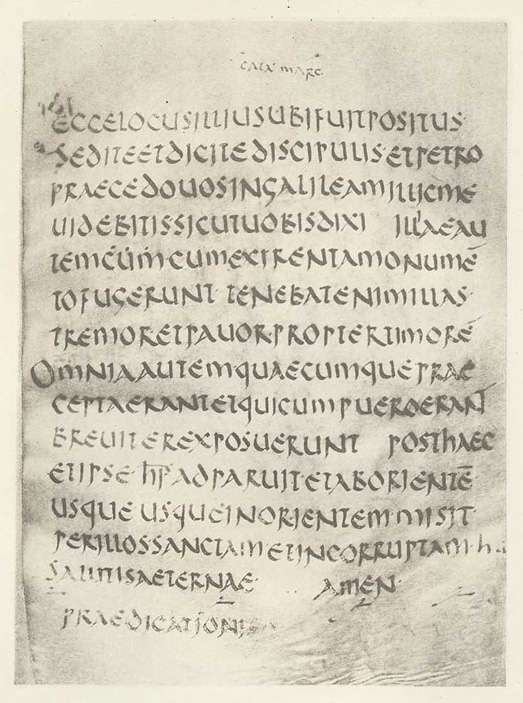
Biblical scholar Margaret Mitchell and an inter-disciplinary team have subjected a purportedly medieval manuscript of Mark's gospel to close analysis and have determined that it is a nineteenth- or early twentieth-century forgery. The story is available in The Art Newspaper, along with a helpful affirmation that even forgeries are valuable learning opportunities:
Mitchell, a biblical scholar, undertook the task of analysing the text and found it to include the same errors contained in an edition of the Greek New Testament published by Philipp Buttmann in 1856. This led her to conclude that the creator of the Archaic Mark used Buttmann’s text as a guide for his forgery. “I’ve been asked repeatedly if I’m disappointed that the work is a forgery. I’m not. There is no longer a question mark after the date of the manuscript and that is tremendously satisfying,” said Mitchell.

The university intends to preserve the codex and encourage its use for further research into the forger’s techniques. “Those who study forgeries may be the largest beneficiaries of our scholarship,” said Mitchell.

[HT: Bible and Interpretation]

Wednesday, January 27, 2010

Satan in Mark

This is probably not very significant. But I noticed this afternoon that Mark refers to the devil as "Satan" (or "the satan" [ὁ Σατανᾶς; ho Satanas]) six times (1.13; 3.23 [2x]; 3.26; 4.15; 8.33), which is almost half of the uses found in the four gospels (fourteen). In contrast, ὁ διάβολος [ho diabolos; "the devil"] is also used fourteen times in the gospels, but not at all in Mark. Unless we understand "Beelzebul" as another name for the devil, it looks like Mark only refers to him as ὁ Σατανᾶς.

In light of the frequently noted Aramaicisms in Mark—Semitic terms the evangelist explains/interprets for the benefit of his audience—I think it's interesting that nowhere in Mark does the evangelist interpret Σατανᾶς, a transliteration of שׂטן [śāṭān]. I'm not sure what to make of this lack, if indeed we should make anything of it at all. It may simply be that Σατανᾶς was the standard way in Markan circles for referring to God's chief adversary and so didn't need any interpretation. But if we can take the mixed use in the other gospels of both Σατανᾶς and διάβολος as evidence that, at least in other spheres, there was some need to explain who Σατανᾶς was, it may be somewhat surprising that Mark doesn't ever clarify ὁ Σατανᾶς with a phrase like, ὅ ἐστιν μεθερμηνευόμενον· ὁ διάβολος [. . . Satan, "which is translated, 'the devil'"].

placing Jesus' baptism in (literary) context

In her comments on Mark 1.9–11, Adela Yarbro Collins appeals to biographies of Greek poets to provide a literary parallel to Mark's account of Jesus' baptism and the declaration of Jesus as God's well-pleasing son. Here's a rather extended passage from Collins, Mark: A Commentary (Hermeneia; Minneapolis: Fortress Press, 2007), 147:
Ancient biographies of poets contain similar accounts near the beginning of the narrative about their main subjects. In the popular biography of Aesop, he is portrayed as a slave, extraordinarily ugly, and unable to speak because of a severe speech impediment. This low status is somewhat mollified by divine power. near the beginning of the narrative, Aesop assists a priestess of Isis. As a reward Isis grants him the power of speech, and the nine Muses bestow upon him the power to devise stories and the ability to conceive and elaborate tales, as well as other gifts of excellent speech. A story was told about the archaic lyric poet Archilochus involving an extraordinary experience which revealed that he would be a poet. When he was leading a cow to market at night while the moon was shining, he met a crowd of women who offered to buy his cow. When he had agreed and they had promised to give him a good price, both the women and the cow disappeared, and before his feet he saw a lyre. He was overcome and realized that they were the Muses. Like Archilochus, the Jesus of Mark has an experience near the beginning of the narrative that transforms him and prepares him for his life's work. Archilochus experienced an epiphany or vision of the Muses, who enabled him to be a poet; Jesus sees the heavens open and the Holy Spirit descending like a dove and hears the divine voice address him as beloved son. The allusions to scripture in the words of the divine voice suggest that Jesus is being appointed as messiah or prophet or to an eschatological role that combines both offices. As Aesop was given gifts of wise speech by Isis and the Muses, Jesus is endowed with the divine Spirit on this occasion, the power that enables him to teach with authority, to heal, and to cast out demons.

It pains me to criticize Collins here, especially because (i) I'm really impressed with her commentary so far, and (ii) I think she's exactly right that we need to contextualize Mark in its larger traditional world. But the stories of Greek poets hardly provide the appropriate traditional world for understanding Mark. Notice the phrase, about halfway through the quote, "Like Archilochus, the Jesus of Mark has an experience near the beginning of the narrative that transforms him and prepares him for his life's work." Like Archilochus?! None of the story Collins has relayed sounds remotely like Mark's account of Jesus, which suggests that very little—if any—of Mark's story of Jesus is "like Archilochus."

The differences simply too great to draw any meaningful parallels between Archilochus and Aesop, on the one hand, and Jesus of Nazareth. Aesop is awarded for assisting a priestess of Isis; Jesus comes to John in the Judean wilderness, which is world's away from the Temple hierarchy in Jerusalem. Archilochus encounters the Muses without knowing it; nothing in Mark 1 suggests Jesus encounters either God or one of his agents unawares. The stories of Aesop and Archilochus simply belong to a completely different world from the stories of Jesus, and only the fact that both are ancient from our point of view hides that fact. It would be just as appropriate to draw links between Mark 1 and stories of John Henry or Emiliano Zapata.

Why does any of this matter? I can think of two reasons. First, notice that these parallels actually affect Collins's interpretation of Mark 1.9–11. She reads the divine voice in 1.11 (and its allusions to Hebrew biblical traditions) as a suggestion that "Jesus is being appointed as messiah or prophet or to an eschatological role that combines both offices." But I don't see any such implication in the text. For one thing, the voice's declaration that Jesus is God's son is not very prominent in the rest of Mark's gospel. Mark uses phrase υἱὸς θεοῦ only at 1.1 (if we accept the textual variant); at 3.11 and 5.7 demons acknowledge Jesus as υἱὸς τοῦ θεοῦ; at 15.39 a centurion calls the recently deceased Jesus υἱὸς θεοῦ. In Mark 9.7 the heavenly voice again declares Jesus God's "beloved son." Perhaps Mark 13.32 is also relevant. If Mark 1.9–11 narrates when Jesus is appointed to the status of God's son, I would expect the rest of the narrative to have more to do with Jesus as God's son. I think Collins would have done better to read this passage as the account of Jesus being declared (not appointed) the son of God (= royal messianic figure). The rest of the gospel makes good sense as the account of Jesus as the chosen king of God's people; notice that as early as 1.14–15 Jesus is announcing the nearness of God's (= his) kingdom.

Second, and even more importantly, Collins's appeal to biographies of Greek poets actually facilitates the trend among NT scholars to read early Christian literature outside of (and even in opposition to) the Jewish cultural context in which the texts were written and apprehended. The parallels between Jesus and Israel's patriarchs, monarchs, prophets, etc. are much more compelling than any similarities with Aesop and/or Archilochus. Perhaps we could make the case that stories of the Greek pantheon and biographies of poets and heroes help us understand the context in which Mark was (later) read and understood. But at this point I am utterly unconvinced that these stories provide any purchase on how the earliest memories of Jesus (say, the first century at least) were expressed, understood, and passed on.

Monday, January 25, 2010

how early Christians related to Israelite tradition

Over the last five years or so I have been growing increasingly aware of and frustrated by the tendency among NT critics to describe early Christians—especially the evangelists—in terms that imply they related to the sacred traditions of Second Temple Judaism as outsiders. Though these descriptions only imply and insinuate a view of the early Christians vis-à-vis their traditions, those implications and insinuations have dramatic consequences for our views of the evangelists as authors, the texts they left behind, and the larger issues of Christian origins we try to get at when we approach the gospels.

Sometimes this tendency almost casts the evangelists' relationship with sacred tradition in a light similar to a heart surgeon's relationship with the organs occupying the open ribcage on the table before her. The evangelists "worked with," "manipulated," "redacted," "revived," "created," "transformed," etc. their traditions, whether their Jesus traditions or sacred Israelite traditions. This view is directly related to the outdated view of the evangelists dominant among the form critics who explicitly and conscientiously cast the evangelists in the role of the Brothers Grimm, collectors of other peoples' traditions and stringers of pearls. For well over fifty years biblical scholarship has been aware of the inadequacies of this conception of the evangelists with respect to the Jesus tradition, but we have nevertheless continued to talk about them in similar terms with respect to Israelite tradition.

Notice, for example, Robert Stein's description of Mark's original audience: "It is also apparent Mark’s readers were familiar with various OT characters and possessed considerable knowledge of the Jewish religion” (Mark [BECNT; Grand Rapids: Baker Academic, 2008], 10; my emphasis). I can’t help but think that Stein has rather understated the point. Mark and his readers—the movement of Jesus’ followers who proclaimed him as Israel’s messiah to Jews throughout the Roman empire and, in time, to gentiles—were not “familiar with” Hebrew biblical traditions. Rather, they lived in a world defined and appraised by those traditions. By way of analogy, I am (vaguely) familiar with things Kanye West has written and/or said, but I live in a world defined by the writings and sayings of Martin Luther King, Jr. Even putting the two men next to each other seems a bit ridiculous, and I think the same can be said of Stein’s (and most NT critics’) comments about Israelite tradition in Mark.

Jewish scholar Lawrence Schiffman evinces a similar conception of the evangelists and the early Christians, especially in his rather strong distinction between ancient Judaism and early Christianity. In his description of one of the Dead Sea Scrolls—4Q521, also known as the Messianic Apocalypse—Schiffman rightly emphasizes this text's Jewish provenance. However, he also draws too stark a distinction between Second Temple Judaism and early Christianity, and that too-stark distinction gives rise to the following:
This text, therefore, has no connection to Christianity at all, except that it indicates the presence of the messianic idea in Judaism before Christianity emerged. It is understandable that those Jews who started the early Jesus movement brought with them the teachings of Judaism that they had learned. This beautiful poem [viz., 4Q521] sums up these beliefs, calling on human beings to observe God's Torah in order to bring about the eternal redemption. (Reclaiming the Dead Sea Scrolls [New York and London: Doubleday, 1995], 350; my emphasis)

"Brought with them"? "That they had learned"?! I can't help but think that we have (wrongly) imagined the evangelists along the lines of representatives of the British Museum who acquire cultural property from distant and exotic lands and cultures and cross borders with said property, relocating these objects in altogether foreign contexts. But the evangelists weren't Britons digging in the sands of Egypt or the ruins of Assyria. They were Jews (as Schiffman acknowledges) who lived and moved and had their being in the stories of Moses, David, Isaiah, Elijah and Elisha . . . the story, in other words, of YHWH, which they saw also in the story of Jesus.

Thursday, January 14, 2010

In the beginning . . .

Classes for the Spring 2010 semester begin later this morning, and I'd like to wish all of Johson Bible College's students a successful and blessed semester. I am teaching two sections of Elementary Greek II, as I did during the Spring 2009 semester (we begin the adventure that is third declension nouns later this morning . . . woo-hoo!). I'm also teaching a senior-level course on Mark's gospel, which is a new course for me. I think it will be an interesting course, so I'm looking forward it. Finishing out my undergraduate load, I'm team-teaching an elective Advanced Greek course that we offer every other spring. That class was a lot of fun in the Spring 2008, and I'm anticipating another good one this time.

The Spring 2010 term actually began on 10 December 2009 for my graduate students, so they should be hard at work already. There I have my World of the NT course, as always; but this semester I'm rewriting History of NT Interpretation, so it isn't being offered.

Between now and May, in addition to teaching, I'll be developing the Mark course, rewriting the History of NT Interpretation course, working on a handful of book reviews, and trying to pull together a book I accidentally wrote last year (the parting of the ways book I mentioned here is a few feet behind the back burner but very much still on my mind). There are also a number of other projects on the horizon; I'll mention those as details emerge.

But for now I'd like to wish JBC's students a great Spring 2010 term. This is my eighth semester at JBC, and each term I've grown closer to my students and learned more from them and because of them.

סמסטר טוב

Thursday, December 24, 2009

Mark (BECNT)

Maybe I'm just getting grumpy, but . . .

That's probably not the best way to start this post. Let's try again.

This morning I read Robert Stein's introductory discussion of the gospel of Mark in his contribution to the Baker Exegetical Commentary on the New Testament (Mark [Grand Rapids: Baker Academic, 2008]), which I've assigned for the course I'm teaching on Mark in the Spring 2010 term. I appreciate the breadth and thoroughness of Stein's discussion, and I realize that the introduction to a commentary is not the place to expect original or groundbreaking scholarship. Also, I've read two others of Stein's books (A Basic Guide to Interpreting the Bible and The Method and Message of Jesus' Teachings [both 1994]), so I knew as I started this book that Stein represents a very traditional scholarly point of view.

So in the context of my broad appreciation for what Stein has accomplished in publishing this commentary (and it is significant), I found myself increasingly exasperated by Stein's rather uncritical approach to Christian origins and Mark's place therein. For instance,

From within Mark we learn a great deal abut the audience for whom it was written. We know it was a Greek-speaking audience that did not know Aramaic, as Mark's explanations of Aramaic expressions indicate (3:17–22; 5:41; 7:11, 34; 9:43; 10:46; 14:36; 15:22, 34). We also know that it was a Christian audience familiar with the gospel traditions. (Stein 2008: 9).

But do we know these things? And if so, how? Nevermind my general questioning of the utility of identifying Mark's audience as "Christian" (As opposed to what? Jewish? What does this mean?), which would be inappropriate for Stein to discuss, perhaps, in this venue. But why should Mark's explanations indicate necessarily that his audience—either in part or in whole—were unfamiliar with Aramaic? I find it just as probable—more so, even—that we should construe Mark's explanations as evidence that the Markan evangelist was accustomed to presenting the Jesus tradition in situations that might also include people (Jews? God-fearers? gentiles?) who were unfamiliar with Aramaic.

I also question the judgment that Mark's was "a Christian audience familiar with the gospel traditions." I wouldn't want to suggest that Mark wrote for people who were unfamiliar with the gospel. But I don't think familiar is a useful adjective for gospel scholarship. For too long we have spoken of the evangelists as "familiar" with gospel traditions or of those traditions as "sources" for their writings. But this language, rooted in earlier generations of scholarship, fail to express the significance that traditions and customs and ethics—in a word, culture—played in the earliest Christian communities (or any communities, for that matter).

Anthropologist Clifford Geertz famously described culture as "webs of significance" (granted, webs "that we ourselves have spun"), and it's well past time for NT scholars as a whole to appreciate that early Christians—the authors of our texts as well as their audiences—lived and moved and had their beings in worlds defined and constrained by their traditions. We might as well say that Mark's audience "was familiar with" oxygen. Or water. Or love. As I've argued elsewhere, this change in perspective has dramatic consequences not only for our interpretation of the biblical texts but also for our appraisal of them.

Tuesday, September 08, 2009

Jesus and purity

I was sent home by the campus nurse late this morning with symptoms that might be early signs of swine flu. Though I have been washing my hands more frequently and taking advantage of the myriad hand sanitizer dispensers that have suddenly and magically appeared all over campus (and throughout the rest of the city!) like acne on a twelve-year-old, I do not truly believe, apparently, that nothing outside the body that goes into my body can defile me.

During my self-inflicted semi-quarantine this afternoon, I began reading from Mark's gospel. Perhaps in the throes of my current state purity is especially on my mind. Perhaps I haven't been drinking enough fluids. But the end of Mark 9, which bears some thematic resemblance to Matt 5.29–30 (remember that Matt 5–7 is typically attributed to Matthew's reworking of Q material), suddenly struck me as a passage on purity:
43 If your hand causes you to sin, cut it off! It is better for you to enter into life maimed than to be sent away into hell—into unquenchable fire—with two hands. 45 And if your foot causes you to sin, cut it off! It is better for you to enter into life lame than to be cast into hell with two feet. 47 And if your eye causes you to sin, cast it away from you! It is better for you to enter the kingdom of God with one eye than to be cast into hell with two eyes, 48 where their worm never dies and their fire is never put out. (Mark 9.43–48; vv 44, 46 were likely later additions on the influence of v 48)

I have always read this passage (and its Matthean parallel) in terms of the radical undesirability of sin. Of course, only an idiot would lop off his hand or foot or pluck out his eye, as if the impulse to sin weren't more closely rooted in the major organs. But Jesus, I've always thought, is speaking hyperbolically. "Avoid sin so radically, so passionately, so consequentially," Jesus is saying, "that you would remove your own self rather than lust after that woman or steal that loaf of bread or do harm against your neighbor." This reading will preach, but is it the best reading of this passage?

Everyone recognizes that purity issues appear from time to time in various NT texts; Acts 3.1–10 and 8.26–40 are the first two that come to my mind. Both texts center on a man (a crippled Jew in Acts 3; a [probably] gentile eunuch in Acts 8) prevented from worshiping YHWH because of a physical deformity. Both texts emphasize the power of Jesus' name to bring these types of men directly into God's presence. And both texts, I think, implicitly contrast their disabled protagonists with the able-bodied Jewish hierocratic leadership that has unrestricted access to the Temple but nevertheless fails to come into God's presence as mediated through Jesus.

Perhaps because I've just finished reading Richard Horsley's recent book, Jesus in Context, I wonder if the Markan passage (and even the Lukan passages referred to, above) provides a glimpse into the distinctive forms that Hebrew biblical traditions could take among the non- or (sometimes) semi-literate, non-elite populace outside the Temple, especially in Galilee and beyond the immediate reach of Judean power structures. In other words, if the "great tradition" embodying the Hebrew Bible among the urban elite, especially in Jerusalem, emphasized physical unblemished-ness as requisite for coming into God's presence, how significant is it that Jesus espouses intentionally (if symbolically) becoming physically blemished precisely in order to enter into God's presence? The priestly expressions of Judaism went to great lengths to protect the people from the dangerous holiness of God, and there were highly stylized, ritualized, and scripted procedures for coming into God's presence. Jesus, if I'm reading Mark 9 rightly, isn't suggesting that Israel's God is actually much safer than the Temple system, with all its buffers against defilement, portrays. Rather, Jesus is suggesting that rather different purity prescriptions grant a person access to God. Not physical wholeness but child-like innocence (see Mark 9.42). Not ritual precision but care for the poor, the powerless, the widow, orphaned, and sojourner.

I'm not sure where this type of reading would lead me. I have a few hunches, though. Rather than simply christocentric (or, following Richard B. Hays, ecclesiocentric), Mark and people with whom he was associated experienced Hebrew biblical traditions as little tradition (rather than great tradition). And they preserved the memory that Jesus did likewise. Torah, the prophets, and the writings weren't simply "about" Jesus; Jesus established [at least some of] the principles according to which the Tanakh functioned in the community. Christocentric/Ecclesiocentric, yes. But not merely so. I also suspect that a number of other pericopae receive brighter illumination by being read in terms of purity and other peculiarly Jewish theologoumena. Here Serge Ruzer's book, Mapping the New Testament, is helpful (even if some of his interpretations are unconvincing).

You Markan scholars out there, Am I way off base? Or has this been the standard interpretation of 9.43–48 for some time now?

My Visual Bookshelf