Showing posts with label SECSOR. Show all posts

Thursday, March 03, 2011

getting ready for SECSOR 2011

The SECSOR 2011 meeting is this weekend (4–6 March) at the Galt House Hotel in Louisville, KY. The pictures look gorgeous, and I'm excited to get on the road. I'll be presenting my paper, "Speaking of Jesus: 'Oral Tradition' beyond the Form Critics," in the SBL New Testament section on Saturday evening. I've been working on this paper for over a month, and I think it's pretty good. But I would think that, wouldn't I?

In the spirit of open and public academic discussion and debate, I've uploaded my paper to both Scribd and Google Docs. I'll embed the Scribd version below. If, for some reason, you prefer Google Docs, you can use the link I've included. Both documents are completely public.

The highlighted numbers in the paper refer to the accompanying PowerPoint presentation. I've tried to upload the .pptx file to Scribd and Google Docs, but it didn't display properly in either place. If you're interested in seeing the PowerPoint, leave a comment here and I'll happily e-mail it to you.

UPDATE: I've finished the handout that I will distribute to anyone determined to listen to my paper. Like the paper itself, you can find the handout on Google Docs, or you can see the embedded Scribd version, below.

Speaking of Jesus: "Oral Tradition" beyond the Form Critics
Speaking of Jesus: "Oral Tradition" beyond the Form Critics (handout)

Thursday, January 06, 2011

is Bultmann's idea of Mark schizophrenic?

In my last post I presented, in his own words, Martin Dibelius's conception of those responsible for the Jesus tradition as the anonymous, unskilled community that passed on the tradition until the evangelists (especially Mark and Matthew, but also Luke) got their hands on it.

In his own landmark form-critical study, Rudolf Bultmann exhibits a different conception of the evangelists (or at least of Mark). Bultmann begins Die Geschichte der Synoptischen Tradition (1921) with a recapitulation of the previous generation's estimation of Mark as "the actual course of historical events" in the life of the historical Jesus, and he then revisits William Wrede's devastating critique of that view. In his revisitation Bultmann writes,
Mark is the work of an author who is steeped in the theology of the early Church, and who ordered and arranged the traditional material that he received in the light of the faith of the early Church—that was the result; and the task which follows for historical research is this: to separate the various strata in Mark and to determine which belonged to the original historical tradition and which derived from the work of the author. (History of the Synoptic Tradition [trans. by John Marsh; Oxford: Basil Blackwell, 1963], 1)

Dibelius, if I read him rightly, considers Mark and Matthew, especially, to be collectors of tradition, hardly authors at all and certainly not in any meaningful sense of the word. So he can dissolve the gospel narratives into their individual pericopae, because the evangelists strung them together, leaving the traditional units they collected more-or-less intact. Bultmann, following Wrede, sees Mark as a much more revolutionary presentation of Jesus. Mark—in this way of reading him—casts Jesus as Israel's messiah, but he well knows that no one during Jesus' lifetime thought of him in messianic terms. So he weaves a narrative in which the messianic secret develops organically from the very beginning, in which Jesus himself at first silences and then gradually affirms his messianic status.

So Bultmann's Mark—again, if I'm reading rightly—is a strange hybrid between two competing conceptions. Bultmann affirms Wrede's innovative Mark, who tells the story of man who never was and so is responsible for both the story and the man. But Bultmann also affirms Dibelius's traditional Mark, who collects the traditions told by others and so is responsible only for anthologizing stories already in circulation. Hence Bultmann's program: "to separate the various strata [viz., the innovative (Wredian) and traditional (Dibelian) strata] in Mark and to determine which belonged to the original historical tradition and which derived from the work of the author."

Those of you more familiar with the history of form-critical scholarship: Is this a helpful way to understand what I'm reading?

the anonymity of gospel tradition

The opening words of the English translation of Martin Dibelius's landmark work, Die Formgeschichte des Evangeliums (1919):
There is a theory that the history of literature is the history of its various forms. This may be true of literature properly so-called, but it cannot be applied indiscriminately to every kind of writing. It has, however, special significance when applied to materials where the author's personality is of little importance. Many anonymous persons take part in handing down popular tradition. They act, however, not merely as vehicles, but also as creative forces by introducing changes or additions without any single person having a "literary" intent. In such cases the personal peculiarities of the composer or narrator have little significance; much greater importance attaches to the form in which the tradition is cast by practical necessities, by usage, or by origin. The development goes on steadily and independently, subject all the time to certain definite rules, for no creative mind has worked upon the material and impressed it with his own personality. (From Tradition to Gospel [trans. by Bertram L. Woolf; New York: Charles Scribner's Sons, 1935], 1)

It would be difficult to explain how strongly and how thoroughly I disagree with just about every word with which Dibelius characterizes the early Christian tradition. That this is our received heritage should give all of us currently involved in exploring and reconstructing Christian origins pause to consider just how far astray our forebears drifted. We should also expect that breaking free of this heritage can only happen with tremendous and focused and sustained effort.

Thursday, November 11, 2010

see you in Louisville

I just found out today that my paper, "Speaking of Jesus: 'Oral Tradition' beyond the Form Critics," was accepted by the (SBL) New Testament section for the 2011 SECSOR meeting. That meeting will be held the weekend of 4–6 March, 2011, in Louisville, KY, at the Galt House. Here's my paper's abstract:
Oral tradition has been a live analytical concept in gospels research at least since the form critics but especially since Werner Kelber’s The Oral and the Written Gospel (1983). Recently, numerous high-profile publications in Jesus and gospels research attest the ascendency of memory as an equally live subject in the exploration and explanation of Christian origins. One by-product of this confluence of issues—oral tradition and memory—has been a renewed discussion of form criticism and its legacy. The apparent connection with the form critics’ aims risks misdirecting contemporary exploration of the early Christians’ use of oral and written traditions down potentially blind alleys. This paper offers three specific areas that distinguish—or ought to distinguish—contemporary oral-traditional research from form-critical inquiry. First, contemporary scholarship conceptualizes orality in terms broader than merely the transmission of tradition. Second, contemporary scholarship problematizes the construction of trajectories as explanatory models of Christian origins. Third, contemporary scholarship highlights both the similarities and the differences between oral and written expressions of tradition and explores the interface between the two. As a result, contemporary scholarship would be well-served by fostering an abrupt rupture between the current interest in the oral Jesus tradition (and the constitutive role of memory therein) and the procedures and products of Formgeschichte.

My thanks to the SBL NT section committee for approving my proposal. You can find more information about SECSOR at their website.

Wednesday, March 10, 2010

SECSOR: Day Three

Sunday morning had three sections I wanted to attend, but I had to balance my desire to hear papers with my urge to get home. Sunday morning papers can be sparsely attended, which is too bad. They're typically of the same quality as their earlier counterparts, and often the discussion (perhaps because of the lower attendance) is even better. Having had to present a paper on Tuesday morning at the SBL's Annual Meeting, I really do sympathize.

At any rate, I heard four papers Sunday morning. The first two papers were part of the ASOR/SBL: Archaeology and the Ancient World IV meeting, and the second two were part of the SBL: New Testament V meeting.
  • The first paper, which was moved from a later meeting because two presenters were unable to attend, was "A Sculpture Fragment from Iron II Moabite Khirbet Mudaybi': A Case Study of Inter-Disciplinary Inquiry for Interpretive Purposes" (Ted Carruth, David Lipscomb University), presented a sculpture fragment and the contextual information impinging upon its interpretation. This is about as far afield from my area of expertise as you can get and not be, say, a NASA engineer, so I have very little by way of comment. But it was interesting to see the kinds of deliberations archaeologists engage in and the kinds of argumentation deemed appropriate for those deliberations.

  • The second paper, "Was There an Economic Crisis under Antipas? Revisiting the Questions of Royal Estates and Taxation in Herodian Galilee" (Sharon Lea Mattila, University of North Carolina at Pembroke), took aim at the application of conflictual models of society as they are applied to reconstructions of first-century CE Galilean society (by, e.g., Richard Horsely, Douglas Oakman, and others). Mattila presented a circumstantial (though convincing) argument that the Great Plain (a.k.a. the Jezreel Valley) between the Galilee and Samaria would have been allotted to Herod Antipas rather than to Archelaus after the death of their father, Herod the Great, in 4 BCE. These lands would have been considered Antipas' private lands and would have provided him with considerable income. Due to time constraints Mattila was unable to adequately consider the question of taxation, but that really is the point. That is, if Antipas did not have control over the Great Plain (and so did not reap its fruits for his own wealth), then the funding for his building projects would have had to have found a different source, probably heavy taxation of the populace. Mattila's implied argument was that, since Antipas held the Great Plain, theories of excessive taxation that have been fashionable in the last three or four decades and have driven much of the sociological interpretation of this time are probably wide of the mark. This, I thought, was an especially interesting way to pursue this question.

    [At this point I had hoped to hear the paper, "How to Read a Book: Irenaeus and the Pastoral Epistles Reconsidered" (Ben White, UNC Chapel Hill), but unfortunately Mattila's paper ended about the same time as White's. If you happened to attend the New Testament IV session and you heard that paper, I'd be interested in getting a brief synopsis and any evaluative comments you might have.]

  • The first paper of the New Testament V session was "If Christ Has Not Been Raised—The Inefficacy of a Qualified Gospel in 1 Cor 15:17" (Mark Proctor, Lee University), offered a critique of certain interpretations of Paul's claim at 1 Cor 15.17 ["If Christ has not been raised, your faith is useless and you are still in your sins"]. That is, some have read this verse as Paul's claim that, if Christ has not been raised from the dead, that forgiveness of sins is impossible. According to this reading, the resurrection is the essential factor in Pauline ideas of forgiveness; forgiveness, in other words, is a function (or result) of Christ's resurrection. Proctor argues that this is wrong on two counts. First, Paul typically locates the forgiveness of sins in relation to Jesus' crucifixion rather than the resurrection. Second, this interpretation neglects the rhetorical structure of Paul's arguments in this section. Instead, Proctor reads 1 Cor 15.17 as Paul's claim that, if Christ hasn't been raised, then his proclamation of the gospel—which trades heavily on the message of Jesus' resurrection—is worthless because he has offered false testimony about God. In other words, forgiveness might still be a real possibility between God and Paul's readers, but Paul's proclamation of that forgiveness would not be trustworthy if his message of the resurrection were false. Proctor's argument was convincing, though I lack the necessary knowledge to know the extent to which the interpretation Proctor opposes characterizes the scholarly literature.

  • The second paper, "From Qumran to Philo: Precedence for Paul's Use of Israel" (Thomas Whitley, Gardner-Webb University), compared the use of Israel among the DSS (1QS, CD, and the Temple Scroll) with the rather different use of the term among Philo's writings. According to Whitley, Israel is used among the Scrolls in a number of different ways: as a label for the nation at large, as a label for the group itself, and others. In Philo, however, Israel usually refers to a spiritual level achieved only by a select élite. Whitley finds elements of both Qumranic and Philonic uses of Israel in Paul (esp. Galatians and Romans). Whitley then made an appeal to sociological theories of identity, which I think was the right move to make. Unfortunately, Whitley makes a mistake common among biblical scholarship's appropriation of sociological inquiry in that he identifies two separate theories: "identity theory," which highlights the identity of the individual, and "social identity theory," which highlights the identity of the group. This, of course, is not correct; social identity theory (and the similar field, social memory theory) takes up the issue both personal and collective identity as fundamentally social processes. If Whitley takes account of this difference between sociological research and its biblical social-scientific criticism, I think he'll have a very interesting analytical perspective to bring to bear upon his data.

There were two other papers in the New Testament V session, both of which looked good in the program. But I hadn't seen my family in over forty-eight hours, and I was itching to get home. So I left. I am sympathetic to how frustrating it can be to be the last two presenters at a conference and to watch your audience melt under the heat of earlier papers and pressures of travel. My apologies to Annie Tinsley (University of Birmingham [UK]) and Presian Burroughs (Duke University). I hope your papers were well received and discussed.

And that was my experience of SECSOR 2010. Next year's meeting will be in Louisville, KY, which sounds like a fabulous venue. Hopefully the weather will be nice that far north, but I'm sure I'll survive. Although . . . I suppose that really is the sort of thing I shouldn't take for granted. See you all in Louisville!

Sunday, March 07, 2010

SECSOR: Day Two (pt IV)

After my miserable performance in the New Testament III session (which I chronicled here), and since the New Testament IV session isn't scheduled until Sunday morning, I was a bit torn about which late-afternoon session to attend. There was a joint ASOR/SBL Archaeology and the Ancient World III session discussing the theme, "Jesus and the Galilean Economy," and an AAR History of Judaism session discussing the theme, "Second Temple Judaism." I chose the ASOR/SBL meeting, even though I could write everything I know about archaeology on the back of my daughter's hand. It was interesting, but I was mostly lost.

The best part of the meeting, however, came from an off-hand comment from the session presider, Ralph Hawkins of Kentucky Christian University. As he was introducing Doug Oakman, he mentioned that Sharon Lea Mattila's paper schedule for Sunday morning. I had no idea Sharon would be here (I've never met her), but I knew I had encountered her name somewhere. Then I remembered: I used her article, "A Question too Often Neglected" (NTS 41 [1995], 199–217), which I discussed in a previous post. So after the meeting I made a bee-line to introduce myself to Sharon, which was a bit of an inconvenience for her, I think. But the ASOR/SBL group was going out to dinner, and she invited me to join them. So I sat between Sharon and Ralph and thoroughly enjoyed the conversation on a number of topics, including a very interesting new book put out by T&T Clark.

Perhaps the best part of the evening, I suppose, was that Sharon assumed I was a graduate student, and I think Ralph, too, didn't realize I've finished my degree. I don't mind being underestimated; in fact, I prefer it. So when they asked my age, Ralph was very encouraging (apparently the average age of the beginning PhD student is 40) and Sharon was surprised I wasn't 25. I felt good on both counts! But the professional aspects of the conversation—rather than those parts that played to my vanity—were the highlight of the meeting thus far. These are one of the perks of my field!

SECSOR: Day Two (pt III)

I came down to SECSOR expecting to return to Knoxville with the same number of books I brought with me. That has never happened before, and it's not happening this time. I purchased two books yesterday, both at better prices than I could find online.
  • First, I purchased George M. Landes's Building Your Biblical Hebrew Vocabulary: Learning Words by Frequency and Cognate (second edition; Atlanta: Society of Biblical Literature, 2001 [1961]).

  • Second, and perhaps more surprising, I purchased Leo Duprée Sandgren's massive volume, Vines Intertwined: A History of Jews and Christians from the Babylonian Exile to the Advent of Islam (Peabody, MA: Hendrickson, 2010). Few books not written by James Dunn are thick enough to print the title across (rather than along) the spine; Sandgren's survey of 1,300 years of history does. The book comes with a CD that includes a .pdf of the book's full-text, which makes it fully searchable. This is, well, awesome. Sandgren divides his historical survey into six sections, and at the end of each he has a brief synthetic discussion that summarizes and recaps the material for that section. This provides a helpful path through an otherwise intimidating text (the book is 838+xxv pages of small, dense type!); I think this is probably a necessity for any book over 500 pages. I've read the Introduction (1–7) and am very impressed so far. A few teaser quotes:
    A history of Jews and Christians in Antiquity must begin somewhere. We begin in 640 B.C.E. It is true there were no Christians then, but neither were there Jews as we understand the term "Jew" today. Both Jew and Christian are primarily religious identities, with due deference to secular humanism as an option within a Jewish or Christian cultural context. In fact, we find the beginnings of Jewishness at the turn of the first century, just when Jewish believers in Jesus and the Gentile converts were making their own beginning. But the religions of Judaism and Christianity come later still, and it may be argued (as it is) that Judaism as a religion came into existence only in response to Christianity as a religion. (1)

    As a religion without a temple, Judaism begins simultaneously with Christianity. The two communities forged their templeless identities in plain sight of each other, and in continual dialogue, and as constant rivals for the title "people of God" or "true Israel." We now recognize that Judaism and Christianity are what they are because of the other. Neither formed itself in isolation. (2)

    It is easier to describe being a Jew, or being a Christian, than the isms to which they belonged. If a person is asked, "Are you a Jew?" we expect, under neutral circumstances, an answer without excessive deliberation. . . . The same may be said for Christians. . . . Asked to describe their Jewish or Christian practices, we would find all manner of variety. Asked to describe their beliefs, we would be overwhelmed. People tend to muddle along inarticulately with questions and answers about God, the universe, and the human predicament. That is perhaps the wisest course, but it frustrates the neat categories and labels of historians. (3)

    Even under ideal circumstances, however, the best we can achieve in historical description in verisimilitude, a verbal picture that is similar enough to the reality behind the elusive facts of history that it is accurate in impressionistic terms. The description of a person may be more or less accurate, hence verisimilar. . . . Memory and literary license are at work, in which each author differs. But when we have compared all the information about Akiba or Jesus, or any historical figure, it is often possible to arrive at a satisfying verisimilitude. (4, 5; my emphasis)

    I love that phrase: accurate in impressionistic terms. Sandgren has, I think, put his finger on the key to a historiographical perspective that is both sufficiently rigorous and critical as well as reasonable about the degree of certainty our evidence can sustain. For such a massive volume, this book is very reasonably priced (list: $34.95), and I strongly recommend it to anyone interested in Christian and/or Jewish origins, the relation between the two, and the so-called Parting of the Ways.

SECSOR: Day Two (pt II)

Well . . . I feel a bit sheepish. My participation in the afternoon New Testament session was, well, unimpressive. So this is more a confession of the papers I didn't hear. C'est la vie. Even so, yesterday afternoon/last night was perhaps my best SECSOR experience to date. More anon.
  • The first paper, "Lord, Lord: Jesus' Use of the Divine Name in the Synoptics" (Jason Staples, UNC Chapel Hill), springboarded from Bart Ehrman's claim (on The Colbert Report!) that the synoptic Jesus never claimed divine status for himself. Staples analyzes Jesus' self-referential use of the double address κύριε κύριε ("Lord, Lord"; Matt 7.21, 22; Luke 6.46; see also Matt 25.11) against the backdrop of the Semitic אדני יהוה (’adōnay YHWH; "Lord LORD"), which is often—though by no means always—is translated with the double κύριος κύριος, especially in the vocative. Staples's case is (i) first that אדני יהוה would have been vocalized Adonai Adonai, and (ii) that second that "a first-century reader (or author) would most likely read Jesus' use of κύριε κύριε as an application of the Name to himself, directly identifying hiself with/as the God of Israel."

  • The second paper, "The Economics of Friendship: An Interpretation of the Narrative Summaries in Acts 2:41–47 and 4:32–35" (Douglas A. Hume, Pfeiffer University) . . . well, the second paper was the second paper after lunch, so I missed most of (qere: all of) Hume's paper since it was, apparently, my nap time. When Hume was finished, I left so as not to be so rude to the remaining presenters.

  • The third paper was "And They Threw Him Out of the Vineyard: An Analysis of the Parable of the Wicked Tenants" (Michael Zolondek, Florida International University).

  • The fourth paper was "A Theology of Mutuality" (Alan Knox, Southeastern Baptist Theological Seminary).

There are more papers Sunday morning, though I'm planning on being a section tart. I'll let you know how it goes.

Saturday, March 06, 2010

SECSOR: Day Two (pt I)

The theme of this morning's New Testament session was "The Gospels," and as it turns out the four papers, between them, touched on all four canonical gospels.
  • The first paper, "John's Use and Disuse of Matthew" (James W. Barker, Vanderbilt University), argued that in at least three specific instances the Fourth Evangelist knew and responded to Matthean redaction: John's reference to forgiving/retaining sins (20.32; see Matthew's binding/loosing tradition); John's account of Jesus riding into Jerusalem on a donkey and his citation of Zech 9.9 (see Matthew's account; cf. the Markan and Lukan parallels); and Jesus' "evangelization" of Samaria in John 4 (cf. Matthew's refusal to allow Jesus entry into Samaria). I'm predisposed against Barker's thesis because of my suspicions vis-à-vis redaction criticism (and so the probative value of asking whether John knew "Matthean redaction"). But Barker does address a very interesting issue standing between synoptics and Johannine scholarship; i.e., How John came to be read alongside and included with the other three gospels. In Barker's reading, such was the intention of the Johannine author (specifically with regard to Matthew's gospel).

  • The second paper, "Jonah, Jews, Jesus, and Gentiles: Matthew's Appropriation of the Sign of Jonah Saying in Light of the Gentile Mission" (David Moffitt, Duke University), approached Matthew's use of the Sign of Jonah via an intertextual reading of the larger Jonah tradition. I'm often wary of intertextual analyses on the basis of John Miles Foley's criticism that, despite the broadened field of vision, intertextuality still privileges discrete, bounded entities ("texts") at the expense of larger traditional dynamics. Moffitt, I think, avoids this problem. His analysis explored the polyvalent connections that the Sign of Jonah enabled early Christian tradents (here, Matthew) to make without insisting that he make all of them or even that he make specific and predetermined uses of them. In other words, Moffitt took into consideration the Jonah tradition as he read the Jonah text. (If memory serves, I also enjoyed Moffitt's paper at last year's SECSOR, which focused [I think] on Hebrews).

  • The third paper, "Mark, the Jerusalem Temple and Jewish Sectarianism" (Tim Wardle, Wake Forest University), analyzed Mark's references to the Temple in Mark 11–15. His analysis raised some interesting questions and rightly, I think, emphasized the Jewish critique of idolatry in the Septuagint's use of ἀ/χειροποίητος ("[not] made with hands"). I think Wardle makes too much of the use of ἱερόν ("temple") and the fact that Mark only refers to the Jerusalem ἱερόν in chapters 11–16. This allows him to (i) ignore the clear reference to the Jerusalem Temple in Mark 1.44 ("Go, show yourself to the priest [τῷ ἱερεῖ] and offer [προσένεγκε] for your cleansing the things Moses commanded, as a testimony to/for/against them"). Despite the difficulties that still attend the precise interpretation of this verse (including the dative αὐτοῖς ["to/for/against them"]), Mark 1.44 is clearly not a critique of the Temple like Wardle legitimately finds in Mark 11–16. (ii) Second, his focus on ἱερόν allows him to read some passages in Mark 11–16 as connoting negatively for the Temple, such as the widow's offering in Mark 12, or even Jesus' lament that the Temple should have been (but wasn't) a "house of prayer for all nations" in Mark 11. As you can see, Wardle's paper raised some interesting questions for me.

  • The fourth paper, "Locating Luke 6:5d: Toward a Social Context for the Sabbath Worker" (Jason Robert Combs, UNC Chapel Hill) sought a social location for the reading at Luke 6.5 in Codex Bezae. In the majority of manuscripts (and likely in Luke's "original"), Jesus in Luke 6.5 "says to them, 'The Son of Man is Lord also over the Sabbath'" [κύριός ἐστιν τοῦ σαββάτου ὁ υἱὸς τοῦ ἀνθρώπου]. In Bezae, however, this reading is postponed until after the healing of the man with the withered hand (Luke 6.6–11), and 6.5d has encounter a man working on the Sabbath: "On the same day, when [Jesus] saw a certain main working [ἐργαζόμενον] on the Sabbath, he said to him, 'Man, if you know what you are doing, you are blessed; but if you do not know, then you are cursed and a transgressor of Torah'" [τοῦ νόμου]. Combs locates this variant as part of the mid- to late-fourth century debates about Sabbath, knowledge, and work. I was reminded of the last chapter of Chris Keith's similar investigation into the socio-historical context that might explain the interpolation of the Pericope Adulterae at John 7.53–8.11 (Keith's book, BTW, has received the John Templeton Award for Theological Promise).

That was it for the morning session. More later, of course, as time permits.

Friday, March 05, 2010

SECSOR: Day One

The 2010 meeting of the Southeastern Commission for the Study of Religion (SECSOR) began tonight. Attendance appears to be down quite a bit from last year, if memory serves. This time last year wasn't exactly plush, economically speaking, so I'm not sure the economy is the main factor at play here. But maybe it is. Or maybe tomorrow will be different. I dunno.

Anyway, I attended tonight's "New Testament I" session, which featured three rather interesting papers (the fourth, "Gossiping Jesus Into Being: The Oral Processing of a Social Personage in the Gospels" [John Daniels, Flagler College] was, unfortunately cancelled).
  • The first paper, "Eschatology and Soteriology in 1 Peter" (Alexander Stewart, Southeastern Baptist Theological Seminary), examined the "now" and "not yet" aspects of the language of salvation in 1 Peter. The paper doesn't exactly break new ground; Stewart acknowledged that he was taking aim at a more popular-level conception of salvation in "the American church." And his focus, as is often the case in discussions of "now" and "not yet," was on the relation between the present and the future. As I mentioned to him in a conversation after the session, however, the question that interests me is the relation (and the distinction!) between the present and the past! That is, if the "new age" is supposed to be different from the "present age"—with its suffering, injustice, etc.—and if early Christians believed that Jesus' death and resurrection inaugurated the new age, what's changed? I still don't think Stewart has addressed the question, though he emphasized conversion (and, I think, the inclusion of gentiles among God's chosen people) as the difference. Something still seems missing to me, but I enjoyed the way Stewart's paper framed the question for me (albeit indirectly).

  • The second paper, "Neglected Considerations in Understanding the Structure of the Book of Revelation" (Kevin Larsen, Mid-Atlantic Christian University), raised questions about Revelation's structure (sequential or cyclical) and, relatedly, its genre. Larsen—whose training is in the gospels and who acknowledged at the start his novice status among the apocalypses—reads Revelation salvation-historically, with Jesus and his climactic role in the story of salvation not figuring into Revelation's narrative until chapter 12. There were a number of interesting observations, I thought, but then again I, too, know very little about John's apocalypse. What I appreciated most, however, was Larsen's insistence that Revelation, as a text, spoke to and was written for real first-century CE people. This is a truism among NT scholars, but with Revelation in particular the temptation to read the text as written for (and about!) later Christians too easily leads interpretation astray.

  • The third paper, "One Saturday in Capernaum: Mark's Gentile Appropriation of the Sabbath" (Ricky Shinall, Vanderbilt University), discussed gentile [mis]understandings of Jewish Sabbath observances and then read Mark's portrayal of Jesus healing and teaching in the Capernaum synagogue on the Sabbath. In Shinall's reading, Mark has little knowledge of or use for Jewish Sabbath observance, except that Sabbath does present a useful occasion for teaching and healing. So, unlike the superstitious Jews (in Mark's perspective, not Shinall's), Jesus is uninhibited in his Sabbath observance and, just as importantly, isn't lazy. Shinall closed by suggesting Mark's misunderstanding of Jewish Sabbath observance supports a Roman rather than Palestinian provenance for the gospel. Unfortunately, there were too many other ways to read the evidence (e.g., whereas gentiles mistakenly thought Jews fasted on the Sabbath, Mark has Simon's mother-in-law serve Jesus and his companions after Jesus healed her fever [Mark 1.31]), though presumably, outside the confines of a 25-minute paper, Shinall addresses this (I would prefer to locate the Sabbath controversies within an inter-Jewish framework; Shinall cited E. P. Sanders and J. P. Meier to explain his preference for a gentile framework).

I missed the presidential addresses, which was too bad given that Jodi Magness presented what I presume was an interesting paper: "Truth and Fiction: The Talpiyot Tomb in Context." The reception afterward (which I did not miss, of course) was perhaps the best-supplied SBL reception I've ever seen. I had the pineapple and some grapes, but there was sushi, various dips, and many other selections. I was thoroughly impressed.

That's it for Day One. I'm looking forward to tomorrow; I'll let you know how it goes. If you'd like to see the program, it's available online on SECSOR's website.

Thursday, March 19, 2009

SECSOR—final thoughts

Last weekend was my first SECSOR meeting, and though it really wasn't what I was expecting (and I'm not sure what I expected), I enjoyed myself. There was no way for someone like me (not a student, but not terribly experienced in the discipline just yet) to know who were credentialed professionals and who were graduate students pursuing their degrees; this had its positives and its negatives. Positively, it was easier for me to focus on the arguments being presented without being distracted by the presenter's authority (or lack thereof). Negatively, it was more difficult for me to contextualize the arguments I was hearing. I found myself categorizing some presenters as graduate students and some as faculty of some well-known institutions, and on at least two occasions I was wrong in both respects.

The book display was small. Not a criticism of SECSOR; this just helped me realize how spoiled we are at the Annual Meeting. I think I've always taken it for granted that all those books in all those booths with all those publishing reps "just show up" every November.

The opportunities for social and informal engagement were deficient; there was one reception on Friday evening and a coffee break on Saturday morning, but other than that it was difficult to find time and ways to meet other scholars in the region. Also, the papers were limited to twenty-five minutes (including response time), which meant that the discussions of each paper were always cut short. We were busy the whole time, so I'm not sure there's time for more social engagement (a reception on Saturday night would be wonderful, but I realize this would have to be funded). But there were six sessions for papers, in addition to two plenary sessions and a few business meetings. Perhaps this could be reduced to five? or four? I know I would have enjoyed meeting some of the established scholars of the southeast and some of the very promising graduate students coming up out of our region.

The people were all very friendly. There wasn't a single paper or response that I thought seemed ill-intended or overly competitive. Perhaps some were, but I didn't experience them. Instead, all the papers (with only one or two exceptions) were excellent both for what I was provoked to think about and for what I couldn't help but argue with. And all the conversations about the papers were genuinely constructive (again, as I experienced them). I personally enjoy the slightly agonistic dynamics of the SBL Annual Meeting, but the more congenial tenor of SECSOR also struck a chord with my begrudging spirit.

This meeting seems to be an excellent venue for regional graduate as well as undergraduate to expose themselves to the field of biblical studies (beyond just its products [viz., books and articles]), to learn how to formulate and present their ideas persuasively and respectfully. I was disappointed by the relatively few number of institutions represented, though I suppose the current economic situation (as well as last-minute scheduling problems) would have affected attendance. Even so, if my own students (current and those who've gone on to seminary or graduate research) are interested in experiencing (and contributing to) professional biblical studies, SECSOR seems to be a good place for you.

A few days ago I had many other thoughts bouncing around in my head, but like ping-pong balls in a leaky lotto machine, many of them have managed to escape through an open (and unattended) orifice. I enjoyed SECSOR 2009, and I'm looking forward to the next meeting, in Atlanta next March (check their website). I hope to see some of you there.

Oh . . . One last thing. If you do come to the 2010 SECSOR meeting, make sure you have detailed, thorough, and clear directions before you set out for Atlanta. I found that, unlike other meetings, it doesn't do you any good to check into the convention hotel and ask the attendant at the check-in desk, "Can you tell me where to go to check in for SECSOR?" They just look at you blankly, wondering to themselves, "Sex or . . . what?"

[PS: I completely forgot . . . here's a quick list of what I bought from the book sellers:

As It Is Written: Studying Paul's Use of Scripture. Edited by Stanley E. Porter and Christopher D. Stanley. Atlanta: Society of Biblical Literature, 2008.


Matthew, James, and Didache: Three Related Documents in Their Jewish and Christian Settings. Edited by Huub Van De Sandt and Juergen K. Zangenberg. Atlanta: Society of Biblical Literature, 2008.


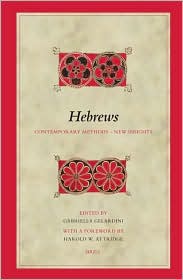
Hebrews: Contemporary Methods—New Insights. Edited by Gabriella Gelardini. Atlanta: Society of Biblical Literature, 2008.


I also ordered a copy of Common Judaism: Explorations in Second-Temple Judaism. Edited by Wayne O. McCready and Adele Reinhartz. Minneapolis: Fortress Press, 2008. But I'm considering this book for one of my graduate courses, so I got this one gratis. Woo-hoo (and thank-you)!

Wednesday, March 18, 2009

SECSOR—day 3 (pt. II)

The last session—New Testament V—was, well, the last session. As I said in my previous post, this was poorly attended, comparatively speaking, but that's par for the course for these types of things. It was too bad, too, because all four papers were interesting and well worth the twenty-five minutes it took to listen to each of them.

The first paper, "Blood, Life, and Purification: Reassessing Hebrews' Christological Appropriation of Yom Kippur," presented by David Moffitt (Duke University), questioned the traditional reading of Hebrews in which Jesus' death, rather than his resurrection (or his life) provides the greatest moment of atonement. This reading depends on the view that Jesus' resurrection doesn't figure (or figures very marginally) in Hebrews and by the analogy of "two great redemptive moments" of Yom Kippur: the slaughter of the sacrifice and the sprinkling of the sacrificial, atoning blood. Moffitt rebuts the first claim, noting a number of instances when the resurrection is actually present or can be inferred in the text. He also emphasizes that blood in the Hebrew Bible and in Hebrews means life, not death; he then offers some ways in which his reading solves some interpretive problems throughout Hebrews.

The second paper, "Anti-Imperialism and Historiography in the Temple Cleansing of the Gospel of John (John 2:13–22)," presented by Janelle Peters (Emory University), suggests that John's account of the Temple Incident takes aim at Roman imperialism and presence in the land. Unfortunately, while Peters was reading her paper, my phone began to vibrate and I had to leave the room momentarily, and so my recollection of her paper is significantly flawed. In addition, I am not at home among Johannine scholarship. But I do vaguely (and so unhelpfully) remember thinking that her thesis was interesting and worth pursuing. I hope to hear her work presented in a future meeting, preferably one in which I can devote my attention with fewer distractions.

The third paper, "'Where the body is, there also the eagles will be gathered': Eschatology and the Arrest of Jesus in Luke's 'Little Apocalypse' and Passion Narrative," presented by T. J. Lang (Duke University), offered a reading of Luke 17.37 hinted at in the paper's title. Lang reads ἀετός ["eagle" or "vulture" (BDAG; s.v.)] as "eagle" and suggests that the Lukan Jesus is incorporating Rome in the saying regarding the circumstances of Jesus' parousia (Lang properly notes that Matthew, not Luke, mentions the parousia). His argument doesn't rely so much on the eagle as a Roman symbol (cf. Ant. 17.151ff.; War 1.650ff.) but rather on ἀετός as an imperial symbol in the LXX. This reading offers some intriguing possibilities for the Lukan gospel, especially the links between the Passion narrative and the travel narrative and for other things besides.

The fourth paper, "Matthew 26:64 and the Enthronement of Jesus," presented by Nathan Eubank (Duke University), read the Romans' parody of Jesus' enthronement (purple garment, crown of thorns, reed for a scepter, etc.) and Matthew's parody of the Romans' parody. I liked the the point that in Matthew's account the parodic has become ironic. A lot of good stuff in this paper, but unfortunately it was the last of the session and so my mind was halfway out the door.

So many good things said about New Testament themes, but at such an unfortunate time. For those of us who were unable (or unwilling) to attend this final session in order to get a head start on the journey home missed some good stuff. And so I'm not too sorry that I can't provide more information on these papers; if you were really that interested, you should have been there! And yet I am disappointed in myself that I can't remember these papers better than I can (though Moffitt distributed copies of his paper, so his is *ahem* crystal clear in my mind . . . at least, it could be if I need it to be).

I'll wrap up some loose ends on SECSOR in one more post. Since the conference ended, now, three days ago, things are fading the grey in my inexorably aging memory. But for those of you so inclined and living in or near the American Southeast, I heartily recommend next year's SECSOR meeting (Atlanta, 5–7 March 2010).

Monday, March 16, 2009

SECSOR—day 3 (pt. I)

The New Testament IV meeting addressed the theme, Theological Issues in the Interpretation of the New Testament. The meeting started at 8.30 am, which wasn't really a problem, but the room had an unlocked door about three feet from the lectern, and from time to time a hapless late-arrival would open the door, take a step or two in, and realize their conspicuous location. That door should probably have had a sign on it. But otherwise, the meeting was interesting.

The first paper, "Christian Triumphalism and the Discourse of Christian Origins: The (Mis)Appropriation of the 'History of Religions School' in Contemporary Scholarship," presented by Diane Segroves (Vanderbilt University), began with the work of nineteenth-century Religionsgeschichtliche Schule ("history of religions school") co-founder Wilhelm Bousett and sought to demonstrate the (inherently?) triumphalistic perspective masked by a "scientific" approach to the history of religion (see, e.g., the problems attached to spät Judentum ["late Judaism"]). She then focused her attention on the work of the "New History of Religions School," including Martin Hengel but especially Larry Hurtado. Like me, Segroves is also looking at the consequences of the essentialization and categorization of Judaism and Christianity as distinct phenomena, though she approaches these questions from a theory of religion perspective (whereas I am trained as a biblical scholar). She helpfully distinguishes the tasks of seeking after origins (genealogy) and pursuing comparative analyses (analogy). And though she does identify some interesting (and problematic) continuities between Hurtado and Bousett, I'm not sure she's adequately accounted for the very significant differences. Of course, she only had twenty-five minutes, and she could only do so much.

The second paper, "Neglecting Widows and Serving the World? Acts 6:1–7 as a Test Case for the Promise of 'Narrative' in Theological Exegesis," presented by Joel B. Green (Fuller Theological Seminary), problematized the distinction between history and theology in Luke-Acts and attempted to show and the two not only inform one another but are pursued simultaneously in the narrative. He offers the intriguing suggestion that Luke does not narrate the apostles' delegation of "table-service" [διακονεῖν τραπέζαις; 6.2] positively, but that he views their shirking of this responsibility negatively. Green's reading takes into account the description of the community's unity (threatened in 6.1–7) as a work of the Spirit and suggests that, in Luke's point of view, the rupture of that unity was an affront (attack?) to the Spirit. This is precisely, again from Luke's point of view, what the apostles should have been concerned with. I like this. I have argued in a couple of unpublished papers that Luke has a subtle but still negative view of a number of episodes often read positively, in particular the story of Gamaliel (Acts 5) and of the split between Barnabas and Paul (Acts 15). Despite my appreciation of Green's paper, I wonder how much Luke might have been satisfied not that the disciples delegated the responsibility for serving tables but that by appointing the Seven the disciples were making provision for this to be taken care of. In other words, the apostles didn't ignore table-service, and I'm not sure Luke would have insisted that they ought to have served tables directly rather than indirectly.

The third paper, "Could it be Satan? A Narrative Ethical Reading of the Ananias and Sapphira Story, Acts 5:1–15," presented by Douglas Hume (Pfeiffer University), continued a narrative reading of the Acts (see Green's paper, above), and explored the implicit role that s/Satan and or wicked spiritual forces were at play in the Ananias and Sapphira story. I remember being reminded of Luke's demonological language for stories that in otherwise don't seem to concern demons or spirit-possession (the healing of Peter's mother-in-law [Luke 4.38–39; cf. Mark 1.29–31] and the healing of the bent woman [Luke 13.11–13]). Sadly, after that I was distracted, and by the time I came back to Hume's paper I had missed too much to really remember how he argued his point. This isn't a criticism of his paper; I think I just hadn't had enough coffee. If you know Douglas Hume, please convey my apologies.

The fourth paper, "Reinterpreting the Shema: Covenantal Theology in the Fourth Gospel," presented by Lori Baron (Duke University), was an excellent paper examining the Shema (Deut. 6.4–9) as context for John's gospel. Famously, all three synoptic gospels, and probably Paul, cite the Shema at some point. (Actually, I think the Shema is formative for Pauline theology, especially the vigor with which he defended gentile inclusion apart from circumcision, kashrut, etc.) John, however, doesn't. But Baron rightfully notes that the language of "oneness," especially as it applied to God, is rampant throughout the Fourth Gospel, and she argues that the Shema is in the background here. Well, I'm not sure Baron used the word "background," and if she did I don't like that term. Rather, I think we can examine the ways the Shema may have framed the theology inscribed in the narrative and the text's reception in the first century. In my opinion, Baron's argument sounds a lot like Daniel Boyarin's very intriguing midrashic reading of John's Prologue in Border Lines (University of Pennsylvania Press, 2004). This reframing of John's gospel in more thoroughgoing Jewish terms offers some intriguing possibilities for understanding the text. Baron's paper was an interesting and exciting part of that larger project.

After the New Testament IV session, there was only one more meeting before the conference ended. I debated skipping the last session, but decided against it (there were some paper titles I thought were intriguing). Then I debated leaving early (I was really missing my family at this point), but decided against it (there were only five of us in the audience, and the presenters deserved to have us there). All four papers were interesting, and I'm glad I stayed. I'll have to tell you about them. But later, in the next post.

Saturday, March 14, 2009

SECSOR—day 2 (pt. II)

I am currently cutting the New Testament III meeting, which features a panel discussion of Joel B. Green's Body, Soul, and Human Life: The Nature of Humanity in the Bible (Baker Academic, 2008). I've not read the book, and since it isn't narrowly aligned with my current interests I'm not likely to for a while. Plus I'm not very keen on panel discussions of books, which isn't to say they're pointless but that I, at least, don't readily see the point. Unless someone wants to have a panel discussion of Structuring Early Christian Memory, in which case I very readily see the point. And so should you.

At any rate, I did attend the New Testament II meeting, which focused on the theme "The Gospels and the Historical Jesus." The first paper, "Making Matthew's Genealogy Count," presented by Stephen Carlson (Duke University), considered the numerical problem of Matthew's genealogy (viz., that Matthew claims forty-two generations from Abraham to Jesus but lists only forty-one, unless we posit a "missing generation" or we count someone twice). Carlson very reasonably suggested that Matthew (or Matthew's source) intends David to be counted twice (he's named twice in 1.6, but more significantly named twice in 1.17). I can't shake the feeling that trying to figure out the mathematics of Matthew's triple series of fourteen generations (γενεαὶ δεκατέσσαρες) is a bit like trying to learn chemistry from a cookbook: The chef doesn't need to focus narrowly on why sugars caramelize under heat or alcohol evaporates in the pan; she just takes advantage of the fact that it does. So also for the explanation of Matthew's genealogical account: no matter how we think Matthew got to fourteen (inclusive counting here, exclusive counting there, counting someone twice or [unusually] reckoning the "Babylonian deportation" [μετοικεσία Βαβυλῶνος] in the counting, or whatever) the important thing is that he does. I don't think, then, that we should read 1.17 in light of 1.2–16 but the other way round: 1.17 tells us how to read 1.2–16. I'm not entirely sure if Carlson would agree with me here, but that's okay.

The second paper, "The Son of Man Must Suffer and Die," presented by Michael Zolondek (Florida International University), set out to authenticate the complex of tradition in Mark 8 from Peter's confession through Jesus' Passion prediction, Peter's rebuke [ἐπιτιμάω] of Jesus, and to Jesus' counter-rebuke of Peter as Satan [Σατανᾶ; 8.33] and one who has in mind human rather than divine things [οὐ φρονεῖς τὰ θεοῦ ἀλλὰ τὰ τῶν ἀνθρώπων]. Zolondek's employed fairly standard historical Jesus tools, especially the criterion of embarrassment, in his discussion of this passage, and (again) as an example of biblical historical criticism this was fairly representative of the field. My problem, soon to be published in multiple venues, is that the traditional historical-critical tools are bankrupt (to echo strongly April DeConick's thoughts [start here]). The argument that the early church wouldn't have created this or that bit of Jesus tradition (that Jesus was baptized by John, or that Peter was the satan, or that Jesus was demon-possessed, or whatever) fails to explain, then, why the early church preserved and reproduced those traditions in their performances—written and oral—of the Jesus story. I deal with this fairly extensively in ch. 7 of Structuring Early Christian Memory, so I won't rehash the arguments here.

The third paper asked, "Did the Evangelist Compose Matthew 13:36–43 and 13:49–50?" presented by Delbert Burkett (Louisiana State University). If you've read his Rethinking the Gospel Sources: From Proto-Mark to Mark (T&T Clark, 2004; helpfully reviewed here by Michael Pahl), then you know that Burkett takes an unusual (idiosyncratic?), decisively literary approach to the synoptic problem. Again, I am publishing on this very area and have serious problems with a paradoxically simplistic over-complication of the literary relationships of written texts. In my view (which features prominently here, if nowhere else), the texts are better conceptualized as embodiments of the Jesus tradition, but for all their material existence and potential (and even actual) influence over other embodiments of the Jesus tradition—written or oral—they remained in the first century embodiments and not text-fixations of the tradition. To identify one argument that I think needs some question, Burkett queried J. Jeremias's list of evidences for Matthean composition in the texts named in his title, and for a number of them noted the ambiguity of the evidence (i.e., that what Jeremias takes as evidence of Matthean composition may reflect Q, or may come from Mark, or may be characteristic of the tradition more broadly). But then when he moves to formulate his own position—that Matthew was a compiler rather than a composer—the ambiguity disappears and he has shown that supposed clues of Matthean composition are rather more meagre than Jeremias thought. I'm not sure the two options presented—compiler or composer—adequately captures the breadth of options available for us to think about the relationship between the evangelist and the gospel. But again, see my forthcoming Structuring Early Christian Memory.

The fourth paper, "Mark 7:15: A Scatological Approach," presented by Matthew Thiessen (Duke University), considered afresh the precise nature of the debate (and the conclusions) between Jesus and the Pharisees in Mark 7. Thiessen calls to our attention the failure of contemporary critical discussion of this passage to consider the physiologically obvious referent of τὰ ἐκ τοῦ ἀνθρώπου ἐκπορευόμενα ["things that come out of a person" (I'm tempted to type ἀνθρώπου)] is, well . . . scat. Thiessen doesn't adopt this reading himself, namely that Jesus considers defecating as a process resulting in impurity, but the question does bring some interesting evidence from (or, better, about) Qumran into view. Thiessen never referenced the lengthy discussion of Mark 7 in James Crossley's The Date of Mark's Gospel (T&T Clark, 2004), but in the post-presentation discussion he said he was familiar with (and persuaded by) James's reading (specifically of Mark 7.19b). I'm still not convinced that Mark has only kosher foods in view at 7.19b, but I agree with Thiessen (and Crossley) that Mark 7, along with other NT passages, portray Jesus as thoroughly engrossed in and affected by purity issues. That is, Jesus belongs to a socio-cultural world were purity—its loss, its renewal, its special role in relating to the Deity, etc.—just is a fact of life, like being licensed to drive a car in twenty-first-century America. Jesus isn't scandalized by purity because he never lived in a world where purity wasn't already always in the air. Now I've gone significantly beyond Thiessen's paper, but his arguments were variously suggestive for me, and I enjoyed his paper (despite its crappy title).

So as I say, I've avoided the New Testament III meeting. The New Testament IV meeting (tomorrow at 8.30 am) looks interesting. I'll comment on it tomorrow.
SECSOR—day 2 (pt. I)

This morning was the first section focusing on NT issues; the section was appropriately, if not creatively, entitled "New Testament I," and all four papers focused on Paul and/or Pauline materials (viz., Romans, 2 Corinthians, Galatians, and the Pastorals and The Acts of Paul and Thecla).

The first paper, "Gentiles Who Keep the Law: Paul's Law-Keeping Gospel," presented by Jason Staples (University of North Carolina, Chapel Hill), examined the second half of Rom. 2, especially from 2.14 onward, and reappropriated this section of Paul's epistle for the core (rather than the margin) of Pauline theologizing. Staples attempted in particular to bracket questions of what Paul could or could not have said, especially from the point of view of traditional "justification by faith" theology, and to first ask what's going on in the Pauline text. I always find this type of endeavor, no matter how successful, as a useful reminder to keep the horse before the cart. I am especially interested in the thoroughly Jewish recontextualization of Paul and his writings, and I'm less interested in efforts to portray Paul's as a "Law- (= "Torah-") free gospel." Staples did an interesting job at showing how important a role both Israel and the Law—the Torah—play in Paul's theological discourse. For what it's worth (admittedly, very little), the paper I've proposed for the 2009 SBL Annual Meeting in November, entitled "Pulling at Paul: Romans 15 and Constructing the Christian Self" and taken up with a rereading of Paul's cultic language in Romans, especially chapter 15, considers very similar issues.

The second paper, "The 'Circle of Grace' in 2 Corinthians 1," presented by Hans Arneson (in the Graduate Program in Religion, Duke University), attempted to untangle the vexing phrase at 2 Cor. 1.11b [ἵνα ἐκ πολλῶν προσώπων τὸ εἰς ἡμᾶς χάρισμα διὰ πολλῶν ευχαριστηθῇ ὑπὲρ ἡμῶν; "so that many people would give thanks for our sake for the gift [given] to us by many" (?)] via a less complicated passage, the "circle (or "cycle") of grace" in 2 Cor. 8–9. In the latter text Paul presents the cycle as one in which the Corinthians receive "in excess" from God, and from their excess give to "the saints in Jerusalem," who in turn do not give thanks to the Corinthians but to God who gave the excess. Arneson applies this model to 2 Cor. 1 and interprets χάρισμα as παράκλησις, a point strengthened by the clustering of παρακλη- language in chapter 1.

The third paper, "Androgyny and the Rhetoric of Conversion: Galatians 3:28c and the Problem of Audience in Galatians," presented by Ben White (University of North Carolina, Chapel Hill), won an award as the best graduate paper of the meeting (if I remember correctly; my apologies if I've misremembered the nature of the honor). White explored recent considerations of "the pagan world of the Galatians" and though was ultimately unconvinced by them (esp. that the rise and/or popularity of the Imperial Cult provides the best reconstructed originative context for Paul's epistle) does agree that Paul is aiming at a pagan context. White exploits the third deconstructed pairing of Gal. 3.28 [οὐκ ἔνι Ἰουδαῖος οὐδὲ Ἕλλην, οὐκ ἔνι δοῦλος οὐδὲ ἐλεύθερος, οὐκ ἔνι ἄρσεν καὶ θῆλυ; "There is neither Jew nor Greek, neither slave nor free, neither male and female"], and especially the unexpected shift from οὐκ ἔνι . . . οὐδέ in the first two pairs to οὐκ ἔνι . . . καί in the third to argue that this makes better sense—much better sense, in fact—in an ethnic, northern Galatian context. I have serious questions about this thesis, in particular whether such a short passage (and I agree that οὐκ ἔνι ἄρσεν καὶ θῆλυ is not ancillary but just as important as the previous pairings, even . . . Ἰουδαῖος οὐδὲ Ἕλλην) can bear such reconstructive weight. Still, also a very interesting paper.

The fourth paper, "Reception of the Pastorals in the Second Century: A Test Case Looking at The Acts of Paul and Thecla," presented by Jeremy Barrier (Heritage Christian University) argued against a literary or even direct oral traditional relationship between the Pastoral Epistles and the second-century Acts of Paul and Thecla. I'll be honest here; I read more of Paul and Thecla while Jeremy was presenting his paper than I ever have throughout the course of my life, so much of the presentation was even further from my expertise than the other papers. Even so, his discussion of oral tradition and his refutation of an oral relationship between texts was interesting. I do think Jeremy evinced some of the standard (but still problematic) assumptions about oral tradition that are endemic in biblical studies (more on this later, I'm sure), but he can hardly be faulted for making assumptions consistent with the state of the question. (If I'm being too cryptic here, let me just say—only minimally less cryptically—that biblical scholarship too easily reifies oral tradition and treats as a thing rather than as a process or [a] set of processes that contextualize and frame [rather than serve as sources for] written traditions. But as I say, more on this later.) Jeremy's PhD dissertation, a commentary on The Acts of Paul and Thecla, is due out later this year by Mohr Siebeck. Interestingly, he has changed his view precisely with respect to the question of a literary relationship between Paul and Thecla and the Pastorals since writing his PhD. I gently recommended that rather than trying to revise his monograph perhaps he should just publish it as is and then publish an article later in the year taking the most recent commentary on Paul and Thecla to task!

After the New Testament I meeting I attended the plenary session, and for reasons of professional courtesy I won't make any comments here about that. [comment deleted] I did lunch in the convention hotel, which is to say I payed too much for too little food and no refills on my soda. And since this is my first regional SBL meeting (I don't count the International SBL meeting I attended in July, 2004, which is nevertheless somewhat similar) I'm struck by (a) how small the meeting is, and (b) how many other conventions are going on at the same time and seemingly in the same space as SECSOR. I take heart, however, that the attendees of other conferences are looking at me just as cross-eyedly and askance as I at them. Hold on just a sec . . . 

Oh yeah, buddy?! I'm not an MD; I'm a REAL doctor!

Sorry 'bout that. I'll write more later.

SECSOR—day 1

Today was the first day of the 2009 Southeastern Commission for the Study of Religion meeting, the combined AAR, ASOR, and SBL southeastern regional meeting. I didn't attend any of the Session I meetings, but tomorrow there are a few sections to which I'm looking forward and about which I plan to write.

But I did hear two presentations tonight: first, Rebecca Todd Peters (Elon University), President of the regional AAR, presented her paper "Beyond the Financial Crisis: Rethinking the Moral Foundations of Political Economy."  Peters's paper was very interesting, especially given my affinity for capitalism. Peters, perhaps predictably, finds fault with the capitalist system, primarily in its assumption (reification?) of an individualistic anthropology. As a biblical scholar with a penchant for sociological theory, I found a lot to agree with in her critique of the individualistic foundations of Western culture (and especially economics), though I did not see myself in her description of capitalism. What made her paper interesting (and not just anti-capitalistic tripe, which it certainly was not) was her refusal to advocate a dehumanizing (my word) socialism that denied the importance of the individual. The task before all of us—whether you identify as a capitalist or otherwise—is to maintain a respect for and appreciation of the individual while simultaneously appreciating (and accounting for) the individual's embeddedness in social worlds. I'm not sure Peters's paper did this, but her call for a prophetic rather than a profit-centered motivation was interesting. I'm not sure these are mutually exclusive, but I think she's right that the prophetic conscience (and calling) ought to have economic impact. Other thoughts swirling in my head, but I must move on.

Second, Scott Spencer (Baptist Theological Seminary in Richmond), President of the regional SBL, presented his paper, "Can We Go On Together With Suspicious Minds? Doubt and Faith as Both Sides of the Biblical-Interpretive 'Coin' (Luke 15:10)." Spencer's presentation was significantly more sermonic than was Peters's, but it was a serious academic discussion in its own right. Spencer challenged both perspectives—that suspicion ought to be the guiding principle in biblical appropriation, and that suspicion is invalid as an aspect of appropriating the Bible, even in communities of faith. Spencer focused on Feminist biblical critiques, which he both valued and appropriated critically (a refreshingly new approach, in my own limited experience). Spencer presented four considerations with respect to the Feminist employment of (and suspicion towards) suspicion as a hermeneutical tool, and I wish for the life of me that I had taken these down. He then finished with a brief reading of Jesus' "Lost Parables" in Luke 15, and especially the Parable of the Lost Coin. Spencer makes a case for the role of suspicion in motivating ongoing, tenacious, persistent engagement with the text, an engagement that may be motivated by a belief that to whoever seeks (ζητέω; cf. Luke 15.8) God in the text will find him.

All in all a promising start. I won't disclose how much I've spent on books (in case my wife looks online), but I will have some 'splainin' to do when I get back. I hope to summarize tomorrows meetings tomorrow, while they're still fresh.

Tuesday, January 27, 2009

SECSOR meeting (13–15 Mar 2009)

If you're planning on attending the 2009 SECSOR meeting (Chapel Hill, NC), and you're looking for someone to share a room with, leave a comment below and some way to contact you.

My Visual Bookshelf