I've started reading David C. Parker's short little book,
The Living Text of the Gospels (Cambridge: Cambridge University Press, 1997). This is an epoch-changing book, both for the studies of the gospels (and other early Christian written texts) and for text-critical research. Fifty years ago New Testament text critics may have been fairly confident regarding the goal of their research—
viz., the recovery of the original text of the writings of the NT. Today, however, most text critics and a growing number of NT scholars more generally are coming to question both the utility of "original text" as an academic pursuit and the utility of text-critical methods for uncovering (or recovering) the prized "original text." David Parker's book is an important factor behind this shift:
Instead of eliminating material in order to recover a single original text, the editor analyses all the developments of the material in order to demonstrate the processes to which they owe their origin. The textual critic's task has not become less important because there is no definitive text to be recovered. There is a sense in which an editor's continuing importance has increased. For when it is assumed that there is an original text [original emphasis], the textual critic's task is very simple: to recover the original text. The user then offers grateful thanks for the definitive product, and gets on with the interpretation, while the editor goes in search of another text to polish off. But if the task does not consist in recovery of an original text, then the study of the entire range of materials available will not cease with the publication of an edition. . . . [T]he quest for an original text need not be the only option available to the modern textual critic, or the only expectation of the modern reader. Returning to the Gospels armed with these possibilities, we ask this question: are the Gospels the kinds of texts that have originals? (6, 7; my emphasis)
At any rate, enough of the introduction to the current state of text-critical research. I'm actually very interested in a comment Parker makes regarding an illustrated manuscript of the Pentateuch. This example, I think, illustrates the kind of claim I make regarding early copies of the written gospels (by "early," I mean of the first three or four centuries). Namely, I suggest that we should read the written texts of the gospels as
moments or
instances of the Jesus tradition rather than as standard, fixed, "canonical" versions of that tradition. In the earliest Christian centuries the Jesus tradition was considerably more fluid than we experience it today (though we should recognize that even today we are comfortable with a surprise level of fluidity; consider as one example the myriad nativity displays every year sporting both angelic hosts and Magi worshiping the baby Jesus, despite the fact that not one single text bring angels and Magi together with Mary, Joseph, and the new-born Christ). Did Matthew, as one who performed the Jesus tradition,
always include eight beatitudes in the third person and one in the second? Did Luke, as another performer,
always limit himself to four beatitudes (in the second person)? And did he
always pair his beatitudes with corresponding woes? I find it unlikely, though providing documented support for my opinion here is especially difficult. So I was especially interested in the following, which seems, at least, to support my approach to relating text and tradition:
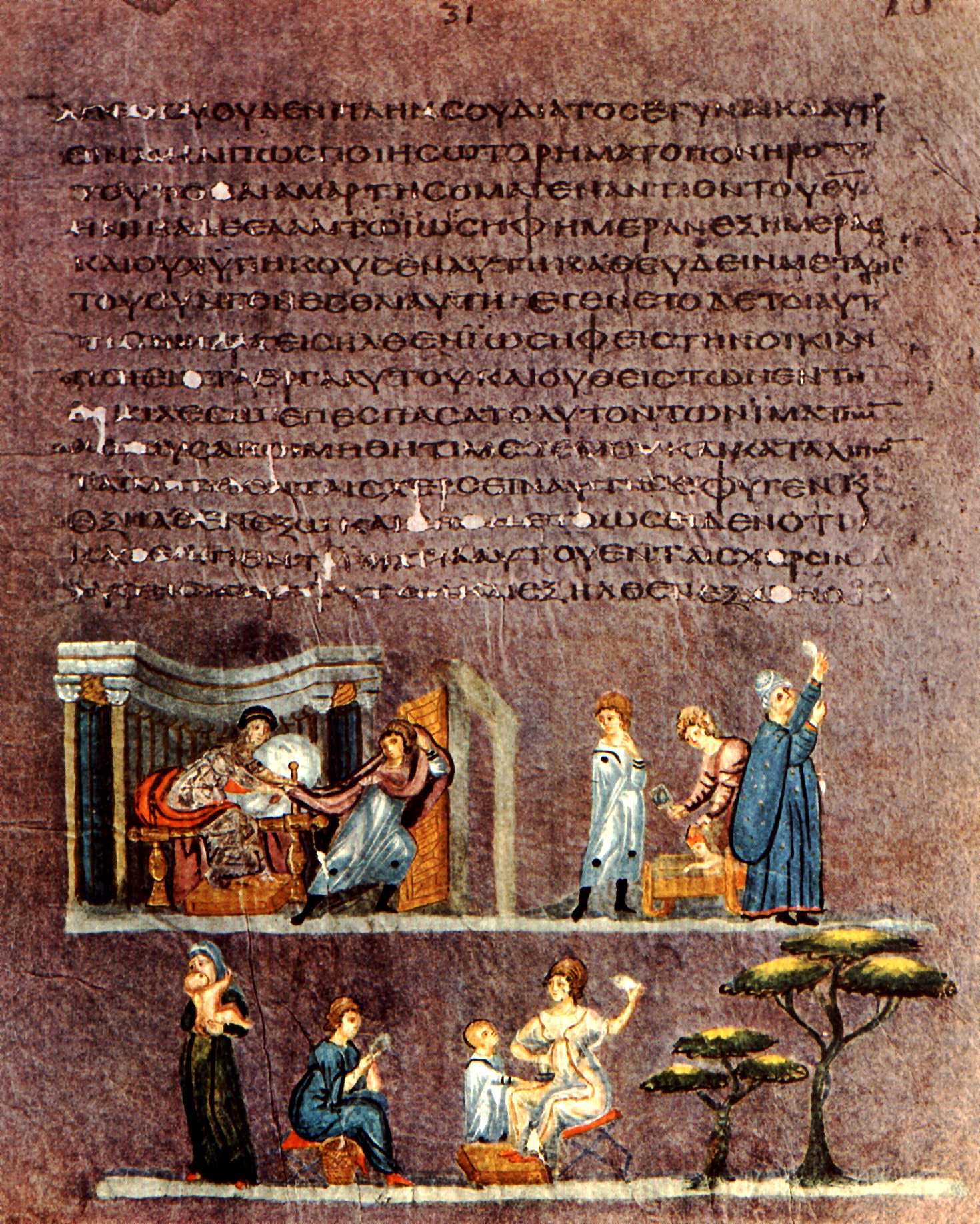
The provision of pictures places the text in a different light for the reader. This may best be illustrated by the example of a manuscript of the Pentateuch. It has a series of miniatures accompanying the story of Joseph. But the miniatures contain material and scenes which are found in Jewish apocryphal writings, and not in the written text of the Genesis. Thus the entire manuscript, text and pictures, is telling a different story from that found in the text alone. (27; the manuscript in question is the Vienna Genesis)
I don't think I agree with Parker's last point. "The entire manuscript" isn't telling "a different story from that found in the text alone." Rather, the manuscript is telling a
larger story from that found in the text alone. For its intended audience, this "larger story" was already invoked and evoked by the manuscript. This is the only way, as far as I can see, why an illustrator would think it okay to illustrate a biblical manuscript with scenes from apocryphal texts. That is, the written text was a
moment or
instance of the larger Joseph tradition. And it doesn't much matter that the written text doesn't narrate other moments or instances of the tradition, some of which are only found in apocryphal writings. Text and tradition belong together, and this "belonging together" happens within the audience, at the moment of reception, rather than within the text. Unfortunately, that means it's much more difficult—and often impossible—for us to see today how text and tradition relate to one another. But every now and then we get a glimpse of the larger traditional connections, and these glimpses remind us not to read our written texts too narrowly, too myopically, or with too great a restriction on what
we think a text does
not say.