Friday, May 27, 2011

Constructing Jesus

I just started Dale C. Allison, Jr.'s most recent (and, apparently, final) contribution to historical Jesus scholarship, Constructing Jesus: Memory, Imagination, and History (Baker Academic, 2010). I have the privilege of writing a review essay for an upcoming issue of The Journal for the Study of the Historical Jesus; the standard format of these kinds of things is that two or three people will offer reviews of a significant recent publication, and the author will respond to each of the reviewers. I've never done anything like this before, so I'm looking forward to this. (Allison and I are also co-participants in an upcoming conference on "the demise of the criteria of authenticity," to be held on Lincoln Christian University's campus in 2012 and for which a volume will be published by T&T Clark International.)

At any rate, I really have only just started reading this book; to date I've only read the preface. But already I like what I'm reading, especially as I compare it to Allison's previous work on Jesus (especially his volume, Jesus of Nazareth: Millenarian Prophet [Fortress Press, 1998]):
This volume as a whole is testimony to my conviction that the means that most scholars have employed and continue to employ for constructing the historical Jesus are too flimsy to endure [yes!!], or at least too flimsy for me to countenance any longer. I learned the discipline during the era when everyone was taught to employ the so-called criteria of authenticity. We were to find Jesus by, first, isolating individual units and then, second, running them through a gauntlet consisting of multiple attestation, dissimilarity, embarrassment, and so on. After many years of playing by the rules, however, I have gradually come to abandon them. I have decided that knowing the old directives has been of much less help than promised. I am trying something else. This book is the result. (x; my emphasis)

This is, perhaps, the best beginning to a book on Jesus I've read in a very long time. And that would include my own book on Jesus.

I'll comment further as I work through this weighty book (pp. xxix + 588).

Thursday, May 26, 2011

400

No, it's not a sequel to the film, 300. It's the number of posts with which I've cluttered Al Gore's Internet. (Actually, this is no. 401; the four-hundredth had the unfortunate title, "contrasts (or, not ridiculicity)." I don't even know what that means . . .)

Tuesday, May 24, 2011

contrasts (or, not ridiculicity)

In contrast to that other article I was reading, Samuel Byrskog's 2003 review of Rudolf Bultmann's classic, Die Geschichte der synoptischen Tradition [1921; ET: History of the Synoptic Tradition (1963)] strikes me as both fair and appropriate. I have my own disagreements with Byrskog's approach to memory and oral tradition, but his evaluation of Bultmann's work and its legacy seems pretty cogent to me. So I appreciate the force with which Byrskog gives the following blunt assessment:
The fundamental problem with Bultmann's method is not its inherent skepticism toward the historicity of the tradition. Occasionally he grants a good deal of continuity to the tradition; and skepticism is indeed part of all critical investigations. Rather, what is essentially problematic is precisely that his method does not work as a tool of historical inquiry. (Byrskog, "review of The History of the Synoptic Tradition" [JBL 122/3 (2003)], 554; emphasis added)

Byrskog goes on to demonstrate the unworkability of Bultmann's method; this is not simply dismissive invective. And so the blunt assessment is not only warranted but also welcome.

ridiculicity

I'm reading a fairly ridiculous article by Helmut Koester. His short piece, "Written Gospels or Oral Tradition?" (JBL 113/2 [1994]: 293–97) responds to Edouard Massaux's argument that the written Gospel of Matthew bore significant influence on other Christian texts of the first two centuries CE. Koester, of course, argues that apparent Matthean tradition in 1 Clement, Ignatius' letters, Justin Martyr, Irenaeus, and others actually stem from oral tradition. And it seems to me that Koester says a number of silly things. For example:
When pieces of tradition are quoted and used in early Christian authors, their function in the life of the community is usually maintained. Indeed, it may not even be necessary to refer to them as traditions related to Jesus. This is most clearly the case in Paul's allusions to sayings of Jesus in Romans 12–14, in 1 Peter, and in the Epistle of James. As far as writings such as 1 Clement, Barnabas, and the letters of Ignatius are concerned, use of sayings of Jesus and allusions to them would seem to be natural continuations of this practice, whether or not Jesus is explicitly mentioned as an authority. Sayings of Jesus were known because they had been established as parts of a Christian catechism; the passion narrative was known because it was embedded into the Christian liturgy. (Koester 1994:297; emphasis added)

The entire perspective informing this paragraph seems absurd to me. Notice how Koester privileges a tradition's "function in the life of the community" over its significance as a "tradition[] related to Jesus." When, for example, a Christian text says something like, "Bless those who persecute you; bless and do not curse" (Rom. 12.14), that text is clearly performing certain functions among the Christian community. However, when another text narrates Jesus saying something to this effect (e.g., Matt. 5.43–48), the latter text is less authentic because its communal function has been muted. (That is, in Romans 12 Paul is overtly trying to persuade the Roman Christians to think and behave a certain way; in Matthew, the Evangelist may be endorsing certain patterns of thought and behavior, but his endorsement is covert, masked by the overt aim of narrating the life and teaching of Jesus.) I can't help but wonder where Koester thinks Jesus' followers procured the traditions that were at work in their communities if not from the teachings of the historical Jesus. I'm not even claiming that such traditions had to actually stem from the historical Jesus; only that the tradition's significance as a "tradition[] related to Jesus" must be more salient than any purported "function in the life of the community."

But even more to the point, I don't understand how Koester can claim that Jesus' teachings "were known because they had been established as parts of a Christian catechism," or that "the passion narrative was known because it was embedded into the Christian liturgy." Koester is clearly a fan of putting carts before horses. Where does Koester think Christian catechisms and liturgy came from if not from the sayings and passion of Jesus, among other things? Instead, the teachings of Jesus and the passion narrative were known because they were foundational to the beliefs and practices of Jesus' followers. As a result, their catechisms and liturgy reflected his teachings and passion. While the catechisms and liturgy might have been vehicles of the traditions of Jesus' teachings and passion, they were not the motivation or reason for knowing these traditions. Otherwise, Koester needs to explain what motivated the church's catechisms and liturgy.

Ridiculous.

Monday, May 23, 2011

on heavenly citizenship

When I was writing my Master's thesis on 1 Peter, one of the things that most impressed me about that letter was the language of "aliens and foreigners" at key points in the text (1.1, 17; 2.11). Paul exhibits a similar idea in a text that Tim Gombis cites in his discussion of the "cruciformity" (or "cross-shaped-ness") of Paul's ethical instructions (see Gombis's Paul: A Guide for the Perplexed [T&T Clark International, 2010], 73):
But our citizenship is in heaven, and it is from there that we are expecting a Savior, the Lord Jesus Christ. He will transform the body of our humiliation so that it may be conformed to the body of his glory, by the power that also enables him to make all things subject to himself. (Phil. 3.20–21)

While I don't have a problem with Paul's point here, I really don't like the way we in the church often read this idea of "citizenship in heaven." We often think a Christian worldview denigrates or diminishes the value of this world—and the pains it inflicts—by way of realizing our citizenship is in heaven. Are you struggling in this world? Don't worry; our citizenship is in heaven. Wondering why good people suffer? It doesn't matter; our citizenship is in heaven. You're hungry or thirsty or naked or forsaken? Silver and gold I do not have, but our citizenship is in heaven.

I think neither God nor Jesus nor Paul would have accepted such an idea. Tim Gombis, however, has helpfully framed Paul's point in Philippians 3 and the idea that we live as subjects of God's kingdom. Gombis writes, "Just as the humiliation of Jesus led to exaltation and glorification, so believers' humiliation for the sake of Christ will result in exaltation and glory" (73–74). This is the actual point at play here: Jesus was exalted to God's right hand and enthroned in the heavens because he sought out and served the poor, the dispossessed, the disenfranchised from Temple or Council or Legion. Seeking and serving the poor, however, led to the cross; it did not lead to recognition as a prophet or even as a philanthropist. And Christ en route to Calvary calls his own to take up their crosses and follow him. But beware. If you take up your cross, you will find yourself nailed to it one day.

Why would anyone take up their cross? Why would anyone lay down their life to help others find theirs? What makes this transaction attractive? Enter our heavenly citizenship. Status as citizens of heaven, of God's kingdom, enables me to serve this world and not just endure it. Heavenly citizenship doesn't denigrate this world; it elevates this world as the object of God's care and concern and call us to enter into and live out of the same care and concern.

This world matters gravely to God, and we the Church must recognize its importance. In those moments when we do recognize this world's value as the work of God's hands, we come alongside the hurting, the hungry, the homeless, the weak. We enter into their pain and disenfranchisement. And we apply to their wounds the balm of God's Spirit. And the kingdom of God, of which we are citizens advances against the ruler of this age.

Thursday, May 19, 2011

identifying Paul (again)

I'm currently reading through Tim Gombis's introductory volume, Paul: A Guide for the Perplexed (T&T Clark International, 2010). Of course, as I mentioned in a previous post, I read Rodrigo Morales's published doctoral dissertation, The Spirit and the Restoration of Israel: New Exodus and New Creation Motifs in Galatians (Mohr Siebeck, 2010), last week. So all things Paul have been on my mind these last few days.

Gombis's discussion of Paul is introductory and pitched at beginning ("perplexed") students, so of course there is lots of room to nitpick and complain about lack of nuance or precision. But the goal of the book isn't to provide nuance or precision; it's to speak in broad strokes and get people into the discussion. Details can come later.

So I hope it's clear that I'm not nitpicking here (or at least I don't think I am). And I should also disclose that I know Gombis personally, and I've found him to be one of the nicer, more congenial younger biblical scholars. I think he and I think a lot alike. But as Gombis briefly introduces Paul's letter to the Galatian communities, he attributes the problem Paul confronts to a "very conservative Jewish Christian faction . . . seeking to make certain that the Christian communities that sprang up in Asia Minor were thoroughly Jewish" (25). A little later, Gombis explains that Paul bristles against the claim that gentile converts "must adopt a Jewish way of life." I'm not sure what to make of Gombis's use of the term Jewish; even (or perhaps especially!) in an introductory volume such as this I think a little more nuance is necessary.

The problem comes down to this: If Paul sets out to correct the claims of the "agitators" (see Gal. 5.10) that gentiles "must adopt a Jewish way of life" (25), what should we think Paul set up as an alternative to that Jewish lifestyle? Should the converts remain gentiles? If so, we need to explain the continued negative references to gentiles in Paul's letters (e.g., Eph. 2.11–12; Gombis accepts Pauline authorship of all thirteen letters attributed to Paul). Should the converts become Christians? If so, we need to explain how Paul never uses the word Christian in any of his letters.

Since neither of these terms—gentile or Christian—will work for Paul, the question remains: What should we think Paul set up as an alternative to the Jewish lifestyle the "agitators" were advocating to Paul's gentile converts in Galatia? I think the only answer that will work, historically or theologically, is, Paul proposes a differently Jewish lifestyle to the universal Torah-obedience advocated by his opponents. If I learned anything from Morales (which I wouldn't expect Gombis to cite even if they weren't both published in 2010), Paul understands his vocation as "apostle to the nations/gentiles" in terms of bringing the blessing of Abraham to bear upon the nations of the Roman Empire, and this precisely because God has poured out his Spirit upon his people Israel and brought an end to their experiences of the covenantal curses (exile and, especially, death).

In other words, and to sum up Morales's point and wrap up this post, the problem Paul has with Torah in Galatians isn't that it's Jewish. The problem is that Israel has failed to keep the terms of the covenant and has brought upon itself the covenantal curses—exile and death (see Deut. 27–30)—rather than the covenantal blessings. But God has not abandoned his people or his promises to them; instead, Israel's messiah, Jesus, overcame the covenantal curses brought on by Israel's failure to observe Torah. (Notice the problem isn't Torah itself but the people's failure to keep Torah.) Now the gentile Galatian believers have a choice to make. Do they take on a Jewish lifestyle defined by Torah? Or do they take on a Jewish lifestyle defined by the blessing of Abraham, now unleashed on God's people in the aftermath of God's Spirit poured out on Israel and a new heart given them? This latter might be what we mean when we refer to a "Christian lifestyle," but we need to recognize (and teach others to recognize) that in all likelihood, for Paul, this was simply a better way to be Jewish.

Tuesday, May 10, 2011

a Pauline transformation of Jewish eschatology?

I have been reading the published version of Rodrigo Morales's PhD dissertation (Duke, 2007), The Spirit and the Restoration of Israel: New Exodus and New Creation Motifs in Galatians (WUNT 2/282; Tübingen: Mohr Siebeck, 2010), which I'm reviewing for IBR. This is an excellent little book (only two hundred pages) that is very clearly and logically structured, cogently and carefully argued, and concisely written. As a brief introduction, Morales proceeds in three basic steps:

  • First, he briefly establishes the Status Quaestionis of the role of the Spirit of God in Paul and, especially, his letter to the Galatians. At a pivotal point in the letter Paul asks, "Was it by works of the Law that you received the Spirit? Or was it by hearing of faith?" While the answer is clear (Paul simply could not be proposing that the Galatians received the Spirit via Torah-observance!), the significance of the Spirit for Pauline thought and rhetoric is not. Morales argues that the connection between the outpouring of God's Spirit and the restoration of Israel provides the key to understanding Paul's argument in Galatians.
  • Second, he surveys the intersection of God's gift of his Spirit and the promise of Israel's restoration among the prophetic Hebrew biblical writings (specifically, Isaiah, Ezekiel, and Joel) in Chapter 2 and among Second Temple Jewish texts in Chapter 3. His aim is not to identify how Paul reads either biblical or extracanonical texts but rather to assess how Paul takes up and employs themes and concepts current among (roughly) contemporaneous expressions of Jewish thought. Key among these themes are, among others, new creation and new exodus imagery, the heart and its need for renewal, and the sonship of God's people.
  • Third, Morales turns to Galatians 3–4 (Chapter 4) and Galatians 5–6 (Chapter 5) to bring the material from previous chapters to bear on the exegetical discussion. I am currently at the beginning of Chapter 4, so I cannot say very much at all about Morales's hermeneutic or exegetical work. But his handling of the texts in Chapters 2–3 has been responsible and cautious, and so I don't anticipate problems here.


Except . . .

Morales makes a comment almost in passing (it's even in a footnote) regarding the shift in late-Second Temple Judaism from metaphorical understandings of "resurrection" (and of "death," too) toward literal interpretations. He says, "The key transformation that Paul brought about was the idea that one figure would be raised in the middle of history, and that others would somehow participate both anticipatorily and ultimately in that eschatological life" (79, n. 5; my emphasis). I have some problems with the phrase "middle of history," because I'm not sure that helpfully frames Paul's rhetoric. Would Paul affirm the present as "the middle of history"? Or would he see in Christ's resurrection the dawning of the new age and the fading of the old? But given the complexities of the dynamics of what are commonly referred to in Christian theology as the "now-and-not-yet" (complexities which Morales recognizes), we likely won't solve that problem here.

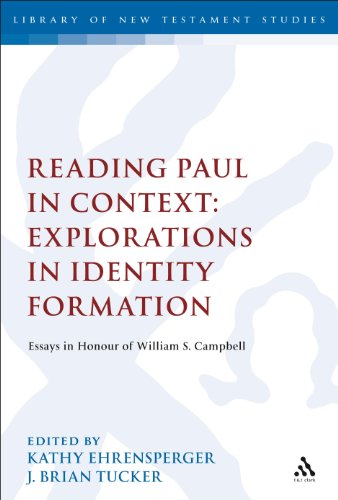
But I have bigger problems with the idea that this was, somehow, a "key transformation" for which Paul was responsible. I'm not at all opposed to the idea that individuals affect, sometimes dramatically, how and what their cultures think. And clearly Paul is one of those individuals. But after reading Jerry Sumney's essay, "'Christ died for us': Interpretation of Jesus' Death as a Central Element of the Identity of the Earliest Church," pp. 147–72 in Reading Paul in Context: Explorations in Identify Formation (FS William Campbell; Edited by K. Ehrensperger and J. B. Tucker; LNTS 428; London: T&T Clark International, 2010), I'm a bit more suspicious of the image of Paul-the-theological-revolutionary than I previously was.

Certainly Paul takes this idea—viz., that the future resurrection was inaugurated and even is proleptically exprienced in Christ's resurrection—and advances it considerably. But here's the question Sumney has taught me to ask: Is it really likely that the pre-Pauline church had not already developed some idea of the inaugurating/proleptic/"middle of history" resurrection of Jesus? How would the earliest Christians, whom Paul the Pharisee (who almost certainly accepted the notion of bodily resurrection in the age to come even before his experience on the Damascus road) saw fit to persecute, have connected their eschatological ideas of resurrection with the experiences of Jesus as raised "according to the Scriptures" (see 1 Cor. 15.3–5)? Is it not more likely that this was one of the ideas Paul found incomprehensible, and so he sought to stamp them out from Israel? Can't we understand the failure of the disciples to understand Jesus' so-called "Passion predictions" in Mark's Gospel (almost certainly later than Paul's letters) as suggesting that this very point caused problems for Jesus' followers prior to their experiences of Easter?

Of course, I'm only raising questions; I have very little to offer by way of answers. In many areas Paul was almost certainly theologically avant-garde. But in some areas—perhaps in many areas—Paul inherited ideas from those around him, whether Jewish, Greek, or even early (or proto-)Christian influences. In the balance of things, do we really want to think that Jesus' earliest followers had to wait for Paul to come around before they began wrestling with the connection between pre-Christ[ian] eschatological ideas about resurrection and the Easter Event? I find this very unlikely.

Still, to end on a positive note, Morales's book is very easy to read. Even if you find it difficult, the thesis he's pursuing (and the evidence he considers) is well worth the effort it takes to access his argument.

Sunday, March 27, 2011

making sense of Paul

As I continue reading Kathy Ehrensperger and J. Brian Tucker's edited volume, Reading Paul in Context: Explorations in Identity Formation (LNTS 428; London: T&T Clark International, 2010), I find myself scratching my head sometimes. I've raved about Ekkhard Stegemann's essay (here and here), and I enjoyed Robert Jewett's analysis of the relationship between the gospel and the revelation of God's wrath in Romans (even if, in the end, I was unconvinced by his universalist interpretation). Neil Elliott's political reading of Romans was significantly less convincing than Stegemann's, perhaps because he trades in the same distinction between theology and politics that he criticizes in others. Mark Nanos's interpretation of Rom. 11.25–26 is suggestive if still, in my opinion, unsatisfying.

But Ian Rock's essay, "Another Reason for Romans—A Pastoral Response to Augustan Imperial Theology: Paul's Use of the Song of Moses in Romans 9–11 and 14–15" (74–89), strikes me as odd. I'll raise two issues here. First, I simply have no idea what Rock means when he refers to "the substantial evidence that the addresses of this letter are not Christians but rather the saints in Rome (Rom. 1.7)" (74; my emphases). Does anyone have any idea what distinction Rock might have in mind here? Is this the complaint that the term Christian is anachronistic for the mid-first century CE? Or does Rock have two distinct (and distinguishable) groups in mind here?

Second, Rock locates Paul primarily within the sphere of Roman imperial political rhetoric (rather than within Israelite/Hebrew biblical tradition), a move reminiscent of Elliott's essay, mentioned above. In fact, Rock asks,
Could Paul's references to the kingship of David, the universal covenant with Abraham, the cosmic character of the Law of Moses, the historicity of the people and Israel as the true people of God, his articulation of the messiahship of Jesus the Son of God and Lord, have all stemmed from a subcultural reading the Aenid? (78; my emphasis)

In general, we biblical scholars don't usually ask questions that can be satisfactorily answered, "yes" or "no." But this one is easy: No. The emphatically Jewish topoi Rock names certainly and without doubt did not "stem from" Paul's reading of the Aenid or any other Roman literature. Are we really to imagine Paul developing the ideas we find in his letters about "the kingship of David, . . ." in response to the imperial claims coming out of Rome? What, then, did Paul think before he encountered these claims (or rather, before he needed to formulate responses to them)?

It may well be that Rock didn't mean to ask whether Paul's Jewish ideas "stemmed from" his encounter with Roman propaganda. Perhaps he's merely after how Paul employed Jewish theological resources to answer things that were being advocated about Caesar, for example in the Aenid. But this isn't what he said. And NT scholarship needs to carefully explore the way NT texts employ Jewish theologoumena to counter Roman political and theological ideology without obscuring the fact that, among the NT authors, Jewish ideas and concepts precede Roman ideas. Our authors were Jews navigating Jewish identity in Roman contexts, not Romans engaging Jewish ideas.

Tuesday, March 22, 2011

Ekkhard Stegemann on Romans 13.1–7

In a post last week I mentioned Ekkhard Stegemann's essay, "Coexistence and Transformation: Reading the Politics of Identity in Romans in an Imperial Context," which opens the volume, Reading Paul in Context: Explorations in Identity Formation. Essays in Honour of William S. Campbell (LNTS 428; London: T&T Clark International, 2010). I cannot recommend highly enough this essay, which, in my view, treads the narrow path between ignoring the political, Roman imperial context that defined every moment of early Christianity in its opening centuries, on the one hand, and focusing on that context so thoroughly that early Christianity becomes, in effect, an anti-Roman response to imperial dynamics, on the other. In some discussions the reader could be forgiven for thinking that Caesar, not Christ, provided the driving impetus for the theologizing processes we see at work in the NT texts; Jesus becomes, almost, merely the vehicle for opposing Rome.

Not so with Stegemann's analysis. I have already said enough to introduce Stegemann's primary thesis (see the post I mentioned above). In his own words, he builds upon William Campbell's work "to show that for Paul the insistence on obedience to the (Roman) rulers and the obedience of faith in Jesus Christ as Son of God in power and Lord, which implies the expectation of the coming of God's kingdom, coexist as well—and that without contradiction" (22). But my introduction does not do justice to Stegemann's masterful portrayal of this coexistence, for example, in the essay's closing paragraph:
Virgil's prophecy for Augustus, which he put in the mouth of Anchises, the father of Aeneas, promised Augustus Caesar, the descendant of the divine (divi genus), that he will extend his empire beyond the stars, and bring a golden age to the Latin land. He will eventually ascend with all th Julian offspring to the exalted firmament (omnis Iuli progenies magnum caeli ventura sub axem; Aen. 6.790–92). For Paul it is Jesus Christ and his followers who will ascend to their Father, God, and his kingdom in heaven, Jesus Christ as the firstborn of the resurrection of the dead and his brothers and sisters after him. But up to now they still coexist with this aeon and its frailties. (23)

I'm not so certain Paul trades on the idea of "ascent" as much as Christian reading of Paul has supposed it has (largely on the basis, I think, of 1 Thess. 4.13–18). And Stegemann, as you can see, includes that idea here. Even so, this is an excellent essay, nearly poetic. And it points the way, I think, for responsible explorations of and appreciations for the political dynamics underlying every word the early Christians said and wrote.

Wednesday, March 16, 2011

on Mark's ending

David Parker addresses "The endings of Mark's Gospel" in the eighth chapter (124–47) of his short but important treatise, The Living Text of the Gospels (Cambridge: Cambridge University Press, 1997). In this chapter, Parker does more than present and analyze the manuscript evidence for the various endings of Mark; he also assesses the effect of these various endings upon the whole story of Mark.

I certainly don't want to deny that the decision of how (or when) to end one's reading of Mark matters. I think the earliest recoverable ending of Mark is 16.8, and it matters for how we read 1.1–16.8 that the final words of the gospel—ἐφοβοῦντο γάρ ["for they were afraid"]—leave the account of Jesus' life after the crucifixion unnarrated (but not unstated!).

Nevertheless, I think Parker over-reaches in his discussion of the endings' importances. Parker writes,
Both the Intermediate and the Long Ending, with their emphasis on proclamation, provide the Gospel with its own validation. By writing, Mark is obedient to this command, for he enshrines the command within his book. The Short Ending provides no such security for the book. Indeed, quite the reverse, for the women's silence means that, within the story, we have no means of knowing that any of it happened. (146; original emphasis)

Ending with the women's silence and fear is certainly strange. But isn't Parker's limitation—"within the story"—rather artificial? Doesn't the very fact of Mark's gospel (by which I mean Mark 1.1–16.8) indicate that the silence is broken, that the women have found their voice despite their fear, and that their testimony has been taken over and become Mark's? If, "within the story," the women never pass on the angelic announcement, then there is no "within the story" to speak of.

But instead, by ending the story at 16.8, with the women fearful and silent, the Markan narrator leaves open a space for the audience to consider their response to the narrative. Will they speak through their fear, as the women surely must have, or will the gospel's proclamation come to an end after its reading? Mark 16.8 encourages—even requires!—not only the women but also us to begin to tell Jesus' story anew. This, in fact, is the transgression of the so-called Longer Endings: Mark 16.8 doesn't call for 16.9 but rather for a return to 1.1, ἀρχὴ τοῦ εὐαγγελίου Ἰησοῦ Χριστοῦ ["The beginning of the gospel of Jesus Christ"]. After 16.8 the audience becomes the narrator, the silence is overcome by the beginning of the gospel, and we the audience-become-narrator become the messenger of God who prepares the way for Jesus (1.2–3).

a point finely (and finally) made

I've begun reading Kathy Ehrensperger and J. Brian Tucker's edited volume, Reading Paul in Context: Explorations in Identity Formation (LNTS 428; London: T&T Clark International, 2010), which presents a collection of essays in honour of William S. Campbell. The first essay is Ekkehard Stegemann's, "Coexistence and Transformation: Reading the Politics of Identity in Romans in an Imperial Context" (3–23), in which Stegemann nuances the politically sensitive readings of Romans that have been cropping up recently.

But this is the point that is (or should be) both patently obvious and thoroughly heeded. Stegemann notes:
Reading Romans in a Roman imperial context does not exclude the recognition that Paul's words and message belong at the same time and to an even greater extent to a Jewish cultural concept, more precisely to an 'apocalyptic' or 'theocentric' or 'messianic' Jewish language. Admittedly C. Bryan stresses this very difference in his critique of the counter-imperial reading of Paul, 'Christians were using some of the same words about Jesus as pagans used about Caesar, but they were hardly using them in the same context, or meaning anything like the same thing by them.' But Jewish culture and especially its 'apocalyptic' or 'messianic' version in some sense represents imperial rhetoric too. (6, citing C. Bryan, Render to Caesar: Jesus, the Early Church, and the Roman Superpower [Oxford: Oxford University Press, 2005], 91)

I'm not sure how "precise" the language of apocalyptic, theocentric, or messianic Judaism really is. But Stegemann rightly resists reading Paul in either Jewish or pagan contexts and understands him as operating as a Jew in a pagan context. To say things a bit differently, I don't think Paul used words like euangelion ("gospel"), kyrios ("lord"), pistis ("faith[fulness]"), etc. simply because these were the catchwords of Roman imperial rhetoric; these are terms that are clearly operative in his biblical/Jewish context. But neither was he unaware of the imperial employment of these terms. And I don't understand why we should think we need to choose between Jewish and Roman readings of Paul. At least since Martin Hengel's landmark study, Judaism and Hellenism (1974), we have known that these aren't two discrete cultural universes. Stegemann's study helps us see more clearly Paul, the Jewish philosopher/evangelist, as he was formed by and engaged with the Roman imperial context in which he lived his entire life and ultimately met his end.

Friday, March 04, 2011

"collective" and/or "social" memory

I'm reading Samuel Byrskog's article, "A New Quest for the Sitz im Leben: Social Memory, the Jesus Tradition and the Gospel of Matthew" (New Testament Studies 52 [2006]: 319–36). Byrskog has recently fired off a series of essays looking to reframe the form-critical concept of Sitz im Leben within the contemporary theoretical framework sustaining NT scholarship. Of course, as I've mentioned previously, I'm not as interested in salvaging NT criticism's form-critical heritage. But inasmuch as Sitz im Leben has degenerated into a fairly generic term that means not much more than "context," it remains flexible enough to serve contemporary needs while maintaining an apparent continuity with the research of previous generations.

At any rate, Byrskog is rightfully drawing attention to the surprising terminological disarray in the secondary literature regarding the communal dimension of memory. "There is a confusing variety of terminology. The literature uses 'family memory', local memory', 'popular memory', 'public memory', 'relational memory', 'cultural memory', etc. These expressions sometimes carry different connotations, but are also often employed synonymously" (321–22). Byrskog's right; the loose use of language here is unfortunate and, I think, masks a worrying imprecision with respect to what we're after when we use these terms.

So I'm sympathetic with what Byrskog's trying to do when he defines more precisely what he means by "social" and "collective" memory. But I'm not sure he's successful. He clarifies:
With James Fentress and Chris Wickham, I will use "social memory" as a label distinct from "collective memory". While the latter is social in that it includes those recollections of a group that are shared by all of its members, being something else than the sum total of all the individual recollections, the former is social in that it deals with the social aspects of the mental act of remembering. Social memory is thus interested in the memory of individuals in social contexts which are larger than the individual and yet related to the individual. (322)

Byrskog describes beautifully the most important insight of social memory theorists: that every act of memory is social. But I'm not sure what his use of "collective memory"actually refers to. Byrskog equates collective memory with "recollections of a group," but I'm not sure what a group's recollection actually is, how it's manifested, for whom it's manifested, or whatever. Funnily enough, Byrskog himself has balked at this very idea of "collective memory": "Groups and cultures might have what we call ‘memory’, which affects the members of those contexts, but groups and cultures do not remember and recall; individuals do” (2000:255; original emphasis). Granted that in this current context (Byrskog's NTS article) he still focuses on the individual rememberer (notice the reference to "all of its [viz., a group's] members"). But I don't understand at what point a sufficient number of individuals within a group exhibit a particular recollection, and I don't understand what makes the memories of individuals "collective" other than, apparently, the mere fact that multiple individuals share them in common.

In a rough draft of another paper, I've questioned Byrskog's concept of "collective memory" this way:
Byrskog affirms that “groups and cultures do nurture a memory of their past” and that “memory is to some extent a social construct” (2000:255), though he does not explain what processes, social or psychological, are involved in this nurturing. This problem plagues Byrskog’s work at multiple points; another example, taken at random: “[O]ral historians of today often attempt to control the uniqueness of each eyewitness account with a sense of its representativeness and a careful method of strategic sampling. In order to do this, one needs to single out persons who are representative of a larger group, and compare their versions with each other. Groups are important, but one needs to focus on the individuals within each group, because the collective version [of the past] might be entirely different from the version of the individual” (2000:69; original emphasis). But what, precisely, is “the collective version” that an oral historian could compare and contrast with an account given by any given individual? And which individual, for that matter, is able to give an account of the past that isn’t already reflective of the history, interests, and culture of the groups to which s/he belongs?

I should clarify that I wrote these comments solely in reference to his very important monograph, Story as History, History as Story (Mohr Siebeck, 2000). However, the same problems are operative in his 2006 article. I'm very, very sympathetic to the interest in the social dynamics of even the most individual of processes (here, memory). And I do think that "remembering together" affects the way individuals express and employ memory. But I just can't convince myself that "collective memory" refers to "group memory" or even the aggregate of individuals' memories. Individuals and groups aren't separate (or separable) entities; my memories all by themselves are already social creations. The act of remembering with other people doesn't transform my memories into social facts; still less does it produce social facts in the melding of multiple individuals' memories. Remembering together augments and extends the social-ness of my/our memories; it does not cause that social-ness.
Thursday, March 03, 2011

getting ready for SECSOR 2011

The SECSOR 2011 meeting is this weekend (4–6 March) at the Galt House Hotel in Louisville, KY. The pictures look gorgeous, and I'm excited to get on the road. I'll be presenting my paper, "Speaking of Jesus: 'Oral Tradition' beyond the Form Critics," in the SBL New Testament section on Saturday evening. I've been working on this paper for over a month, and I think it's pretty good. But I would think that, wouldn't I?

In the spirit of open and public academic discussion and debate, I've uploaded my paper to both Scribd and Google Docs. I'll embed the Scribd version below. If, for some reason, you prefer Google Docs, you can use the link I've included. Both documents are completely public.

The highlighted numbers in the paper refer to the accompanying PowerPoint presentation. I've tried to upload the .pptx file to Scribd and Google Docs, but it didn't display properly in either place. If you're interested in seeing the PowerPoint, leave a comment here and I'll happily e-mail it to you.

UPDATE: I've finished the handout that I will distribute to anyone determined to listen to my paper. Like the paper itself, you can find the handout on Google Docs, or you can see the embedded Scribd version, below.

Speaking of Jesus: "Oral Tradition" beyond the Form Critics
Speaking of Jesus: "Oral Tradition" beyond the Form Critics (handout)

Tuesday, March 01, 2011

thinking poorly about Mark's audience

As part of my senior-level undergraduate course on Mark's gospel I've assigned James Edwards's commentary in Eerdman's Pillar New Testament Commentary series (The Gospel according to Mark [Grand Rapids: Eerdmans, 2002]). Edwards argues that Mark was written for gentile Christians in or near Rome. While I don't have a problem with this position (though neither do I subscribe to it), I do have a problem with Edwards's favorite argument in its favor.

Whenever Mark translates an Aramaic phrase or a Jewish custom (e.g., Mark 5.41–42; 7.2–5), Edwards makes a comment regarding Mark's gentile Roman audience. And whenever he does so, I make a point to explain to my students how unnecessary such comments are. But now Edwards has crossed the line from claiming more than the data demands (a common and, in my view, acceptable practice) to making claims that simply aren't true. Let me explain.

In his comments on Mark 7.34 ["Jesus looked up into heaven and sighed, and he said to him, 'Ephphatha' (which means, 'Be opened')."], Edwards drops a footnote in which he claims, "The need to translate an Aramaic saying into Greek again indicates that Mark is writing for non-Jews" (2002:225, n. 28). But this simply isn't true! At the very least, such a view assumes that every Jew in Mark's world understood Aramaic.

Instead, we need to recognize at least two basic facts, both of which require explanation. First, Mark includes Jesus command in an Aramaic form. Second, Mark translates the Aramaic command into Greek. Edwards focuses on this second datum and infers, therefore, that Mark must be writing for non-Jews. But, as I've already said, this goes too far. The most we can say with confidence is that Mark is writing for people who know Greek but do not know Aramaic.

The really interesting question, I think, is: Why did Mark include the command in Aramaic in the first place? Answers will be speculative, of course. But I can think of two: First, there was a power associated with Jesus' actual spoken words, and so Mark included those words even though he wrote for a Greek-speaking audience. We have remains of hundreds of magical papyri, mostly from Egypt, that attest the perceived power of foreign words (somewhat like the pseudo-Latin of Harry Potter). But second—and here's where Edwards goes astray—the presence of both the Aramaic command and its Greek translation may suggest that Mark is writing for a multi-ethnic (and multi-lingual?) audience. If so, then Mark may preserve the Aramaic/Judaic form of much of his tradition because many among his audience were well positioned to appreciate its preservation, but he explains the Aramaisms/Judaisms because others (many?) among his audience would not have understood them.

At any rate, if you're convinced, along with Edwards, that Mark writes for gentile Christians in/near Rome, then you need to provide some explanation why Mark includes words like, Ephphatha, or Talitha koum, or Elōi, Elōi lema sabachthani. Certainly the gospel story is intelligible without them, so why does Mark bother to include them at all?

the men of my dreams?

When I woke up this morning I realized that I had been dreaming that I was having a dialogue with Bart Ehrman about David Parker's discussion of the manuscript tradition of Jesus' teaching(s) on divorce (Matt 5.27–32; 19.3–9; Mark 10.2–12; Luke 16.18). I'm sure this says something about me, but for the life of me I just can't imagine what.

Just to add to the weirdness, one of Ehrman's children made a brief cameo appearance (not one of his actual children, I don't think). After Bart and I (we're on a first-name basis) finished, I ran into my Academic Dean.

Dreams don't get much more random than that.

For Parker's analysis, see, The Living Text of the Gospels (Cambridge: Cambridge University Press, 1997), 75–94.

Wednesday, February 23, 2011

New JSP imminent

According to their website, the current issue of The Journal for the Study of the Pseudepigrapha is still the December 2010 issue. However, I have it on good authority that the next issue (20/3 [March 2011]) will be issued very soon. When it's released I'll put up a link and a list of its contents. But for now, as a teaser, let me suggest that this issue will feature a very helpful discussion of the literal vs. metaphorical intentions of the therapeutic language in 4Q521. That text, famously found among the cache of texts from Cave 4 near the Dead Sea and originally published in 1992, contains striking thematic and traditional similarities to Jesus' response to John the Baptist's disciples, recorded in Matt. 11.2–6||Luke 7.18–23.

James Tabor, who published an essay with Michael Wise on this fragmentary text in the early 1990s, has posted a translation and discussion on his website. All of this is very interesting!!

Tuesday, February 15, 2011

Taylor-made Bultmann, again

In his book, The Formation of the Gospel Tradition (London: Macmillan and Co., 1933), Vincent Taylor has a remarkably perceptive comment about the potential authenticity of material in the gospels that scholars might, for whatever reason, judge secondary. In context, Taylor is discussing Rudolf Bultmann's radical scepticism ("[I]t is not strange that [Bultmann] has been looked upon as Strauss Redivivus" [14]) and the "Barthian sympathies" evident in Bultmann's 1925 book, entitled simply Jesus.
In this book "community-sayings" often become a transparent veil. Bultmann will point out how characteristic they are, and that they could never have been formed if Jesus had not taught this or that. The procedure of the community, he argues, "is the best witness for the teaching of Jesus" (J. 72). The certainty with which the community put the eschatological message into His lips is hard to understand if He did not actually proclaim it, and one cannot doubt that the most important words which demand complete obedience to God's will go back to Him.The book did us the service of showing what ought perhaps not to have been doubted, that a "community-saying" is not an invention ex nihilo, but a construction which could not have existed apart from the movement created by Jesus Himself. (Taylor 1933:14–15)

To many of us, the idea of Jesus' followers creating any saying of Jesus will be inappropriate. But scholars have recently come to appreciate that even verbatim reproduction of another person's words is to (re)create them as our own (not unlike how I have recreated Taylor's words in this post, and Taylor himself recreated Bultmann's words). (Re)Creation is not necessarily falsification. Matthew may have said, "Blessed are the poor in spirit," but he did so as a representative of the Jesus tradition and to the community of Jesus' followers. Apparently, Matthew expected his audience to accept that his words were also Jesus' words. Taylor's explanation of Bultmann's work clearly communicates this idea.

Thursday, February 10, 2011

Forgering Ahead: Bart Ehrman and NT Pseudepigraphy

As I mentioned previously, Bart Ehrman graced our fair city and gave the inaugural David L. Dungan Memorial Lecture, "Does the New Testament Contain Forgeries? The Surprising Claim of Modern Scholars." Ehrman's point was, in a word, Yes, the New Testament does contain forgeries. This doesn't strike me as one of modern scholarship's "surprising claims"; it is, after all, well over two hundred years old. But Ehrman's point—and he may be right here—is that the results of the work of "modern scholars" has not been as widely diffused as we might like. Of course, Ehrman presents the results of modern scholarship in rather tendentious terms (I don't think you have to be a fundamentalist or even conservative Christian to agree with this); it would be "surprising" if NT scholars began calling pseudepigraphal (falsely inscribed) texts "forgeries."

At any rate, Ehrman's lecture is available on the University of Tennessee's website; see here for the video (including the Q&A that followed), which is linked with Ehrman's PowerPoint. An even dozen of my institution's faculty, staff, and students attended the lecture on Thursday, 27 January, and last night (9 February) we met—along with some interested students who weren't able to attend the lecture—to discuss Ehrman's claims. I think a helpful and encouraging discussion followed, and on top of that we got to eat dinner together. Score!

I prepared written notes for last night's discussion. First I tried to summarize Ehrman's lecture to remind us what we heard (or to catch up any students who weren't able to hear Ehrman in person); then I responded to two aspects of the lecture ([i] his use of the term, forgery, and [ii] his tabulation of NT documents). Of course, there were other things to respond to, but I limited my prepared remarks to these two. You're welcome to look over my comments; if you have any additional insights, any questions, or if I misrepresent Ehrman or respond inappropriately to him, please feel free to leave a comment here.

Can We Trust the New Testament? A Response to Bart D. Ehrman

Monday, February 07, 2011

relating text and tradition

I've started reading David C. Parker's short little book, The Living Text of the Gospels (Cambridge: Cambridge University Press, 1997). This is an epoch-changing book, both for the studies of the gospels (and other early Christian written texts) and for text-critical research. Fifty years ago New Testament text critics may have been fairly confident regarding the goal of their research—viz., the recovery of the original text of the writings of the NT. Today, however, most text critics and a growing number of NT scholars more generally are coming to question both the utility of "original text" as an academic pursuit and the utility of text-critical methods for uncovering (or recovering) the prized "original text." David Parker's book is an important factor behind this shift:
Instead of eliminating material in order to recover a single original text, the editor analyses all the developments of the material in order to demonstrate the processes to which they owe their origin. The textual critic's task has not become less important because there is no definitive text to be recovered. There is a sense in which an editor's continuing importance has increased. For when it is assumed that there is an original text [original emphasis], the textual critic's task is very simple: to recover the original text. The user then offers grateful thanks for the definitive product, and gets on with the interpretation, while the editor goes in search of another text to polish off. But if the task does not consist in recovery of an original text, then the study of the entire range of materials available will not cease with the publication of an edition. . . . [T]he quest for an original text need not be the only option available to the modern textual critic, or the only expectation of the modern reader. Returning to the Gospels armed with these possibilities, we ask this question: are the Gospels the kinds of texts that have originals? (6, 7; my emphasis)

At any rate, enough of the introduction to the current state of text-critical research. I'm actually very interested in a comment Parker makes regarding an illustrated manuscript of the Pentateuch. This example, I think, illustrates the kind of claim I make regarding early copies of the written gospels (by "early," I mean of the first three or four centuries). Namely, I suggest that we should read the written texts of the gospels as moments or instances of the Jesus tradition rather than as standard, fixed, "canonical" versions of that tradition. In the earliest Christian centuries the Jesus tradition was considerably more fluid than we experience it today (though we should recognize that even today we are comfortable with a surprise level of fluidity; consider as one example the myriad nativity displays every year sporting both angelic hosts and Magi worshiping the baby Jesus, despite the fact that not one single text bring angels and Magi together with Mary, Joseph, and the new-born Christ). Did Matthew, as one who performed the Jesus tradition, always include eight beatitudes in the third person and one in the second? Did Luke, as another performer, always limit himself to four beatitudes (in the second person)? And did he always pair his beatitudes with corresponding woes? I find it unlikely, though providing documented support for my opinion here is especially difficult. So I was especially interested in the following, which seems, at least, to support my approach to relating text and tradition:
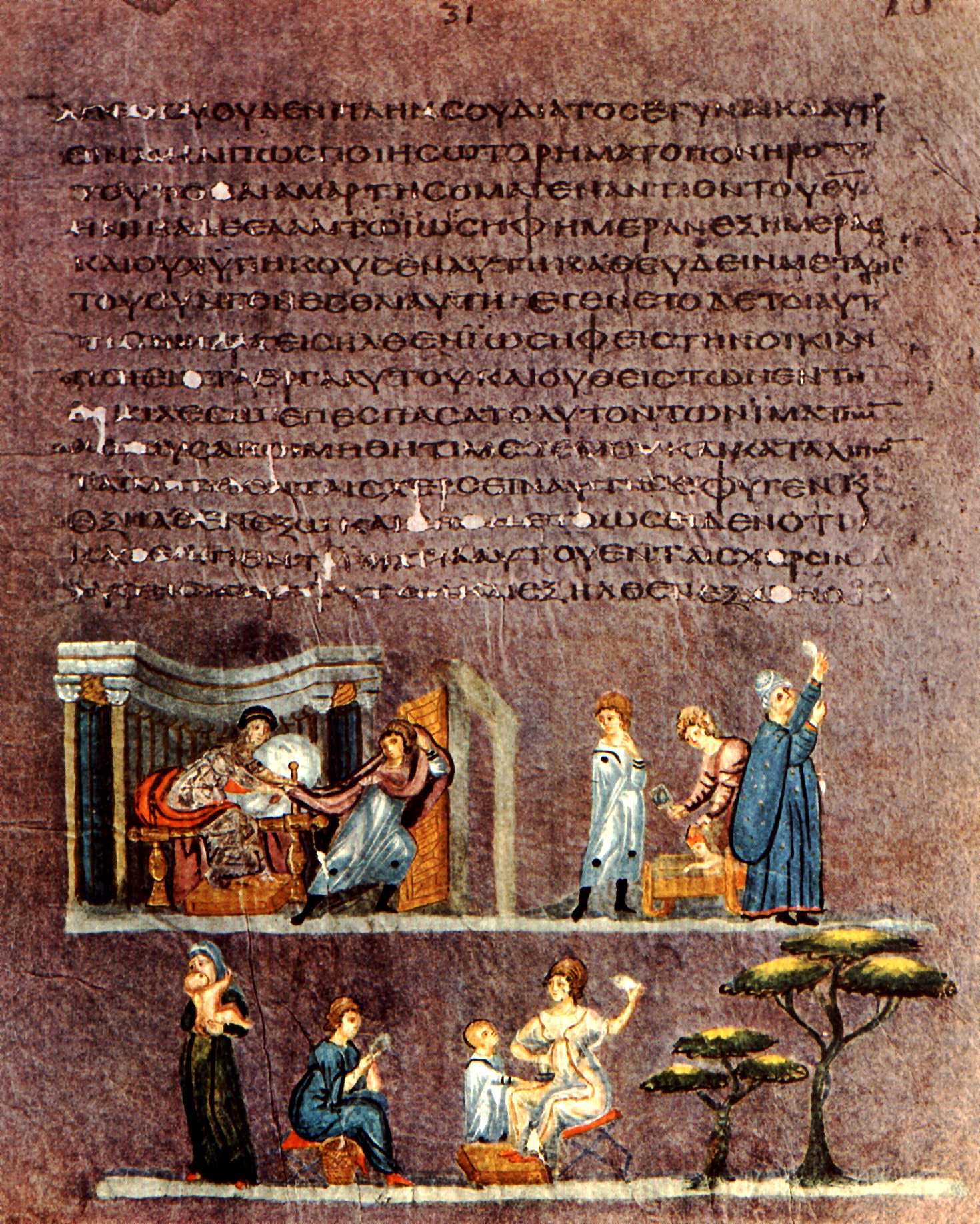
The provision of pictures places the text in a different light for the reader. This may best be illustrated by the example of a manuscript of the Pentateuch. It has a series of miniatures accompanying the story of Joseph. But the miniatures contain material and scenes which are found in Jewish apocryphal writings, and not in the written text of the Genesis. Thus the entire manuscript, text and pictures, is telling a different story from that found in the text alone. (27; the manuscript in question is the Vienna Genesis)

I don't think I agree with Parker's last point. "The entire manuscript" isn't telling "a different story from that found in the text alone." Rather, the manuscript is telling a larger story from that found in the text alone. For its intended audience, this "larger story" was already invoked and evoked by the manuscript. This is the only way, as far as I can see, why an illustrator would think it okay to illustrate a biblical manuscript with scenes from apocryphal texts. That is, the written text was a moment or instance of the larger Joseph tradition. And it doesn't much matter that the written text doesn't narrate other moments or instances of the tradition, some of which are only found in apocryphal writings. Text and tradition belong together, and this "belonging together" happens within the audience, at the moment of reception, rather than within the text. Unfortunately, that means it's much more difficult—and often impossible—for us to see today how text and tradition relate to one another. But every now and then we get a glimpse of the larger traditional connections, and these glimpses remind us not to read our written texts too narrowly, too myopically, or with too great a restriction on what we think a text does not say.

Wednesday, February 02, 2011

the first review

I received an e-mail yesterday from T&T Clark that included a review of Structuring Early Christian Memory: Jesus in Tradition, Performance, and Text. Daniel Frayer-Griggs, of the University of Durham, has reviewed my book for Theological Book Review, and he has had kind things to say. I've included the concluding paragraph of his review below:
This is a profoundly ambitious and highly technical work, calling for nothing short of a paradigm shift in gospels research. Rodriguez's discussion of social memory theory is highly suggestive and should enliven both gospels and historical Jesus research, and, while he is perhaps too sceptical regarding the existence of Q and the continued relevance of source and redaction criticism, his analysis of the relationship between orality and textuality is learned and illuminating.

Thank you, Mr Frayer-Griggs. I hope we meet one day.

My Visual Bookshelf