Saturday, May 02, 2009

Warren Carter on Revelation

I was surprised by this discussion of Revelation (admittedly, in the context of a book on John, in a chapter on the synagogue in first-century Asia Minor, a province of the Roman Empire). Carter says:
Recent scholarship on Revelation argues, from an examination of life in imperial Asia and of the letters to the seven churches in Revelation 2–3, that this text addressed not situations of persecution as previously thought, but situations of what the author regards as overaccommodation and compromise with Roman imperial society. The author challenges the overaccommodated lifestyle of the majority in the churches, urging them to discern the (demonic!) nature of the empire and to distance themselves from societal participation. In the words of 18:4, they are to "come out of her, my people, so that you do not take part in her sins, and so that you do not share in her plagues" (NRSV). Revelation reveals that Rome, a "dwelling place of demons" (18:2), is already under God's judgment (Rev 6), asserts the devilish nature of Rome's empire and imperial worship (Rev 12–13), exposes its political power and economic greed (Rev 18), envisions God's supreme rule even now and in the future (Rev 4–5; 22), and anticipates Rome's imminent and final demise in the establishment of God's purposes by Jesus, the Lamb slaughtered by Rome but raised by God's power (Rev 18–22). In the meantime, the author urges the seven churches to distance themselves from imperial society. (John and Empire, 39)

Earlier this year I read through a Greek text of Revelation and began thinking I'd like to spend some time doing research at the back of the canon. As of now I haven't, so this strangest, perhaps, of NT books is well beyond my area of expertise.

Even so, I think when we read Revelation as a text about "the end of the world," this book loses the ability to say anything about our lives in the world, here and now, except indirectly and by implication. Maybe this isn't an inevitable consequence, but I think all the futuristic, apocalyptic (in the Jerry Jenkins/Tim LaHaye sense) perspectives have obscured the ways that Revelation is relevant to the twenty-first century church more broadly. I have been known to say that the main thrust of Revelation was that, in the end, Jesus wins, and you really want to be on his team. But does Revelation have more—maybe even significantly more—to say to us now?

Until Carter I had only ever heard people talk about Revelation as a text written to churches in the context of rather extreme persecution (John is, after all, exiled on Patmos!). But the idea that the church has identified itself too closely with the empire, rather than is experiencing persecution at her hands, turns at least some of that thinking on its head. Perhaps much of the apocalyptic imagery driving John's visions isn't directed at a violent empire whose machinations have hurt and endangered a growing and yet increasingly marginal Jewish movement. Perhaps that imagery, instead, is directed at a pagan empire with whom the early followers of Jesus had learned to negotiate and co-exist. Certainly I would think being able to get along is a good thing, but at what cost? Had the church then—and has the church now—given up or simply forgotten its core identity for the sake of getting along?

It's too early for me to say I'm convinced. But the possibility is intriguing. Consider this: In an age when the church has become very comfortable with the centers of power—whether hosting presidential debates and praying at presidential inaugurations, or sustaining massive consumer industries and spending billions in marketing, or identifying with the burgeoning environmentalist market that looks to be the next source of global wealth redistribution, or whatever—perhaps Revelation can reorient us to being faithful participants and prophetic voices in the marketplaces (commercial, political, and otherwise). Perhaps Revelation can show us again how not to legitimate this world's power structures but rather to demonstrate their pallor in the light of God's glorious power.

A. N. Wilson's reflections on Palm Sunday

On 11 April, the Mail Online ran a piece by British writer A. N. Wilson that is well worth reading (even well worth linking to three weeks late!). The essay, "A Religion of Hatred: Why We Should No Longer Be Cowed by the Chattering Classes Ruling Britain Who Sneer at Christianity" gives an inside look at not simply atheism or agnosticism but actual anti-Christian vitriol from a former anti-Christian.

Too often Christians are only too eager to find someone to be offended by or something to revile (it's amazing how thin-skinned Christians can be!). Even so, there are actually offensive and revulsive people and things out there. But too often we get so caught up defending God and defending Christianity that we forget God hasn't called us to get defensive in a fallen and ill-loving world. Rather, he's called us to be brave enough to live and love in the midst of death and hatred. We, unfortunately, have not been faithful.

And yet . . . sometimes we do get it right. Sometimes we do forget to insist on the last word and we focus on showing love to the end. And sometimes we do make a difference.

If you don't know, A. N. Wilson rejected his parents faith and, more than simply choosing not to be a Christian, has spoken and written against the Christian faith very publicly. His book, Jesus, is one of those very many that claim to rescue Jesus from the mire of the church's devotion to him and dust him off, revealing a rather hapless man who failed in this life and then was twisted into the Son of God in the next. And though we can easily (readily, even) document the distortion of the historical Jesus—the Jesus who can be known through the processes of historical critical inquiry—from confessional and pietistic perspectives, the answer, I think, is not found in distorting Jesus in the other direction.

It seems that Wilson would agree. Wilson's article is well worth reading in its entirety, but I include these brief paragraphs to whet your appetite.
My belief has come about in large measure because of the lives and examples of people I have known - not the famous, not saints, but friends and relations who have lived, and faced death, in the light of the Resurrection story, or in the quiet acceptance that they have a future after they die.

The Easter story answers their questions about the spiritual aspects of humanity. It changes people's lives because it helps us understand that we, like Jesus, are born as spiritual beings.

Every inner prompting of conscience, every glimmering sense of beauty, every response we make to music, every experience we have of love - whether of physical love, sexual love, family love or the love of friends - and every experience of bereavement, reminds us of this fact about ourselves.

[HT: Ben Witherington]

Postscript: I glanced briefly at the comments to Ben Witherington's blog post and noticed that the top two comments (at the time, at least) missed the hope and . . . well, miracle of faith and instead took to defending theological views. Granted that the self-styled BW3 had to poke at those of the Reformed tradition in his post, can we knock off the bickering and, with the angels in heaven, rejoice with the one who has [re-]found his faith?!

Thursday, April 30, 2009

private religion, communal religion

I've begun reviewing Warren Carter's John and Empire: Initial Explorations (T&T Clark, 2008; see also here). I'm only on p. 7, so my comments here aren't directed at the book so much as they are motived by them.

Carter begins by critiquing what he identifies as the two dominant approaches to reading John's gospel, (i) a privatized, spiritual reading, and (ii) a sectarian, communal reading. The first reading strategy is much more applicable to my own experience, especially in the churches of which I've been a part (and perhaps even of my current faith community). This isn't so much simply about how we read John but more about how we conceptualize what Christianity is—what it means to believe in Jesus, what eternal life refers to, what it was that Jesus rescued from God's wrath when he was crucified on a Roman cross and raised to life by the power of God.

In my fellowship of churches, these things are individual, private affairs, and very often only spiritual ones at that. I believe that Jesus is the Christ, meaning that my mind has given some cognitive assent to that as a proposition. And I have eternal life, meaning that some center of my consciousness—whatever or wherever that may be—will continue on forever "with God." Typically, that center of consciousness is expressly not a material entity; my soul or my spirit will go to be "with God" "in heaven."

Carter takes aim at this as a legitimate way of reading John. This way of thinking—this worldview, even—misses more of John than it gets, and so it hopelessly misunderstands the gospel. And my church, similarly, takes aim at this as a legitimate way of being a Christian. Multiple times our minister has explained it this way: There are [at least] three components of the gospel: (i) an aspect of incarnation, in which God, in Jesus, enters into and identifies with the human condition rather than peering at it from above, (ii) an aspect of atonement, in which Jesus address an ontological human problem and not simply a socio-cultural one, and (iii) an aspect of restoration, in which God's concern is for all of creation, material as well as spiritual, human as well as nonhuman. In what is inevitably a simplification of complex phenomena (but still, perhaps, helpful for understanding some things), more mainline expressions of Christianity have tended to emphasize (i) and (iii), focusing on the so-called social gospel, while more fundamentalist and/or evangelical expressions have emphasized (ii).

But as I was reading Carter from my socio-religious perspective (briefly outlined above), I began thinking about a problem many people like me experience, in which our children, as they enter the struggle to forge and fit into their own identity, find themselves unable to identify with our faith. How is it that so many genuine, passionate Christians cannot communicate their faith in compelling, convincing ways, even to their own children?!

Could this provide part of the answer? Carter says,
The Greco-Roman world's constituting of religion as an integral part of the political and societal landscape that among other things functioned to bind people together with each other and with their gods suggests that any attempt to understand John's "good news" cannot allow our contemporary restricted notions of privatized and spiritualized religion to limit and distort the inquiry. John's inclusion of signs of material transformation and of the narrative of Jesus' crucifixion by Pilate, the Roman governor, for example, attests the Gospel's participation in the material, the physical, the somatic, the societal, and the political: John does not regard these spheres as irrelevant. (Carter 2008: 7; my emphasis)

The phrase bind[s] people together is what caught my eye. Even in our highly individualized, postmodern world we long for and go to great lengths to find bonds with other people and social (and theological) structures that transcend ourselves. In John's world, Carter argues, religion played an important function here. But in our own world, we have denied religion any place at this particular table, trying instead to find professional, social, and now especially virtual connections with others in lieu of religious ones.

It strikes me, then, that as we become whoever we become—that is, as we fight to make our own connections with other people and institutions—religion seems wholly irrelevant. Two things result. First, religion appears to have nothing to offer us as we pursue our primary needs, now not only food, shelter, and the like but rather significance, meaning, and relationship. Second, religion appears dispensable to human relationships. I can reject my parents' spirituality, or yours, without rejecting them (or you). Many people explicitly make the effort to think like this, though I would think just as many people genuinely find themselves either hurt by their children's apostasy or surprised that their parents have overreacted so strongly.

I'm not sure where this leads me, except of course to emphasize that the individual, private, spiritualized view of religion, and especially Christianity, fails more than it succeeds and probably won't do my family the good that I want for us. Conservative Christians—fundamentalist, evangelical, or whatever—can rail against scholarship as impious or irreverent if it wants, but here (viz., Carter) I think critical scholarship has something important to offer those of us who take the Bible and its claims over our lives seriously. That is, if we continue to think of Christianity primarily in terms of me and God, if we continue to shut our eyes to those [central] aspects of the gospel that bind us with one another, with creation itself, and with the Creator God who cares for every aspect of this world—spiritual, material, social, etc.—our faith will only ever by myopic, anemic, and for those people we love, irrelevant.

Monday, April 27, 2009

the legacy of form criticism (pt. deux)

I've just finished reading Jesus, the Voice, and the Text (see my previous post), which ended with a contextualization and autobiographical retrospective by Kelber himself on the significance of his work, its aims (intended consequences) and results (actual consequences), as well as a brief response to a few issues raised in earlier essays in the volume. I think this essay, entitled "The Oral-Scribal-Memorial Arts of Communication in Early Christianity," is without question the single best piece Kelber has written (and which I've read).

Kelber spends considerable space recapitulating and reinforcing his critique of form criticism, even to the point of providing an exceedingly handy eleven-point summary of the problems, as he sees them, with the form-critical project (see pp. 244–46). His eighth point rejects explicitly any "evolutionary gradualism" at work in early Christian traditioning processes, which makes my previous post all the more . . . ironic (in the sense in which Alanis Morissette refers to irony, not in any actually ironic sense). Having explicitly rejected the evolutionary development of early Christian Jesus tradition (and this was a springboard for Kelber's work at least as early as 1983), he can still be read—legitimately, I think—as assuming a developmental trajectory from oral to scribal. This assumption needs to be undone.

And yet the essay currently under discussion, though still evincing residual theoretical and exegetical problems, is a wonderful statement of the important gains and immediate challenges of a media-critical approach to Christian origins. I leave you with the following, from the section sub-headed "Epilogue," and encourage you to read the rest.
I now look upon [The Oral and the Written Gospel] as a product of that phase when I was operating, as neophytes in the field are likely to do, with a relatively simple concept of media, exhibiting a tendency to think in terms of pure forms. And yet, OWG succeeded beyond my expectations in reigniting the oral-scribal issue in biblical scholarship. Over the years, however, my media paradigm has undergone unmistakable complexification. Increasingly aware of the uneven, fluctuating and polymorphic nature of the ancient verbal arts, my conceptualizations have grown to encompass phenomena such as oral-scribal interfaces, multiple oral originals, recitation and repetition, the social, even political role of ancient scribes, textual performance and the formation of cultural identity, and now always memory. In short, I cam to understand that all media are, by definition, mediating forces that variously interface with a people's historical experiences. I therefore concede a measure of fictionality to the fourfold media typology of orality, chirography, typography and electronics, because in ordinary media life these modes of communication run together and manifest themselves in mutual re-absorptions. (pp. 260–61)

These are welcome words, indeed.

[PS You can click on Jesus, the Voice, and the Text in My Visual Bookshelf (above) to see a snippet of my review, which will appear in a forthcoming issue of the Stone-Campbell Journal.]

Saturday, April 25, 2009

the legacy of form criticism

Currently I'm reviewing Jesus, the Voice, and the Text (ed. Tom Thatcher, Baylor University Press), a reflection on the current state of media studies and Christian origins twenty-five years after the publication of Werner Kelber's seminal The Oral and the Written Gospel. I am simultaneously heavily indebted to and highly critical of Kelber's work, so reading this book has been a rather . . . ambiguous experience for me.

In the midst of the essay, "The Scar of the Cross" (Chris Keith and Tom Thatcher), I realized that one of the perennial problems with Kelber's analysis perhaps betrays the influence and legacy of form criticism, despite the awesome and devastating critique of form-critical perspectives that Kelber has levelled over the past three decades. Let me explain.

Keith and Thatcher explain Kelber's critique of the form-critical estimation that the Markan passion narrative (Mark 14–16) preserves an early and integrated account of Jesus' death, especially as that critique focuses on the paratactic, episodic structure of "oral thought" (I have a huge problem with this as an analytical category; see my forthcoming essay, "Reading and Hearing in Ancient Contexts" [JSNT]). Kelber, according to Keith and Thatcher, says that a structured, developed plotline such as we find the Markan passion narrative "are unlikely to have originated in an oral milieu" (271, n. 1). In other words, the oral gospel tradition was aggregating rather than synthesizing, episodic rather than tightly plotted, and Mark's passion narrative reflects a textual/scribal (= later) rather than oral (= earlier) context.

My first response was that Kelber has helpfully challenged us to reimagine the situation in which stories about Jesus were orally performed, but he has unhelpfully continued to assume that Mark's gospel arose in a media situation more like our own than the "oral environment" of the first-century Mediterranean world. But as I thought about this, I realized more is going on here. At the heart of form-critical analyses is the assumption that the Jesus tradition developed along certain trajectories, typically from pristine to corrupted forms but, for Taylor at least, in the other direction. E. P. Sanders, however, demonstrated as early as the late 1960s the problem of assuming uni-directional development; trajectories in early Christian traditioning (and this is the point) simply didn't exist.

Kelber recognizes this; his point (sometimes too vaguely applied) about "equiprimordiality" attacks exactly this assumption. But Kelber has simultaneously preserved this assumption, only this time in the trajectory from "orality" (or oral patterns of thinking) to "textuality/scribality" (or textual/scribal patterns of thinking). But, as I said above and argue elsewhere, trajectories never were operative in early Christian traditioning, and that includes any supposed movement from orality to textuality. This holdover from the form-critical era has also plagued other scholars' work (esp. Joanna Dewey), and media studies would do well to expose and abandon it to the dustbin of academic history.

Thursday, April 09, 2009

This Day in History (well, two days ago in history)

So 7 April was my birthday. While I'm not at liberty to disclose my age, let it suffice to say that I've never been as old as I am now! This year wasn't a special birthday, really; I didn't turn some factor of 10 and I didn't have any new legal status bestowed upon me (like the ability to drive or buy alcohol), but my wife did sufficiently direct attention toward me to remind me that Tuesday was, in some way, my day. Thanks, babe.

So what did we do? Well, first we had dinner at McDonald's. I know, I know . . . a meal at Mickey-D's is barely a meal, let alone a special meal. Even so, I always appreciate eating in a place where I can enjoy my family and not worry that my daughter's unmuffled exuberance is bothering other patrons. If you expected a quiet meal at McDonald's, then you're the idiot and I'm not going to worry about offending you. As we were ordering I noticed that our local McD's was training two new cashiers, and apparently the complexity of the electronic till was a bit overwhelming. So both fast and food were a tad euphemistic for our experience. But as I say, I enjoyed being with my family. Even Krystal's could be an enjoyable meal with my wife and daughter, though I hope never to have to eat those words!

Afterward we dropped my daughter off with some friends; my wife arranged for someone else to take her to dance and for another friend to pick her up and spend the night. So we had the house to ourselves that night. As a surprise, my wife took me to a Chris Tomlin concert; I think he was performing in Knoxville especially in celebration of my birthday. Israel Houghton and New Breed opened; they did an amazing job presenting their music as well as Israel's testimony. Musically, Houghton and New Breed create an interesting mix of Gospel, Urban, Jazz, and Pop influences; they were a lot of fun to watch and amazing to listen to.

Tomlin also provided an entertaining performance, though his was more showy and less musically impressive. I'm not the biggest Chris Tomlin fan, by any means, but I really did enjoy the show. I couldn't help, however, but notice the facial similarities between Tomlin and a certain actor who famously drove 88 mph in a suburban mall parking lot; I provide this picture and ask you to decide for yourself. We had to leave the concert early; I spent the whole day getting progressively sicker, and by the time we left I was shivering uncontrollably and could barely talk. I felt bad for ruining my wife's birthday gift to me, but she was a great sport. She took wonderful care of me, bringing me the appropriate medicines, some chicken noodle soup, and a package of crackers.

So it was a good birthday, though so far I haven't enjoyed being #@&!$/-#?^ years old. Oh . . . one last thing. In my opinion Tomlin did a little too much talking (perhaps we wouldn't have had to leave early if he had been a little more forthcoming with the music). But much of his talk concerned a new project he's involved with called One Million Can. Among other goals, One Million Can is hoping to raise $150K to build five homes for children in Uganda (that's $30K for a home that can house eight children!). If God has provided for you during these difficult economic times such that you can be a part of his providing for others, I encourage you to see if One Million Can is worthy of your giving. If you are among those who are particularly struggling this year, please remember the young girls and boys whose lives have been devastated by war and poverty as you turn to your God and mine in prayer.

So . . . happy birthday to me. I'm still sick two days later, but I can't complain. I'm reasonably confident that I'll see my next birthday, and that I won't miss a single meal between now and then, except perhaps voluntarily. I am, among God's children, most richly blessed.

Monday, March 23, 2009

discussion of an important resource

This isn't new, but I hadn't seen it before. Over at NT Gateway Mark Goodacre links to Rodney Decker's helpful review of the BDAG, the lexicon you'll want to buy when you find that forgotten $140 in your jeans pocket. For my Greek students, if you're wondering whether or not BDAG is worth the pretty penny it takes to get your own copy, Decker's discussion should help you make a more informed decision.

[For those of you whose girl/boyfriend(s) and/or spouse(s) are in my Greek class, I am in now ay responsible if your loved one(s) spends rent and/or food money on a book you'll never even want to look at.]

Saturday, March 21, 2009

Thursday, March 19, 2009

SECSOR—final thoughts

Last weekend was my first SECSOR meeting, and though it really wasn't what I was expecting (and I'm not sure what I expected), I enjoyed myself. There was no way for someone like me (not a student, but not terribly experienced in the discipline just yet) to know who were credentialed professionals and who were graduate students pursuing their degrees; this had its positives and its negatives. Positively, it was easier for me to focus on the arguments being presented without being distracted by the presenter's authority (or lack thereof). Negatively, it was more difficult for me to contextualize the arguments I was hearing. I found myself categorizing some presenters as graduate students and some as faculty of some well-known institutions, and on at least two occasions I was wrong in both respects.

The book display was small. Not a criticism of SECSOR; this just helped me realize how spoiled we are at the Annual Meeting. I think I've always taken it for granted that all those books in all those booths with all those publishing reps "just show up" every November.

The opportunities for social and informal engagement were deficient; there was one reception on Friday evening and a coffee break on Saturday morning, but other than that it was difficult to find time and ways to meet other scholars in the region. Also, the papers were limited to twenty-five minutes (including response time), which meant that the discussions of each paper were always cut short. We were busy the whole time, so I'm not sure there's time for more social engagement (a reception on Saturday night would be wonderful, but I realize this would have to be funded). But there were six sessions for papers, in addition to two plenary sessions and a few business meetings. Perhaps this could be reduced to five? or four? I know I would have enjoyed meeting some of the established scholars of the southeast and some of the very promising graduate students coming up out of our region.

The people were all very friendly. There wasn't a single paper or response that I thought seemed ill-intended or overly competitive. Perhaps some were, but I didn't experience them. Instead, all the papers (with only one or two exceptions) were excellent both for what I was provoked to think about and for what I couldn't help but argue with. And all the conversations about the papers were genuinely constructive (again, as I experienced them). I personally enjoy the slightly agonistic dynamics of the SBL Annual Meeting, but the more congenial tenor of SECSOR also struck a chord with my begrudging spirit.

This meeting seems to be an excellent venue for regional graduate as well as undergraduate to expose themselves to the field of biblical studies (beyond just its products [viz., books and articles]), to learn how to formulate and present their ideas persuasively and respectfully. I was disappointed by the relatively few number of institutions represented, though I suppose the current economic situation (as well as last-minute scheduling problems) would have affected attendance. Even so, if my own students (current and those who've gone on to seminary or graduate research) are interested in experiencing (and contributing to) professional biblical studies, SECSOR seems to be a good place for you.

A few days ago I had many other thoughts bouncing around in my head, but like ping-pong balls in a leaky lotto machine, many of them have managed to escape through an open (and unattended) orifice. I enjoyed SECSOR 2009, and I'm looking forward to the next meeting, in Atlanta next March (check their website). I hope to see some of you there.

Oh . . . One last thing. If you do come to the 2010 SECSOR meeting, make sure you have detailed, thorough, and clear directions before you set out for Atlanta. I found that, unlike other meetings, it doesn't do you any good to check into the convention hotel and ask the attendant at the check-in desk, "Can you tell me where to go to check in for SECSOR?" They just look at you blankly, wondering to themselves, "Sex or . . . what?"

[PS: I completely forgot . . . here's a quick list of what I bought from the book sellers:

As It Is Written: Studying Paul's Use of Scripture. Edited by Stanley E. Porter and Christopher D. Stanley. Atlanta: Society of Biblical Literature, 2008.


Matthew, James, and Didache: Three Related Documents in Their Jewish and Christian Settings. Edited by Huub Van De Sandt and Juergen K. Zangenberg. Atlanta: Society of Biblical Literature, 2008.


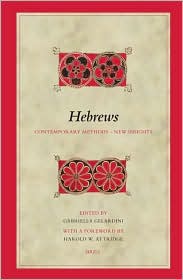
Hebrews: Contemporary Methods—New Insights. Edited by Gabriella Gelardini. Atlanta: Society of Biblical Literature, 2008.


I also ordered a copy of Common Judaism: Explorations in Second-Temple Judaism. Edited by Wayne O. McCready and Adele Reinhartz. Minneapolis: Fortress Press, 2008. But I'm considering this book for one of my graduate courses, so I got this one gratis. Woo-hoo (and thank-you)!

Wednesday, March 18, 2009

SECSOR—day 3 (pt. II)

The last session—New Testament V—was, well, the last session. As I said in my previous post, this was poorly attended, comparatively speaking, but that's par for the course for these types of things. It was too bad, too, because all four papers were interesting and well worth the twenty-five minutes it took to listen to each of them.

The first paper, "Blood, Life, and Purification: Reassessing Hebrews' Christological Appropriation of Yom Kippur," presented by David Moffitt (Duke University), questioned the traditional reading of Hebrews in which Jesus' death, rather than his resurrection (or his life) provides the greatest moment of atonement. This reading depends on the view that Jesus' resurrection doesn't figure (or figures very marginally) in Hebrews and by the analogy of "two great redemptive moments" of Yom Kippur: the slaughter of the sacrifice and the sprinkling of the sacrificial, atoning blood. Moffitt rebuts the first claim, noting a number of instances when the resurrection is actually present or can be inferred in the text. He also emphasizes that blood in the Hebrew Bible and in Hebrews means life, not death; he then offers some ways in which his reading solves some interpretive problems throughout Hebrews.

The second paper, "Anti-Imperialism and Historiography in the Temple Cleansing of the Gospel of John (John 2:13–22)," presented by Janelle Peters (Emory University), suggests that John's account of the Temple Incident takes aim at Roman imperialism and presence in the land. Unfortunately, while Peters was reading her paper, my phone began to vibrate and I had to leave the room momentarily, and so my recollection of her paper is significantly flawed. In addition, I am not at home among Johannine scholarship. But I do vaguely (and so unhelpfully) remember thinking that her thesis was interesting and worth pursuing. I hope to hear her work presented in a future meeting, preferably one in which I can devote my attention with fewer distractions.

The third paper, "'Where the body is, there also the eagles will be gathered': Eschatology and the Arrest of Jesus in Luke's 'Little Apocalypse' and Passion Narrative," presented by T. J. Lang (Duke University), offered a reading of Luke 17.37 hinted at in the paper's title. Lang reads ἀετός ["eagle" or "vulture" (BDAG; s.v.)] as "eagle" and suggests that the Lukan Jesus is incorporating Rome in the saying regarding the circumstances of Jesus' parousia (Lang properly notes that Matthew, not Luke, mentions the parousia). His argument doesn't rely so much on the eagle as a Roman symbol (cf. Ant. 17.151ff.; War 1.650ff.) but rather on ἀετός as an imperial symbol in the LXX. This reading offers some intriguing possibilities for the Lukan gospel, especially the links between the Passion narrative and the travel narrative and for other things besides.

The fourth paper, "Matthew 26:64 and the Enthronement of Jesus," presented by Nathan Eubank (Duke University), read the Romans' parody of Jesus' enthronement (purple garment, crown of thorns, reed for a scepter, etc.) and Matthew's parody of the Romans' parody. I liked the the point that in Matthew's account the parodic has become ironic. A lot of good stuff in this paper, but unfortunately it was the last of the session and so my mind was halfway out the door.

So many good things said about New Testament themes, but at such an unfortunate time. For those of us who were unable (or unwilling) to attend this final session in order to get a head start on the journey home missed some good stuff. And so I'm not too sorry that I can't provide more information on these papers; if you were really that interested, you should have been there! And yet I am disappointed in myself that I can't remember these papers better than I can (though Moffitt distributed copies of his paper, so his is *ahem* crystal clear in my mind . . . at least, it could be if I need it to be).

I'll wrap up some loose ends on SECSOR in one more post. Since the conference ended, now, three days ago, things are fading the grey in my inexorably aging memory. But for those of you so inclined and living in or near the American Southeast, I heartily recommend next year's SECSOR meeting (Atlanta, 5–7 March 2010).

British PhD theses

Over at primal subversion Sean has mentioned a useful resource for finding and accessing British PhD theses. You have to establish a free account, which takes about five minutes. But after another five minutes poking around I've found a number of interesting theses (particularly one about Jesus in early Christian memory!), many of which were available for free download. This is a wonderful source that makes a vast amount of work, much of which was previously only narrowly available and difficult to find, much more accessible.

[Sorry. The website is called EThOS and is available here.]

Monday, March 16, 2009

Useful Links

Over at Biblical Studies and Technological Tools, the following list of links appeared (in early February; I've been meaning to get to this for weeks). At any rate, some of these look like very useful tools, and at the very least I wanted to have a place where I could find the link easily. That's what this is. But you, too, might find these useful. If you do, let mgvh know you got there from here.

SECSOR—day 3 (pt. I)

The New Testament IV meeting addressed the theme, Theological Issues in the Interpretation of the New Testament. The meeting started at 8.30 am, which wasn't really a problem, but the room had an unlocked door about three feet from the lectern, and from time to time a hapless late-arrival would open the door, take a step or two in, and realize their conspicuous location. That door should probably have had a sign on it. But otherwise, the meeting was interesting.

The first paper, "Christian Triumphalism and the Discourse of Christian Origins: The (Mis)Appropriation of the 'History of Religions School' in Contemporary Scholarship," presented by Diane Segroves (Vanderbilt University), began with the work of nineteenth-century Religionsgeschichtliche Schule ("history of religions school") co-founder Wilhelm Bousett and sought to demonstrate the (inherently?) triumphalistic perspective masked by a "scientific" approach to the history of religion (see, e.g., the problems attached to spät Judentum ["late Judaism"]). She then focused her attention on the work of the "New History of Religions School," including Martin Hengel but especially Larry Hurtado. Like me, Segroves is also looking at the consequences of the essentialization and categorization of Judaism and Christianity as distinct phenomena, though she approaches these questions from a theory of religion perspective (whereas I am trained as a biblical scholar). She helpfully distinguishes the tasks of seeking after origins (genealogy) and pursuing comparative analyses (analogy). And though she does identify some interesting (and problematic) continuities between Hurtado and Bousett, I'm not sure she's adequately accounted for the very significant differences. Of course, she only had twenty-five minutes, and she could only do so much.

The second paper, "Neglecting Widows and Serving the World? Acts 6:1–7 as a Test Case for the Promise of 'Narrative' in Theological Exegesis," presented by Joel B. Green (Fuller Theological Seminary), problematized the distinction between history and theology in Luke-Acts and attempted to show and the two not only inform one another but are pursued simultaneously in the narrative. He offers the intriguing suggestion that Luke does not narrate the apostles' delegation of "table-service" [διακονεῖν τραπέζαις; 6.2] positively, but that he views their shirking of this responsibility negatively. Green's reading takes into account the description of the community's unity (threatened in 6.1–7) as a work of the Spirit and suggests that, in Luke's point of view, the rupture of that unity was an affront (attack?) to the Spirit. This is precisely, again from Luke's point of view, what the apostles should have been concerned with. I like this. I have argued in a couple of unpublished papers that Luke has a subtle but still negative view of a number of episodes often read positively, in particular the story of Gamaliel (Acts 5) and of the split between Barnabas and Paul (Acts 15). Despite my appreciation of Green's paper, I wonder how much Luke might have been satisfied not that the disciples delegated the responsibility for serving tables but that by appointing the Seven the disciples were making provision for this to be taken care of. In other words, the apostles didn't ignore table-service, and I'm not sure Luke would have insisted that they ought to have served tables directly rather than indirectly.

The third paper, "Could it be Satan? A Narrative Ethical Reading of the Ananias and Sapphira Story, Acts 5:1–15," presented by Douglas Hume (Pfeiffer University), continued a narrative reading of the Acts (see Green's paper, above), and explored the implicit role that s/Satan and or wicked spiritual forces were at play in the Ananias and Sapphira story. I remember being reminded of Luke's demonological language for stories that in otherwise don't seem to concern demons or spirit-possession (the healing of Peter's mother-in-law [Luke 4.38–39; cf. Mark 1.29–31] and the healing of the bent woman [Luke 13.11–13]). Sadly, after that I was distracted, and by the time I came back to Hume's paper I had missed too much to really remember how he argued his point. This isn't a criticism of his paper; I think I just hadn't had enough coffee. If you know Douglas Hume, please convey my apologies.

The fourth paper, "Reinterpreting the Shema: Covenantal Theology in the Fourth Gospel," presented by Lori Baron (Duke University), was an excellent paper examining the Shema (Deut. 6.4–9) as context for John's gospel. Famously, all three synoptic gospels, and probably Paul, cite the Shema at some point. (Actually, I think the Shema is formative for Pauline theology, especially the vigor with which he defended gentile inclusion apart from circumcision, kashrut, etc.) John, however, doesn't. But Baron rightfully notes that the language of "oneness," especially as it applied to God, is rampant throughout the Fourth Gospel, and she argues that the Shema is in the background here. Well, I'm not sure Baron used the word "background," and if she did I don't like that term. Rather, I think we can examine the ways the Shema may have framed the theology inscribed in the narrative and the text's reception in the first century. In my opinion, Baron's argument sounds a lot like Daniel Boyarin's very intriguing midrashic reading of John's Prologue in Border Lines (University of Pennsylvania Press, 2004). This reframing of John's gospel in more thoroughgoing Jewish terms offers some intriguing possibilities for understanding the text. Baron's paper was an interesting and exciting part of that larger project.

After the New Testament IV session, there was only one more meeting before the conference ended. I debated skipping the last session, but decided against it (there were some paper titles I thought were intriguing). Then I debated leaving early (I was really missing my family at this point), but decided against it (there were only five of us in the audience, and the presenters deserved to have us there). All four papers were interesting, and I'm glad I stayed. I'll have to tell you about them. But later, in the next post.

Saturday, March 14, 2009

SECSOR—day 2 (pt. II)

I am currently cutting the New Testament III meeting, which features a panel discussion of Joel B. Green's Body, Soul, and Human Life: The Nature of Humanity in the Bible (Baker Academic, 2008). I've not read the book, and since it isn't narrowly aligned with my current interests I'm not likely to for a while. Plus I'm not very keen on panel discussions of books, which isn't to say they're pointless but that I, at least, don't readily see the point. Unless someone wants to have a panel discussion of Structuring Early Christian Memory, in which case I very readily see the point. And so should you.

At any rate, I did attend the New Testament II meeting, which focused on the theme "The Gospels and the Historical Jesus." The first paper, "Making Matthew's Genealogy Count," presented by Stephen Carlson (Duke University), considered the numerical problem of Matthew's genealogy (viz., that Matthew claims forty-two generations from Abraham to Jesus but lists only forty-one, unless we posit a "missing generation" or we count someone twice). Carlson very reasonably suggested that Matthew (or Matthew's source) intends David to be counted twice (he's named twice in 1.6, but more significantly named twice in 1.17). I can't shake the feeling that trying to figure out the mathematics of Matthew's triple series of fourteen generations (γενεαὶ δεκατέσσαρες) is a bit like trying to learn chemistry from a cookbook: The chef doesn't need to focus narrowly on why sugars caramelize under heat or alcohol evaporates in the pan; she just takes advantage of the fact that it does. So also for the explanation of Matthew's genealogical account: no matter how we think Matthew got to fourteen (inclusive counting here, exclusive counting there, counting someone twice or [unusually] reckoning the "Babylonian deportation" [μετοικεσία Βαβυλῶνος] in the counting, or whatever) the important thing is that he does. I don't think, then, that we should read 1.17 in light of 1.2–16 but the other way round: 1.17 tells us how to read 1.2–16. I'm not entirely sure if Carlson would agree with me here, but that's okay.

The second paper, "The Son of Man Must Suffer and Die," presented by Michael Zolondek (Florida International University), set out to authenticate the complex of tradition in Mark 8 from Peter's confession through Jesus' Passion prediction, Peter's rebuke [ἐπιτιμάω] of Jesus, and to Jesus' counter-rebuke of Peter as Satan [Σατανᾶ; 8.33] and one who has in mind human rather than divine things [οὐ φρονεῖς τὰ θεοῦ ἀλλὰ τὰ τῶν ἀνθρώπων]. Zolondek's employed fairly standard historical Jesus tools, especially the criterion of embarrassment, in his discussion of this passage, and (again) as an example of biblical historical criticism this was fairly representative of the field. My problem, soon to be published in multiple venues, is that the traditional historical-critical tools are bankrupt (to echo strongly April DeConick's thoughts [start here]). The argument that the early church wouldn't have created this or that bit of Jesus tradition (that Jesus was baptized by John, or that Peter was the satan, or that Jesus was demon-possessed, or whatever) fails to explain, then, why the early church preserved and reproduced those traditions in their performances—written and oral—of the Jesus story. I deal with this fairly extensively in ch. 7 of Structuring Early Christian Memory, so I won't rehash the arguments here.

The third paper asked, "Did the Evangelist Compose Matthew 13:36–43 and 13:49–50?" presented by Delbert Burkett (Louisiana State University). If you've read his Rethinking the Gospel Sources: From Proto-Mark to Mark (T&T Clark, 2004; helpfully reviewed here by Michael Pahl), then you know that Burkett takes an unusual (idiosyncratic?), decisively literary approach to the synoptic problem. Again, I am publishing on this very area and have serious problems with a paradoxically simplistic over-complication of the literary relationships of written texts. In my view (which features prominently here, if nowhere else), the texts are better conceptualized as embodiments of the Jesus tradition, but for all their material existence and potential (and even actual) influence over other embodiments of the Jesus tradition—written or oral—they remained in the first century embodiments and not text-fixations of the tradition. To identify one argument that I think needs some question, Burkett queried J. Jeremias's list of evidences for Matthean composition in the texts named in his title, and for a number of them noted the ambiguity of the evidence (i.e., that what Jeremias takes as evidence of Matthean composition may reflect Q, or may come from Mark, or may be characteristic of the tradition more broadly). But then when he moves to formulate his own position—that Matthew was a compiler rather than a composer—the ambiguity disappears and he has shown that supposed clues of Matthean composition are rather more meagre than Jeremias thought. I'm not sure the two options presented—compiler or composer—adequately captures the breadth of options available for us to think about the relationship between the evangelist and the gospel. But again, see my forthcoming Structuring Early Christian Memory.

The fourth paper, "Mark 7:15: A Scatological Approach," presented by Matthew Thiessen (Duke University), considered afresh the precise nature of the debate (and the conclusions) between Jesus and the Pharisees in Mark 7. Thiessen calls to our attention the failure of contemporary critical discussion of this passage to consider the physiologically obvious referent of τὰ ἐκ τοῦ ἀνθρώπου ἐκπορευόμενα ["things that come out of a person" (I'm tempted to type ἀνθρώπου)] is, well . . . scat. Thiessen doesn't adopt this reading himself, namely that Jesus considers defecating as a process resulting in impurity, but the question does bring some interesting evidence from (or, better, about) Qumran into view. Thiessen never referenced the lengthy discussion of Mark 7 in James Crossley's The Date of Mark's Gospel (T&T Clark, 2004), but in the post-presentation discussion he said he was familiar with (and persuaded by) James's reading (specifically of Mark 7.19b). I'm still not convinced that Mark has only kosher foods in view at 7.19b, but I agree with Thiessen (and Crossley) that Mark 7, along with other NT passages, portray Jesus as thoroughly engrossed in and affected by purity issues. That is, Jesus belongs to a socio-cultural world were purity—its loss, its renewal, its special role in relating to the Deity, etc.—just is a fact of life, like being licensed to drive a car in twenty-first-century America. Jesus isn't scandalized by purity because he never lived in a world where purity wasn't already always in the air. Now I've gone significantly beyond Thiessen's paper, but his arguments were variously suggestive for me, and I enjoyed his paper (despite its crappy title).

So as I say, I've avoided the New Testament III meeting. The New Testament IV meeting (tomorrow at 8.30 am) looks interesting. I'll comment on it tomorrow.

SECSOR—day 2 (pt. I)

This morning was the first section focusing on NT issues; the section was appropriately, if not creatively, entitled "New Testament I," and all four papers focused on Paul and/or Pauline materials (viz., Romans, 2 Corinthians, Galatians, and the Pastorals and The Acts of Paul and Thecla).

The first paper, "Gentiles Who Keep the Law: Paul's Law-Keeping Gospel," presented by Jason Staples (University of North Carolina, Chapel Hill), examined the second half of Rom. 2, especially from 2.14 onward, and reappropriated this section of Paul's epistle for the core (rather than the margin) of Pauline theologizing. Staples attempted in particular to bracket questions of what Paul could or could not have said, especially from the point of view of traditional "justification by faith" theology, and to first ask what's going on in the Pauline text. I always find this type of endeavor, no matter how successful, as a useful reminder to keep the horse before the cart. I am especially interested in the thoroughly Jewish recontextualization of Paul and his writings, and I'm less interested in efforts to portray Paul's as a "Law- (= "Torah-") free gospel." Staples did an interesting job at showing how important a role both Israel and the Law—the Torah—play in Paul's theological discourse. For what it's worth (admittedly, very little), the paper I've proposed for the 2009 SBL Annual Meeting in November, entitled "Pulling at Paul: Romans 15 and Constructing the Christian Self" and taken up with a rereading of Paul's cultic language in Romans, especially chapter 15, considers very similar issues.

The second paper, "The 'Circle of Grace' in 2 Corinthians 1," presented by Hans Arneson (in the Graduate Program in Religion, Duke University), attempted to untangle the vexing phrase at 2 Cor. 1.11b [ἵνα ἐκ πολλῶν προσώπων τὸ εἰς ἡμᾶς χάρισμα διὰ πολλῶν ευχαριστηθῇ ὑπὲρ ἡμῶν; "so that many people would give thanks for our sake for the gift [given] to us by many" (?)] via a less complicated passage, the "circle (or "cycle") of grace" in 2 Cor. 8–9. In the latter text Paul presents the cycle as one in which the Corinthians receive "in excess" from God, and from their excess give to "the saints in Jerusalem," who in turn do not give thanks to the Corinthians but to God who gave the excess. Arneson applies this model to 2 Cor. 1 and interprets χάρισμα as παράκλησις, a point strengthened by the clustering of παρακλη- language in chapter 1.

The third paper, "Androgyny and the Rhetoric of Conversion: Galatians 3:28c and the Problem of Audience in Galatians," presented by Ben White (University of North Carolina, Chapel Hill), won an award as the best graduate paper of the meeting (if I remember correctly; my apologies if I've misremembered the nature of the honor). White explored recent considerations of "the pagan world of the Galatians" and though was ultimately unconvinced by them (esp. that the rise and/or popularity of the Imperial Cult provides the best reconstructed originative context for Paul's epistle) does agree that Paul is aiming at a pagan context. White exploits the third deconstructed pairing of Gal. 3.28 [οὐκ ἔνι Ἰουδαῖος οὐδὲ Ἕλλην, οὐκ ἔνι δοῦλος οὐδὲ ἐλεύθερος, οὐκ ἔνι ἄρσεν καὶ θῆλυ; "There is neither Jew nor Greek, neither slave nor free, neither male and female"], and especially the unexpected shift from οὐκ ἔνι . . . οὐδέ in the first two pairs to οὐκ ἔνι . . . καί in the third to argue that this makes better sense—much better sense, in fact—in an ethnic, northern Galatian context. I have serious questions about this thesis, in particular whether such a short passage (and I agree that οὐκ ἔνι ἄρσεν καὶ θῆλυ is not ancillary but just as important as the previous pairings, even . . . Ἰουδαῖος οὐδὲ Ἕλλην) can bear such reconstructive weight. Still, also a very interesting paper.

The fourth paper, "Reception of the Pastorals in the Second Century: A Test Case Looking at The Acts of Paul and Thecla," presented by Jeremy Barrier (Heritage Christian University) argued against a literary or even direct oral traditional relationship between the Pastoral Epistles and the second-century Acts of Paul and Thecla. I'll be honest here; I read more of Paul and Thecla while Jeremy was presenting his paper than I ever have throughout the course of my life, so much of the presentation was even further from my expertise than the other papers. Even so, his discussion of oral tradition and his refutation of an oral relationship between texts was interesting. I do think Jeremy evinced some of the standard (but still problematic) assumptions about oral tradition that are endemic in biblical studies (more on this later, I'm sure), but he can hardly be faulted for making assumptions consistent with the state of the question. (If I'm being too cryptic here, let me just say—only minimally less cryptically—that biblical scholarship too easily reifies oral tradition and treats as a thing rather than as a process or [a] set of processes that contextualize and frame [rather than serve as sources for] written traditions. But as I say, more on this later.) Jeremy's PhD dissertation, a commentary on The Acts of Paul and Thecla, is due out later this year by Mohr Siebeck. Interestingly, he has changed his view precisely with respect to the question of a literary relationship between Paul and Thecla and the Pastorals since writing his PhD. I gently recommended that rather than trying to revise his monograph perhaps he should just publish it as is and then publish an article later in the year taking the most recent commentary on Paul and Thecla to task!

After the New Testament I meeting I attended the plenary session, and for reasons of professional courtesy I won't make any comments here about that. [comment deleted] I did lunch in the convention hotel, which is to say I payed too much for too little food and no refills on my soda. And since this is my first regional SBL meeting (I don't count the International SBL meeting I attended in July, 2004, which is nevertheless somewhat similar) I'm struck by (a) how small the meeting is, and (b) how many other conventions are going on at the same time and seemingly in the same space as SECSOR. I take heart, however, that the attendees of other conferences are looking at me just as cross-eyedly and askance as I at them. Hold on just a sec . . . 

Oh yeah, buddy?! I'm not an MD; I'm a REAL doctor!

Sorry 'bout that. I'll write more later.

SECSOR—day 1

Today was the first day of the 2009 Southeastern Commission for the Study of Religion meeting, the combined AAR, ASOR, and SBL southeastern regional meeting. I didn't attend any of the Session I meetings, but tomorrow there are a few sections to which I'm looking forward and about which I plan to write.

But I did hear two presentations tonight: first, Rebecca Todd Peters (Elon University), President of the regional AAR, presented her paper "Beyond the Financial Crisis: Rethinking the Moral Foundations of Political Economy."  Peters's paper was very interesting, especially given my affinity for capitalism. Peters, perhaps predictably, finds fault with the capitalist system, primarily in its assumption (reification?) of an individualistic anthropology. As a biblical scholar with a penchant for sociological theory, I found a lot to agree with in her critique of the individualistic foundations of Western culture (and especially economics), though I did not see myself in her description of capitalism. What made her paper interesting (and not just anti-capitalistic tripe, which it certainly was not) was her refusal to advocate a dehumanizing (my word) socialism that denied the importance of the individual. The task before all of us—whether you identify as a capitalist or otherwise—is to maintain a respect for and appreciation of the individual while simultaneously appreciating (and accounting for) the individual's embeddedness in social worlds. I'm not sure Peters's paper did this, but her call for a prophetic rather than a profit-centered motivation was interesting. I'm not sure these are mutually exclusive, but I think she's right that the prophetic conscience (and calling) ought to have economic impact. Other thoughts swirling in my head, but I must move on.

Second, Scott Spencer (Baptist Theological Seminary in Richmond), President of the regional SBL, presented his paper, "Can We Go On Together With Suspicious Minds? Doubt and Faith as Both Sides of the Biblical-Interpretive 'Coin' (Luke 15:10)." Spencer's presentation was significantly more sermonic than was Peters's, but it was a serious academic discussion in its own right. Spencer challenged both perspectives—that suspicion ought to be the guiding principle in biblical appropriation, and that suspicion is invalid as an aspect of appropriating the Bible, even in communities of faith. Spencer focused on Feminist biblical critiques, which he both valued and appropriated critically (a refreshingly new approach, in my own limited experience). Spencer presented four considerations with respect to the Feminist employment of (and suspicion towards) suspicion as a hermeneutical tool, and I wish for the life of me that I had taken these down. He then finished with a brief reading of Jesus' "Lost Parables" in Luke 15, and especially the Parable of the Lost Coin. Spencer makes a case for the role of suspicion in motivating ongoing, tenacious, persistent engagement with the text, an engagement that may be motivated by a belief that to whoever seeks (ζητέω; cf. Luke 15.8) God in the text will find him.

All in all a promising start. I won't disclose how much I've spent on books (in case my wife looks online), but I will have some 'splainin' to do when I get back. I hope to summarize tomorrows meetings tomorrow, while they're still fresh.

Wednesday, March 04, 2009

book notice

I was excited to read on T&T Clark's blog a pre-publication announcement heralding the imminent release of Minna Shkul's book, Reading Ephesians: Exploring Social Entrepreneurship in the Text. Minna and I did our PhDs concurrently at Sheffield, and I'm excited to see her work more widely available. If you only buy one book at the SBL 2009 meeting, it should be this one.

If you buy two books at the SBL, may I humbly suggest you pick up another volume mentioned in their pre-pub announcement? I recommend my Structuring Early Christian Memory: Jesus in Tradition, Performance, and Text. Note that T&T Clark's announcement ellides the last two words of my title, which I will read as a polite way of saying my title is too long. Also, it is interesting to see how another person summarizes my argument. For the most part theirs is an accurate description of my book, with one possible exception. I'm not sure I would have used the word obscured. What I would say is that social memory research has complicated the relationship between past and present. But overall I'm very happy with this announcement. Now . . . go and buy!

Wednesday, February 25, 2009

What kind of γένος was early Christianity?

Ever since my master's thesis on 1 Peter, in which I argued, among other things, that Peter (i.e., the author, irrespective of 1 Peter's actual authorship) was writing to a mostly gentile audience and inscribing on them Jewish identity markers (e.g., 1 Pet. 2.9–10), I have been interested in the phenomena of first-century Christian identities. Lately, I've been flirting with a new, perhaps unnecessarily provocative formulation of the relevant questions. I'd be interested in any response from you.

In popular Christian lingo, we commonly say something along the lines of, "Paul's ministry among the gentiles converted pagans to Christianity directly without requiring them to first become Jews." This type of thinking about Paul is common and also affects contemporary reading of other NT texts (e.g., Acts 10–11). At its heart, of course, is the assumption (which goes largely ignored, if not unnoticed) that to become a Christian is not to become a Jew.

But is this how the labels would have been understood in a first-century context? If we were average, everyday, nameless gentiles going about our business in the agorai of any major city of the Mediterranean and someone in our family forsook the family devotion to Apollo or Artemis or any of the other gods to worship Israel's God and his crucified prophet, Jesus, would we understand this development as anything other than a conversion to Judaism? And if not (and I'm not assuming a negative answer, except perhaps for the sake of argument), is this because we, as outsiders, have an insufficient understanding of the relation between Christianity and Judaism? In other words, would Paul, or Peter, or the average Christian, have seen a gentile's conversion to Christianity as not being a conversion to (a form of) Judaism?

At the moment I'm reviewing Not God's People: Insiders and Outsiders in the Biblical World, by Lawrence M. Wills. His discussion of "Jew and Gentile as Other in Paul" provides a helpful discussion of a number of issues regarding the construction of the We and the Other, though the book as a whole suffers some important weaknesses. But he makes one particular comment that stood out to me for being fairly standard within New Testament scholarship and yet perhaps in serious need of rethinking. Wills says,
Immediately before and after Paul's formula of "neither Jew nor Greek" (Gal 3:28) it is emphasized that those who have been baptized into Christ are now children of God and children of Abraham. Paul, and other writers of the early church, quickly developed new language of being children of God, an extended kinship group. All ethnicity in the ancient world was understood as genealogy, and Paul bestows a new family tree on the converted gentiles. (2008: 187; my emphasis)

My problem: I realize that it won't do for us to ignore any differences between Christianity and Judaism in the first century; clearly there were differences between Jesus, Paul, and other characters in first-century Christian narratives and other Jewish figures with whom the former came into conflict. But how do we justify to ourselves and our readers the assertion that the family tree onto which gentile converts to Christianity were grafted (to echo both Wills and Paul) was new and not Jewish? How can Wills (or other NT scholars, for that matter) recognize Paul's appeal to Abraham (!) as a patriarch of the heirs of the promise and yet ignore the clearly Jewish markers delimiting Jesus' followers from others dotting the social landscape?

As a tentative hypothesis, then, I would like to test the formulation: In the first century CE (and so throughout the texts comprising the New Testament), to become a follower of Jesus was to convert to an expression of Second-Temple era Judaism (even toward the end of the century after the Temple was destroyed). I would understand the dynamics of these labels as analogous to the dynamics that would have obtained if a gentile resident of the Decapolis became an Essene and took up residence at Qumran. Clearly there are differences between Essenism and Christianity, but those differences do not amount to the former being an expression of Judaism and the latter something else altogether. Gentiles-become-Christians were gentiles-become-Jews, though other Jews (some of whom considered themselves devotees of Jesus) would have engaged Paul critically on the question of the terms of this "becoming."

What say you?

Friday, February 20, 2009

Theological bullying

Over on the wiki I use as part of my second-year Greek class, I've posted the following discussion about 1 Timothy 2 and doing biblical theology:

As I was translating 1 Timothy 2, I let my mind wander a bit inappropriately, perhaps. When I read the description of God as one πάντας ἀνθρώπους θἐλει σωθῆναι καὶ εἰς ἐπίγνωσιν ἀληθείας ἐλθεῖν in 2.4, my immediate response was to be a bit smug. "See?" I thought to myself, "The Calvinists must not read the Pastoral Epistles as often as they read Calvin's Institutes." Okay . . . a slight exaggeration, but you get the point. I was reading 1 Tim. 2.4 in the context of the Calvinist/Arminian debate about limited atonement, and in that context this passage clearly favors my point of view.

The problem with this, of course, is the same as the problem with the Calvinists' fondness for Ephesians 1 and the language of predestination there: The Calvinist/Arminian debates—all of them—are medieval debates and never form the proper context for reading Scripture. I came back to myself in the immediately following verse: εἷς γὰρ θεός, εἷς καὶ μεσίτης θεοῦ καὶ ἀνθρώπων, which our author clearly presents as the basis for the statement in v 4. Now, how "God is one" (or "There is one God," but I think this obscures the echoes of Deut. 6.4 that I think the text intends) applies to the question of limited atonement is beyond me; I just don't see it. So I have to reevaluate the significance of v 4, even though it so beautifully supported my own theological perspective.

In the undisputed Pauline epistles (esp. in Romans, but elsewhere, too), God's oneness is an important element in Paul's argument that Jews and gentiles are acceptable before God on the same basis, and Torah (which differentiates Jew and gentile and so violates the principle of God's oneness) is not that basis. The gospel is. So when Paul says things like "For there is no distinction, for all have sinned and fallen short of the glory of God" (Rom. 3.22–23), or "You are all one in Christ Jesus" (Gal. 3.28), he is talking about both Jews and gentiles, not every individual human.

When reading 1 Timothy, we'll have to make the necessary adjustments for time, place, and the ambiguities surrounding questions of our epistle's authorship. Even so, when we read in v 4 that God wants πάντας ἀνθρώπους to be saved, and then in v 5 the basis for this comment is the oneness of God (compare, among many possible texts, Rom. 3.29–31), I think we are compelled to read this passage in the context of a debate about a national understanding of election (God has chosen this nation or group as his people) rather than a debate regarding the scope of Christ's atonement (for all humanity or only for those whom God predestined and elected unconditionally).

If I'm really going to take the Bible seriously, I don't think we can only pay attention to when others are reading the text in an improper (or at least less proper) context; we also have to be constantly vigilant that we, too, read Scripture in the proper context as best as we can reconstruct it. Sometimes that means acknowledging that a text that seems to support our theology doesn't. This text doesn't oppose my theology, either; it just isn't concerned with the theological debates that in many ways defined the Protestant movement from very early on.

My Visual Bookshelf