Showing posts with label text criticism. Show all posts

Monday, February 07, 2011

relating text and tradition

I've started reading David C. Parker's short little book, The Living Text of the Gospels (Cambridge: Cambridge University Press, 1997). This is an epoch-changing book, both for the studies of the gospels (and other early Christian written texts) and for text-critical research. Fifty years ago New Testament text critics may have been fairly confident regarding the goal of their research—viz., the recovery of the original text of the writings of the NT. Today, however, most text critics and a growing number of NT scholars more generally are coming to question both the utility of "original text" as an academic pursuit and the utility of text-critical methods for uncovering (or recovering) the prized "original text." David Parker's book is an important factor behind this shift:
Instead of eliminating material in order to recover a single original text, the editor analyses all the developments of the material in order to demonstrate the processes to which they owe their origin. The textual critic's task has not become less important because there is no definitive text to be recovered. There is a sense in which an editor's continuing importance has increased. For when it is assumed that there is an original text [original emphasis], the textual critic's task is very simple: to recover the original text. The user then offers grateful thanks for the definitive product, and gets on with the interpretation, while the editor goes in search of another text to polish off. But if the task does not consist in recovery of an original text, then the study of the entire range of materials available will not cease with the publication of an edition. . . . [T]he quest for an original text need not be the only option available to the modern textual critic, or the only expectation of the modern reader. Returning to the Gospels armed with these possibilities, we ask this question: are the Gospels the kinds of texts that have originals? (6, 7; my emphasis)

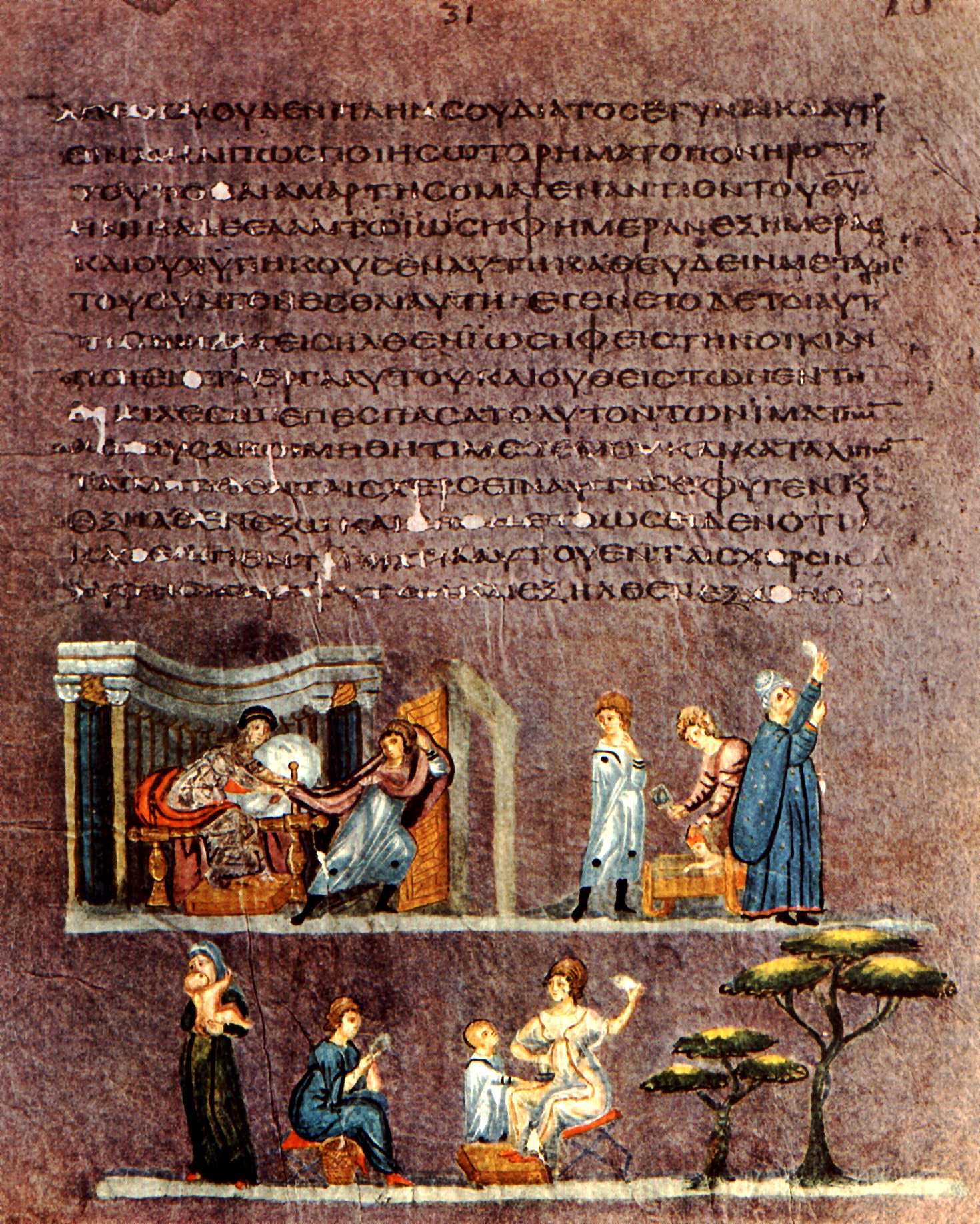
At any rate, enough of the introduction to the current state of text-critical research. I'm actually very interested in a comment Parker makes regarding an illustrated manuscript of the Pentateuch. This example, I think, illustrates the kind of claim I make regarding early copies of the written gospels (by "early," I mean of the first three or four centuries). Namely, I suggest that we should read the written texts of the gospels as moments or instances of the Jesus tradition rather than as standard, fixed, "canonical" versions of that tradition. In the earliest Christian centuries the Jesus tradition was considerably more fluid than we experience it today (though we should recognize that even today we are comfortable with a surprise level of fluidity; consider as one example the myriad nativity displays every year sporting both angelic hosts and Magi worshiping the baby Jesus, despite the fact that not one single text bring angels and Magi together with Mary, Joseph, and the new-born Christ). Did Matthew, as one who performed the Jesus tradition, always include eight beatitudes in the third person and one in the second? Did Luke, as another performer, always limit himself to four beatitudes (in the second person)? And did he always pair his beatitudes with corresponding woes? I find it unlikely, though providing documented support for my opinion here is especially difficult. So I was especially interested in the following, which seems, at least, to support my approach to relating text and tradition:
The provision of pictures places the text in a different light for the reader. This may best be illustrated by the example of a manuscript of the Pentateuch. It has a series of miniatures accompanying the story of Joseph. But the miniatures contain material and scenes which are found in Jewish apocryphal writings, and not in the written text of the Genesis. Thus the entire manuscript, text and pictures, is telling a different story from that found in the text alone. (27; the manuscript in question is the Vienna Genesis)

I don't think I agree with Parker's last point. "The entire manuscript" isn't telling "a different story from that found in the text alone." Rather, the manuscript is telling a larger story from that found in the text alone. For its intended audience, this "larger story" was already invoked and evoked by the manuscript. This is the only way, as far as I can see, why an illustrator would think it okay to illustrate a biblical manuscript with scenes from apocryphal texts. That is, the written text was a moment or instance of the larger Joseph tradition. And it doesn't much matter that the written text doesn't narrate other moments or instances of the tradition, some of which are only found in apocryphal writings. Text and tradition belong together, and this "belonging together" happens within the audience, at the moment of reception, rather than within the text. Unfortunately, that means it's much more difficult—and often impossible—for us to see today how text and tradition relate to one another. But every now and then we get a glimpse of the larger traditional connections, and these glimpses remind us not to read our written texts too narrowly, too myopically, or with too great a restriction on what we think a text does not say.

Monday, October 04, 2010

the [un]orthodox corruption of scripture

More from Harry Gamble, who refers to a polemical fragment from Little Labyrinth (Eusebius, Ecclesiastical History 5.28.8–19; see Gamble 1995: 122–23). I don't want to reproduce the quote; you can follow the link if you're interested. The point, however, is that Hippolytus (?) is writing against certain named Christian scholars in Rome who have disseminated copies of the scriptures (= the gospels?) in order to support a particular theological point of view. According to Gamble:
The work of each [viz., Theodotus, Asclepiades, Hermophilus, and Apolloniades] was current in many copies, so that copies were easily obtained and compared. It is unlikely that the ready availability of copies was due to purely private, individual copying. Despite its scholastic aspect, this textual work in Rome was not disinterested but stood in the service of exegesis and theological argument, which makes it still more probable that the emended texts were produced in numerous copies, the better to promote their wide use and thus sustain a particular theological viewpoint.1

I can't help but remember Bart Ehrman's work, particularly in The Orthodox Corruption of Scripture: The Effect of Early Christological Controversies on the Text of the New Testament (London and New York: Oxford University Press, 1993). Ehrman's thesis is that the "corruption" (in its technical, text-critical sense of variation rather than its popular sense of degradation) of scripture wasn't the sole domain of heterodox scribes and theologians; orthodox (or proto-orthodox) tinkerers also affected the readings in the text. As I read Ehrman, however, I couldn't help but think that Ehrman's analyses depended on too little data. That is, Ehrman made his claim for the orthodox corruption of scripture on the basis of individual variant readings and only rarely considered (i) the effect of a given change on the subsequent manuscript tradition or (ii) the effect of a given theological perspective on potentially problematic readings throughout a given manuscript. Of these, the latter is even rarer than the former.

Gamble's discussion, however, makes clear what Ehrman assumes: that changes to individual manuscripts had limited effect upon the tradition as a whole. If a person or a group of people wanted to conscientiously alter the reading of a text and wanted that change to displace an earlier reading, additional steps had to be taken. In the case of the Little Labyrinth that Eusebius cites, the heterodox teachers in Rome were involved not just in corrupting scriptural texts but also in disseminating their corrupted texts. The Little Labyrinth mocks its opponents' folly: "[The readings] of Asclepiades, for example, do not agree with those of Theodotus. And many of these can be obtained, because their disciples have assiduously written the corrections, as they call them, that is the corruptions, of each of them" (Eus. H.E. 5.28.17; my emphasis). But behind the author's scorn for the numerous copies then in circulation and the ammunition these copies provide against the scribes responsible for them, we can sense a certain frustration—even concern—that the flood of corrupted manuscripts might actually affect the Church's reception of the sacred tradition.

Perhaps, given the paucity and selectivity of the data that survives from antiquity, such evidence against the "proto-orthodox corruptors" of scripture is unlikely to have survived. Even so, this is the type of data I would look for in support of Ehrman's thesis. Gamble, who takes up the question directly of the relation between the authority invested in a text, its textual stability, and its preservation, provides a more helpful basis for historical discussion in that he appeals to actual textual evidence. Ehrman, it seems to me, often relies on the hermeneutical potential and theological possibilities of particular variants and their placement within the very interpretive framework for which he's arguing (viz., the orthodox corruption of scripture).


1 Harry Y. Gamble, Books and Readers in the Early Church: A History of Early Christian Texts (New Haven and London: Yale University Press, 1995), 123.

Tuesday, August 10, 2010

Ehrman in proper context

As we wrap up Bart Ehrman's The Orthodox Corruption of Scripture, it would be helpful to make a couple of points in closing to make sure we properly apprehend the value of this provocative book while being ever aware of its shortcomings. The following are given in no particular order:
  • The word corruption in Ehrman's title is misleading, probably intentionally so. This is a technical term within the field of text criticism, and Ehrman uses it in line with its technical usage. Or at least he claims to.
    The term "corruption" derives from traditional text-critical discourse, in which the "original" text (i.e., as it was actually penned by an author) is the dominant concern, with changes of that text—whether accidental or intentional—representing contaminations of that original. Not everyone, however, assigns a pejorative sense to the term. This neutral usage is found particularly among critics who recognize the problem of privileging the original text over forms of the text created during the course of transmission. . . . This takes me now to a different theoretical understanding of the significance of textual variation in the New Testament manuscripts, an understanding that derives less from traditional categories of originals and corruptions than from modern literary theories that call these categories into question. Because scribes occasionally changed their texts in "meaningful" ways, it is possible to conceptualize their activities as a kind of hermeneutical process. Reproducing a text is in some ways analogous to interpreting it. (29)

    Corruption, as Ehrman uses it, signifies no more than "change from an 'original' text" without any pejorative sense, and in fact only means that the process of transmitting a handwritten text (a manuscript) also involved processes of interpreting the text. This is very good; I have no problems here. But Ehrman well knows that corruption—as in corruption of scripture—means something entirely different and that those who judge a book by its cover (and we all do, even if some of us reserve the right to revise our judgment) will take his title to mean the falsification, degradation, et cetera of the Bible. Ehrman is too media-savy not to know this, and his many appearances in popular fora (not least the Colbert Report and the Daily Show) bank on this misconception. Ehrman is having his cake and eating it, too.
  • The vast majority of examples Ehrman adduces as examples of "the orthodox corruption of scripture" express or clarify the meaning of the reading Ehrman supports as the original reading. That is, few of the changes he discusses alters the meaning of the text to make it say something it didn't or couldn't have said before the corruption. That is, we are very often talking about appending Christ to the name Jesus, or Joseph for his father, and such like. Very few of the variants Ehrman analyzes take the text in a different direction, for example naming another Christ (say, "Brian") or a substantively different portrayal of Jesus. (See his discussion of Heb. 2.9 [146–50] for one variant that does present a substantive alteration of the original reading.) In fact, many of the changes Ehrman chalks up to orthodox corruption—meant to ward off heterodox interpretations—were just as liable to being read differently by proto-orthodox and Gnostics, or docetics, or whoever as were the uncorrupted (or pre-corrupted) texts. Notice, for example, the following cautionary note:
    We do well to recall that Gnostics were notorious among the orthodox for overlooking the "straightforward" meaning of the words of the biblical text (straightforward, that is, to the orthodox). Among other things, this means that even were a scribe to make such a corruption in light of the heretical position, the Gnostics (as least according to the heresiologists) would have remained undisturbed, because for them the words of the text were ultimately unimportant on the literal level. (173–74, n. 104)

    Don't miss what he's saying. Irrespective of how accurately this depicts actual Gnostic hermeneutical practices, Ehrman claims here that orthodox polemicists (i) made subtle changes to the NT manuscripts they transcribed in order to shore up their own particular interpretations and/or to stave off heretical readings even as (ii) they knew that heretical exegetes "would have remained undisturbed." Having cake; eating cake.
  • These criticisms notwithstanding, Ehrman has demonstrated, I think, that scribes who copied NT manuscripts were also inhabitants of their social worlds, and that inhabitation included the polemical contexts of the early church. Anyone at all acquainted with text criticism knows that scribes mistakenly made changes to their texts; just as uncontroversial is that scribes also made intentional changes from their exemplars. Ehrman establishes what we maybe should have suspected all along: That sometimes scribes' intentional changes were motivated by the debates and controversies that provided the contexts in which Christians of all stripes read the NT texts. But this may make the previous point all the more noteworthy: Given the fact that scribes modified scripture in response to how others [mis]read the texts, we should perhaps be impressed with how rarely those changes actually changed the text's meaning and significance. Stated another way, the Church Fathers certainly could engage in some fantastic, even outlandish, exegetical practice, no less than their heterodox counterparts. But Ehrman doesn't produce any examples of an orthodox exegete supporting an incredible interpretation by means of emendation.
  • Even so, we should recognize how limited in scope are the consequences of Ehrman's analyses (despite his claims to the contrary in the conclusion [274–83]). At numerous points Ehrman has rightly recognized a lack of consistency in [proto-]orthodox scribes' textual alterations. But this inconsistency stands in tension with the overall thesis of Ehrman's book, that scribes altered the text to make it say what it already meant. The fact is, sometimes they didn't. And given the historical situation Ehrman wants us to envision, inconsistency = a lack of willingness/motivation to expunge potentially difficult or ambiguous texts from scripture. Two other observations mitigate the force of Ehrman's thesis. First, many (though certainly not all) of the variants Ehrman adduces as "orthodox corruptions of scripture" simply do not bear the weight Ehrman puts upon them. For example, on pp. 237–38 he argues that, in some instances, "scribes have simply interpolated references to Jesus' 'humanness' into passages that otherwise say nothing directly about it." As an example he offers the variant at John 7.46 in \mathfrak{P}66, which changes οὐδέποτε ἐλάλησεν οὕτως ἄνθρωπος ["No one has ever spoken in this way"] to οὐδέποτε οὕτως ἄνθρωπος ἐλάλησεν ὡς οὗτος λάλει ὁ ἄνθρωπος ["No one has ever spoken the way this man speaks"]. I can readily see why Ehrman reads this variant as an anti-docetic corruption, but the supposed ambiguity of the original text, along with the "improvement" offered by the variant, do not make it so. Without any evidence that the reading in \mathfrak{P}66 actually did stave off docetic christological formulations, formulations which were sustained precisely by a certain reading of John 7.46, Ehrman's case is circumstantial at best. Second, with few exceptions Ehrman was only able to document changes within individual manuscripts and/or families of manuscripts. The larger tradition itself—what was embodied within and expressed through the surviving manuscripts—was able to absorb these corruptions without losing every trace of the original reading. Again, in a few cases the corruption (nearly) thoroughly replaced the original reading, and in a few other cases determining conclusively which reading was original and which the corruption was impossible. But for the vast majority of variants Ehrman puts forward, we could clearly differentiate earlier and later readings. In other words, the consequence of the "orthodox corruption of scripture" was fairly limited in scope.
All in all, Ehrman's book well deserves the attention we give it. He reminds us on every page that real texts were handwritten, physical objects produced by real people with real temperaments and, sometimes, real strong opinions on the debates of their day. The cold, dispassionate, objective copy of the UBS Greek New Testament or the NA27that sit on my desk—still less the modern English translations developed from them—are not the text of the New Testament transmitted through the centuries. In fact, the stable texts that give me comfort depend upon the handwritten manuscripts, with all their vagaries, not the other way around.

Monday, August 09, 2010

a text-critical question

I have a question about how textual critics identify problems requiring explanation and then proceed to search for and land upon satisfactory solutions. I'm currently in the throes of reading Ehrman's extensive discussion of the textual issues surrounding Luke 22.19–20.1 First, let me present the problem in very brief terms.

There are, essentially, two readings to consider, the "longer," more traditional, reading here is as follows:
19 "Then, taking [some] bread and giving thanks, he broke it and gave it to them, saying, 'This is my body, given for you. Do this in remembrance of me.' 20 And likewise the cup, after eating, saying, 'This cup is the new covenant in my blood, poured out for you. 21 But look! The hand of the one who is betraying me is with mine upon the table.'"

This longer text is attested "by all Greek manuscripts except D [= Bezae] and by most of the ancient versions and Fathers."2 The "shorter, or Western, text"—that is, the reading attested in Bezae and in mss of the Old Latin, which is typically an expansionist tradition—omits vv. 19b–20:
19 "Then, taking [some] bread and giving thanks, he broke it and gave it to them, saying, 'This is my body. 21 But look! The hand of the one who is betraying me is with mine upon the table.'"

Ehrman rightly emphasizes how difficult it is to explain the omission of 19b–20 in the Western tradition if the longer reading is original. There aren't, apparently, any satisfactory contextual factors to support an accidental omission (e.g., homoeoteleuton or homoeoarchton). And, of course, why any scribe would intentionally omit (i) the description of Jesus' body as "given for you . . ." and (ii) any reference to cup at all presents insurmountable problems.

Ehrman provides other arguments in favor of the shorter reading, to be sure. But quite a bit of weight is put on the difficulty involved with explaining how vv. 19b–20 dropped out of the Western manuscript tradition if these verses were originally part of Luke's gospel. And I don't suppose I have anything to offer by way of explanation (though note that the UBS committee felt strong enough about including vv. 19b–20 in the text that they give it a [B] rating). But here's my question: How does the proposed originality of the shorter reading explain the presence of the shorter reading in some Western manuscripts? On the surface the answer seems obvious, but upon closer look the problems Ehrman seeks to avoid by accepting the Western reading loom just as large.

  • Given the intractable problems explaining why any scribe would drop vv. 19b–20 from his exemplar, don't we still need to explain why Luke would omit this passage from his Markan source (on either the Two-Source or Farrer theories of synoptic relationships) or, less likely, from Matthew (assuming the Griesbach-Farmer hypothesis)? I can't find ready explanation why Luke would drop this passage, and this—it seems to me—balances evenly the difficulty of why a later scribe would omit it.
  • Ehrman finds it significant that the vocabulary of vv. 19b–20 is non-Lukan and sounds an awful lot like Paul's version of the Last Supper in 1 Cor. 11.

    Interestingly, this "other tradition" (i.e., vv. 19b–20 in the longer text) is not only anomalous within Luke's Gospel itself, it also has very few connections with Luke's source, the Gospel of Mark. Instead, as has been frequently noted, the additional words practically mirror the familiar account of the institution preserved in Paul's first letter to the Corinthians. The fact that the words of the longer text of Luke are not precisely those of Paul should not be used, as it sometimes is, to argue that they could not have been added secondarily to the text of the Gospel. No one need think that a scribe referred to his manuscript of 1 Corinthians to check the accuracy of his interpolation into Luke. Instead, the addition has all the marks of a familiar narrative based on, or at least parallel to, Paul's account of Jesus' Last Supper.3

    I'm not convinced. If the best explanation for the manuscript data for which we must account is that a scribe inserted a Eucharistic tradition from another text into Luke's gospel, why should they have chosen 1 Corinthians? This becomes even more of a problem the more we stress the differences—and there are significant differences—between Paul's Eucharist and that found in Mark and Matthew. If a scribe felt the shorter, "original" text of Luke's version of the Last Supper required supplementing, why choose Paul's distinctive account instead of Mark's or Matthew's? Certainly we can't expect scribes in antiquity to be as aware of different traditions as we are (and esp. that Paul's account of the Eucharist conflicted with Luke's way of thinking about Jesus' death). But inasmuch as Matthew was the most popular, most widely read, and most frequently copied of the canonical gospels, I think we need to ask why a scribe would interpolate Paul's instead of Matthew's version of the Last Supper. The language of 22.19b–20 may be distinctive within Luke-Acts, but its Pauline rather than Matthean flavor creates a problem for a theory of interpolation. This falls short of proof for these verses' originality, but it does weaken Ehrman's argument in favor of the shorter reading.
  • [The following two problems belong together; I give the weaker one first.]
  • If we accept the shorter reading because we simply can't imagine why a scribe would drop vv. 19b–20 (and let me say again, I can't imagine why), we actually need to suppose that at least some Christians of the West observed a Eucharistic liturgy of bread alone or that took the cup first and then broke the bread (see vv. 17–18). Either this, or we will have to suppose that the scribes responsible for the manuscripts bearing the shorter reading tolerated a striking discrepancy between their Eucharistic practices (supported by the accounts of Mark, Matthew, and/or 1 Corinthians) and Luke's gospel.
  • The alternative to expecting a Lukan Eucharistic liturgy (according to the shorter reading) is to suppose that scribes in the second century and later [Bezae is a fifth-century uncial!] observed a traditional Eucharistic liturgy and preserved the original [= shorter] Lukan account of the Last Supper. This, in fact, is exactly what Ehrman argues. But how does the originality of the shorter reading have any explanatory power for the reading in Bezae and the Old Latin if we assume that these same scribes also observed a traditional Eucharist? We rightly scratch our heads and wonder how/why a scribe might have elided vv. 19b–20, but on Ehrman's explanation we still have to deal with scribes who believed the institution of the Lord's Supper occurred one way (see the traditional Eucharistic liturgy we are now positing for these scribes) but who believed, somehow, that the original text of Luke's gospel portrayed a significantly different account of that institution. In other words, it seems to me that the shorter reading still requires explanation in fifth century, irrespective of any judgment of originality. In yet other words, even the if the shorter reading is "original" and the longer reading "corrupt," the shorter reading would [ought?] have struck ancient scribes as corrupt. So why did they preserve this shorter, "original" reading?
In the end, I am (i) unable to answer Ehrman's objection that it's simply too difficult to explain the shorter reading if the longer reading is original, and (ii) unconvinced by his arguments that the shorter reading is, in fact, original. Instead, I think the unusual data requiring explanation is still the shorter reading: Why should any manuscript tradition omit vv. 19b–20? I don't know, but I don't think the problem is solved by supposing this is the original reading. Instead, I think it's a problem that Ehrman has to resort to reading Luke so far afield from one of his favorite sources and one of his favorite Christian characters; notice that he has no problem suggesting that Luke "understands the death of Jesus differently from both the predecessor of his Gospel (Mark) and the hero of his Acts (Paul)."4 But why should Luke have so willingly accepted (and reproduced) so much of Mark's gospel and expended so much effort broadcasting and endorsing Paul's reputation, if he held a fundamentally different view of so pivotal a Christian tenet as the death of Christ?!

So again, my question is: How does the proposed originality of the shorter reading explain the presence of the shorter reading in some Western manuscripts? Can anyone provide a reasonable answer?

[CLARIFICATION: Ehrman continues in this chapter to discuss the [in]famous "Western Non-Interpolations," a body of variants that he finds in service of anti-docetic polemics (see, e.g., pp. 255–56, n. 145). In many of these (e.g., Luke 24.12, 40, inter alia) the question I'm raising regarding his analysis of 22.19–20 would be inappropriate. The reason I find the shorter western reading's originality insufficient to explain its presence in Bezae and the Old Latin is precisely the use of the tradition in question (viz., the Lord's Supper) in the liturgical life of the church. Luke 24.12, of course, was not liturgically significant and so may be preserved more accurately (and succinctly) in the Western manuscript tradition.]


1 See Bart Ehrman, The Orthodox Corruption of Scripture, 198–209.
2 According to B. Metzger, A Textual Commentary on the Greek New Testament (second edition; New York: United Bible Societies, 1994 [1971]), 148.
3 Ehrman, Orthodox Corruption, 204.
4 Ehrman, Orthodox Corruption, 203.
My Visual Bookshelf